Orphan Train Historical Background
I am interested in exploring how people tell the stories of their lives and what these stories reveal (intentionally or not) about who we are. I am intrigued by the spaces between words, the silences that conceal long-kept secrets, the elisions that belie surface appearance. And I am interested in the pervasive and insidious legacy of trauma – the way events beyond our control can shape and define our lives. All of my books address these themes.
Like my four previous novels, my novel Orphan Train is about cultural identity and family history. For the first time, however, I am undertaking a project that requires a large amount of historical, cultural, and geographical research. My novel traces the journey of Vivian Daly, a now-90-year-old woman, from a small village in Ireland to the crowded streets of the Lower East Side to the wide-open expanses of the Midwest to the coast of Maine. Her life spans nearly a century, encompassing great historical change and upheaval.
Change has been the defining principle of Vivian Daly’s life, and from a very young age she learned to adapt, to inhabit new identities. For many reasons, she has told no one about her early life: her difficult childhood in Ireland and the lies and secrets that propelled her, alone, toward a frighteningly open-ended future. She spent her entire adult life minimizing risk, avoiding complicated entanglements, and keeping silent about the past. But now, through a series of events, she encounters a stranger who wants to know her story. As Vivian begins to face the truth about what happened long ago, the past becomes more and more present for her. Vivian’s recollections come in tiers: her turbulent adulthood in the Midwest; her early life on the Lower East Side of Manhattan, living in a tenement; and finally, her childhood in Kinvara, on the western coast of Ireland.
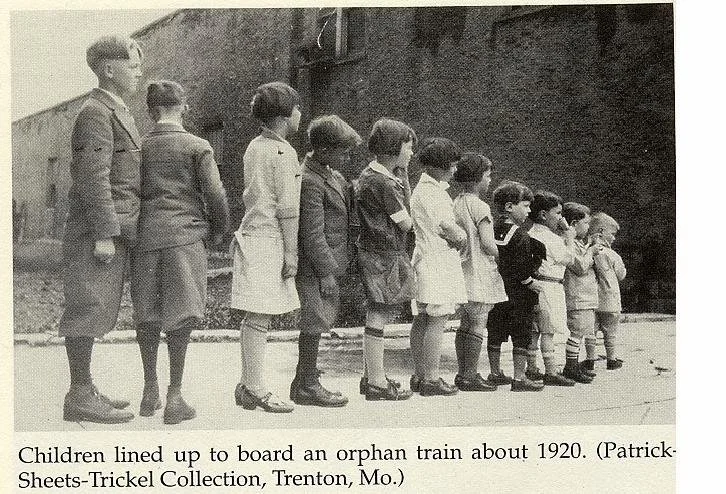
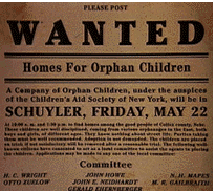
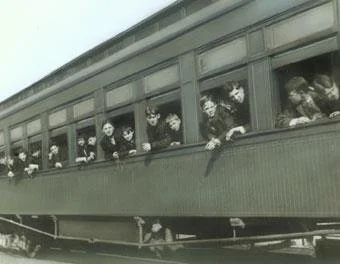
Orphan Train is a specifically American story of mobility and rootlessness, highlighting a little-known but historically significant moment in our country’s past. Between 1854 and 1929, so-called “orphan trains” transported more than 200,000 orphaned, abandoned, and homeless children – many of them first-generation Irish Catholic immigrants – from the coastal cities of the eastern United States to the Midwest for “adoption” (often, in fact, indentured servitude). Charles Loring Brace, who founded the program, believed that hard work, education, and firm but compassionate childrearing – not to mention Midwestern Christian family values – were the only way to save these children from a life of depravity and poverty.
The children, many of whom had experienced great trauma in their short lives, had no idea where there were going. The train would pull into a station, and townspeople assembled to inspect them – often literally scrutinizing teeth, eyes, and limbs to determine whether a child was sturdy enough for field work or intelligent and mild-tempered enough to cook and clean. Babies and healthy older boys were typically chosen first; older girls were chosen last. After a brief trial period, the children became indentured to their host families. If a child wasn’t chosen, he or she would get back on the train to try again at the next town.
Some children were welcomed by new families and towns. Others were beaten, mistreated, taunted, or ignored. They lost any sense of their cultural identities and backgrounds; siblings were often separated, and contact between them was discouraged. City children were expected to perform hard farm labor for which they were neither emotionally nor physically prepared. Many of them, first-generation immigrants from Italy, Poland, and Ireland, were teased for their strange accents; some barely spoke English. Jealousy and competition in the new families created rifts, and many children ended up feeling that they didn’t belong anywhere. Some drifted from home to home to find someone who wanted them. Many ran away. The Children’s Aid Society did attempt to keep track of these children, but the reality of great distances and spotty record-keeping made this difficult.
I became interested in the story of the orphan trains because my husband’s grandfather, Frank Robertson, was rumored to have been a train rider. It was believed that he traveled on an orphan train from New York to Jamestown, North Dakota with his four siblings when he was ten years old. In the course of researching this family lore, I found that although orphan trains did, in fact, stop in Jamestown, and orphans from these trains were adopted there, the Robertson clan came from Missouri. But my interest was piqued, and I started researching this period in history.
After reading newspaper clippings, I began searching the Web for more information. I found first-person accounts, orphan-train reunion groups, and historical archives. That research led me to New York Public Library, where I found original materials: lists of orphans from foundling hospitals, handwritten records, notes from desperate mothers explaining why they were abandoning their children. I found that approximately 145 orphan train riders are still alive in the United States; orphan-train reunions are still being held in towns across the Midwest. A novel began to take shape in my mind.
My own background is partly Irish, and so I decided that I wanted to write about an Irish girl who has kept silent about the circumstances that led her to the orphan train. “People who cross the threshold between the known world and that place where the impossible does happen discover the problem of how to convey that experience,” Kathryn Harrison writes. Over the course of this novel Vivian moves from shame about her past to acceptance, eventually coming to terms with she’s been through. In the process she learns about the regenerative power of claiming – and telling – one’s own life story.
In Orphan Train, Vivian Daly’s first-person, past-tense account of her experience on the orphan train and her journey from Irish-Catholic immigrant to Protestant Midwesterner alternates with the present-day, present-tense, third-person-limited story of Vivian’s life on the Maine coast. (I have quite a bit of experience with this kind of autobiographical narrative, and am intimately familiar with its quirks, subtexts, and possibilities. Some time ago I wrote a nonfiction book with my mother called The Conversation Begins: Mothers and Daughters Talk about Living Feminism, for which we interviewed, and created first-person accounts for, more than 60 women.) The present-day story takes place over six weeks; the narrative arc of Vivian’s history encompasses 90 years.