Sign up for Christina’s Newsletter

Christina Baker Kline

Author Website

  • Books
    • Please Don’t Lie
    • The Foursome
    • The Exiles
    • A Piece of the World
    • Orphan Train
      • Orphan Train Girl: The Young Readers’ Edition of Orphan Train
    • Other Novels
      • Bird in Hand
      • The Way Life Should Be
      • Desire Lines
      • Sweet Water
    • Nonfiction
      • Always Too Soon
      • About Face
      • Child of Mine
      • Room to Grow
      • The Conversation Begins
  • Events
  • NEWS
  • Other Writing
  • About
    • Bio
    • FAQs
    • Contact
    • Photos
  • Newsletter

June 22, 2011 By bakerkline

Don’t Skip the Sex Scenes

Novelist Ellen Sussman explains why she likes to write – and read – about sex:

When the first Amazon reader review for my new novel, French Lessons, showed up on the website, I was thrilled. Five stars! Enthusiastic praise! And then came the last couple of lines: I wish she didn’t write the sex scenes. Women don’t want to read about sex.

Really?  I like to read about sex.  And I like to write about it.  Interesting things happen on the page when people make love.  It’s not just about the sex, though a reader might get a charge out of that as well – it’s about what gets exposed during sex.  A sex scene is an opportunity for the writer to reveal unexpected things about her characters:  about the way they relate to each other, their vulnerabilities and desires, the way they fit together (or don’t) emotionally as well as physically.

But it’s not easy. Many writers skip the sex scenes because they’re damn hard to write. How do you make them fresh, and how do you make them matter?

The most important consideration for me as a writer (and as a reader) is that the sex scene exists for a reason. It’s not gratuitous – it isn’t meant just as a turn-on. (We can read other genres for that experience.)  The sex scene in literary fiction has to take us someplace new. It has to surprise us or affect the story line or take us somewhere deeper. When I’m writing, I ask myself how I can use this sex scene – in the way I use any scene – to move my story forward.

The scene must engage the reader. A graphic description of sex usually doesn’t work – I try to find surprising details, quiet moments, the fresh image.  You don’t want to lose your reader because you’ve explained too much or gone too far.  Often, desire is sexier than the sex act itself.  So the writer needs to look beyond the naked limbs and focus on what’s happening to the heart when all that heavy breathing takes place.

French Lessons is mostly about love and loss.  It’s about complicated relationships and intimacy, and sex is a part of all of that.  We wouldn’t learn very much if the lights go out just when we’re getting to the good part.

Ellen Sussman is the author of a new novel, French Lessons, published by Ballantine. Her first novel, On a Night Like This, was a San Francisco Chronicle bestseller. It has been translated into six languages.  She is also the editor of two anthologies, Dirty Words: A Literary Encyclopedia Of Sex and Bad Girls: 26 Writers Misbehave, which was a New York Times Editors’ Choice and a San Francisco Chronicle bestseller.


Filed Under: Guest Blogs, The Creative Process Tagged With: Bad Girls, Dirty Words, Ellen Sussman, French Lessons, reading about sex, sex, writing about sex

June 10, 2011 By bakerkline

Literary Names: Do Characters Name Themselves?

On Sunday — June 12 — I’ll be on a panel called “Going Beyond ‘Tom, Dick and Mary’: Naming and Giving Your Characters Dimension” at Books NJ: A Celebration of Books and the Readers who Love Them, 1-5 p.m. at the Paramus Public Library.  (Stop by and say hello!)  Consequently I’ve been thinking a lot about character names this week.

So has novelist and playwright Joanne Lessner, author of Pandora’s Bottle and Critical Mass, who wonders whether she names her characters….or they name themselves:

In my alternate life (the one where I’m a jet-setting opera singer based in London), I have a clutch of children with fabulous names. The girls are called Tessa, Lily, Francesca and Imogen, and the boys are Sebastian, Phineas, Jasper and Colin. In my actual life, I’m a New York-based writer and performer with two kids who got my first round draft picks: Julian and Phoebe. But as a writer, surely I can pepper my work with those other glorious, un-exercised gems, right?

Well, not exactly.

J.K. Rowling has famously said that Harry Potter just strolled into her head, fully formed. I understand what she means. My characters have a habit of knocking on my mental door wearing nametags. Even names that carry hints of significance are often a chicken and egg situation. For example, the hero of my novel, Pandora’s Bottle, is named Sy Hampton.  I don’t recall consciously choosing his name, but one reader asked if it was meant to illustrate a “sigh” of disappointment (he’s having a mid-life crisis.) Another suggested that “Hampton” indicates a yearning for the finer things in life epitomized by those exclusive Long Island enclaves. Those are certainly reasonable assumptions, but I can’t say honestly whether Sy grew more melancholy and striving because of his name, or if, when I named him, my subconscious instinctively know where he was heading. However, I do know that when my editor floated the possibility of changing his name – feeling that Sy suggested someone of a slightly older generation – I just couldn’t.

The anti-heroine of a novel I’m working on now is named Katelyn. I must confess, I’ve never been a fan of that name or its multiple spellings, so imagine my surprise when that’s what my fingers typed. Her last name is Marx, which I also don’t recall selecting, but have since recognized has political overtones in line with Katelyn’s schemes. The success of her plans will hinge on her ability to remain chameleon-like and forgettable. What better way to illustrate that quality than with a name with multiple, hard-to-keep-track-of spellings? Except that, again, I gave it no thought whatsoever. Katelyn Marx just showed up for work the day I started writing and politely introduced herself.

Still, it doesn’t always work that way. Minor characters, in particular, can be more reticent, and as they blink patiently at me in the doorway, I try to let my mind free associate until something clicks. Even so, these characters often don’t live and breathe in quite the same way as the ones who are instinctive. But giving serious thought to a name is not necessarily a bad thing, and when you hit it right, you know. As one writer friend told me recently, a simple change from Lily to Billie made her character come alive.

One situation that does require special care is naming for the stage, where the sound is more important than the way it looks on the page. In my play, Critical Mass, a character named Stefano Donato kept my cast’s tongues twisted. It looks neat and symmetrical in print, but the actors had to remind themselves where the accents were every time they said it. Lesson learned.

In a musical, names that rhyme are a boon.

I’m currently adapting Wilkie Collins’s gothic novella The Haunted Hotel. The heroine’s name is Agnes – not much joy there. But make her Alice, and suddenly we’ve got malice, callous and palace, which happens to be the name of the eponymous hotel. Her faithless lover? Collins named him Herbert. But rechristened Edward, he can lure another woman bedward. Even here, though, where active choice is involved, expedience takes precedence over all those names I’d love to employ.

An acting teacher of mine once said that your gut is a better actor than your brain, and I think the same holds true for writers, particularly when choosing the right names for characters. I’ve had the experience of reading others’ work and being distracted by a name that’s too fussy, unrealistic, or forced in some intangible way, and I find myself wondering if that person was mining his or her well of untapped baby names hoping to press an old favorite into active service. So for now I’ll have to hope that I get a surprise visit someday from Tessa, Francesca, Phineas or Jasper – unless I can come up with some good rhymes for them. Until then, I’ll continue to let my subconscious do the work, opening my door to whoever knocks, and eagerly asking that character his or her name.

Joanne Sydney Lessner is the author of Pandora’s Bottle, a novel inspired by the true story of the world’s most expensive bottle of wine (Flint Mine Press, 2010). This post originally appeared on Pamela Redmond Satran’s Nameberry blog.


Filed Under: Guest Blogs, The Creative Process Tagged With: character names, J. K. Rowling, Joanne Lessner, Nameberry, naming characters, Pamela Redmond Satran

May 30, 2011 By bakerkline

Embrace the Digital Age! A Contrarian Opinion

Some time ago I posted a piece by Chad Taylor, a freelancer for Kirkus Reviews and a purveyor of fine tweets (attracting the likes of such literati as Susan Orlean and Caroline Leavitt) on why Twitter is actually a good thing for writers.  Here’s his take on the fuss over e-books, self-publishing, and the demise of publishing as we know it:

Writing is a romantic endeavor. The problem is that too often writers romanticize the wrong things. A decade ago print journalists howled about the rise of bloggers as if they were pillaging Huns.  Today, many novelists and other writers lament the death of print newspapers and the rise of the e-book because it’s a different model than the one we’ve grown up with.  But times change. Technology changes. Almost always, I would say, for the better.

Three thousand years ago Plato told everyone who would listen that this newfangled thing called an “alphabet” was going to be the death of storytelling. Why would anyone remember stories, he asked, when you could just “write them down”?  Plato — with all his ageless brilliance and wisdom — was so caught up in what the new technology would take away that he never bothered to consider what advantages it might bring. In a similar way, our generation rails against the advent of digital printing and e-books because it changes the things we’re comfortable with: the weight of a bound book in your hand; writing annotations in margins; passing a physical copy from one person to the next. James Gleick refers to this as “a lack of imagination in the face of new technology.”

E-printing and digital distribution allows for direct, intimate contact between author and reader. Why buy a copy of a book from Barnes & Noble, then stand in line for hours to get it signed at a formal event, when I can download a copy for half the price from Amazon, then talk to the author directly about it via Twitter, Facebook or email? Removing the cost of paper-and-glue publishing will also eliminate the need for an author to give 70% of each sale to Random House. Bad news for Random House; great news for anyone who’s ever tried to feed his or her family writing novels.

Computers have made the act of writing more immediate, more visceral and accessible to everyone.  It’s easier to write and edit on a word processor than to bang a manuscript out on a typewriter, and the act of sharing a draft with other people requires an email or thumb drive, not a trip to Kinko’s, unwieldy boxes, and an unreliable postal service.  It allows writers to easily interact with other writers and receive feedback instantly on what we’re doing. It enables us to meet and share with people we’d never have dreamed of interacting with even 10 years ago.

The bottom line is this:  Social media allows us to intimately connect with people looking for exactly what we’re offering, sell directly to the people who most want to pay for our art, and hear firsthand how what we do matters to the people who most appreciate it.  And that’s a good thing.


Filed Under: Guest Blogs, The Writing Biz Tagged With: Chad Taylor, digital age, e-books, Kirkus Reviews, new technology, pillaging huns, Plato, Twitter

December 16, 2010 By bakerkline

What Makes a Title Great?

Novelist Caroline Leavitt on the impossibility — and importance — of finding the perfect title:

When I finished my new novel, I was relieved, excited, overwhelmed, and then terrified.  I knew I wasn’t really finished — I had to do the one thing that makes my head feel as if it is going to explode:  I had to find the right title. Having published eight other novels, I knew that a title wasn’t just my own creative decision.  My editor, my agent, publicity and marketing were going to weigh in, and truthfully, I could see why. The title’s the first thing a prospective reader sees (besides the cover, of course, which is a whole other story), and if you can’t grab someone’s attention with a few words on the glossy jacket, you may not have a chance with the thousands more that are inside.

A lot of my writer friends are expert book namers.  They argue with marketing, they follow their instincts and convince their editors about the rightness of their choices, but I’ve had no such luck. I admit that I’m horrible at titles, that none of the ones I ever think of seem right to me.  I can, however, recognize a decent title when I see it.  Or at least, I think I can.

Originally, my new novel was called Traveling Angels.  It’s a screenwriting term I got from story guru John Truby.  A traveling angel is a person who comes into the midst of a village, changes everyone’s life, and then vanishes.  How perfect for my novel!  Or so I thought.  But my publisher was afraid no one would get the title.  Plus, it sounded too soft for them, and what did it really mean?  How many people would get the screenwriting reference?  So I came up with a one word-title. Breathe. One of my main characters, a nine-year-old boy, is severely asthmatic. The word “breathe” could also apply to the other characters, who could use a good deep breath themselves.  I loved it.  I was sure it was right!

It wasn’t.  “Not strong enough,” my beloved editor told me.  She asked me to come up with a list, but it was actually she who came up with Pictures of You.  “It’s the name of a Cure song,” she told me, which I knew, and I instantly loved the idea.  (One of my other novels, Coming Back to Me, was the title of a Jefferson Airplane song I loved, and an homage to my husband, whose book on the band, Got A Revolution, was making many Best of the Year lists.)  Plus, the title Pictures of You fit in all sorts of ways, since the novel is about photography and how we choose to see (or not see) the ones we love.

I’m writing another novel now, due to Algonquin in 2012, and of course I’ve worked hard on the title, trying desperately to come up with something that would be both evocative of the story and mind-grabbing.  Set in the late 1950s and early 60s, this new novel is about how we try to keep the ones we love safe, how the unseen in our lives affects the parts we are aware of.  I thought I found the perfect title: The Missing One.  My editor emailed me.  “I love what I’ve read so far of your pages,” she wrote, “but the title has to go.”

Caroline Leavitt’s new novel, Pictures of You, officially out in January 2011, is already in its 3rd printing!   She can be reached at www.carolineleavitt.com, at facebook at http://www.facebook.com/carolineleavitt, at Twitter at @Leavittnovelist, and on her blog, http://carolineleavittville.blogspot.com/.

Filed Under: Blog, Guest Blogs, The Writing Biz Tagged With: book titles, Caroline Leavitt, creative process, finding a title, Inspiration, novels, Pictures of You

December 9, 2010 By bakerkline

Nothing is Ever Lost

In which the writer Mark Trainer explains how old ideas can spring to life when you least expect it:

One of my writing teachers way back when, George Garrett, used to say of being a writer, “Nothing is ever lost.”  He meant it as comfort when every lit mag under the sun had rejected your story.  Just because you can’t make use of it now doesn’t mean you won’t be able to years down the road.  It’s true for the ideas we have for stories as well.  The first story I published originated with a single sentence I discovered in some notebooks (otherwise terrible) that I’d written when I was fourteen or fifteen.

The story that St. Martins Press has just published as an e-book, New Wife, had an even longer gestation.  I’m not proud of this, but during college some friends and I used to watch a soap opera during lunch—okay, it was All My Children.  When they change one of the actors on a soap — just before her first appearance — there’s usually a voice-over that says, “The part of Alexis Stone [or whoever] is now being played by Jane Smith.”  But if you miss the day when this announcement is made, you tune in next time to see a stranger being treated as though she is Alexis.  Alexis’s children hug this unfamiliar person and call her Mommy.  All the family pictures used for set decoration now include this person, as though the former actor had never existed.  I remember thinking back then that it would be interesting to transpose that situation onto the real world. Maybe it would make a good skit for SNL or something.  It just took 25 years to find the context that would give this idea resonance.

Here’s a strange and dangerous thing: The ideas that have worked the best in this way are the ones I never wrote down.  Maybe it’s because they seemed more like gags than the seeds of Literary Fiction.  Sometimes even in the simple act of jotting down an idea, you limit it in some way, give it a point of view and a context that fix it in the place it was found rather than letting it find the place it wants to go.

Late last spring, I found myself thinking about a couple of much older friends suffering from memory loss and dementia.  It led me to think how delicate the mental threads are that connect us to the people closest to us, and how we forget some things exactly because we never imagined we could forget them.  The name of your best friend’s husband or the lyric to a favorite song will temporarily slip away because they’re so familiar you haven’t taken any steps to fix in them in your memory.  I have elaborate systems in place to make sure I remember where my glasses are, but nothing to make sure I remember my daughter’s face.

I was sitting in a coffee shop on Capitol Hill across from my wife, both of us staring into computers.  Could the misfiring of a couple of neurons, I thought to myself as I looked over the table, make me forget you?  And then I’d be like that viewer watching the soap opera, wondering why everyone was pretending that this stranger was my wife.  I wrote the first few paragraphs and then realized the meter on our parking space was about to run out.  (And a note about titles: I had to save the file as something as we rushed out; “New Wife” was the product of half a second’s thought, but it never got changed.)

The rest of the writing was a process of following a small idea to its logical conclusion, placing an odd premise in a context that’s as recognizable and ordinary as most of our daily lives.  If my character doesn’t recognize his wife, what about his son?  Will he forget him too?  Wouldn’t he have to manage his job, his household chores, and everything else while he wonders why no one else thinks this woman isn’t who she’s supposed to be? And is there a reason for all this forgetting?  Is there any way to turn it around?  I felt like I’d come a long way from the soap-opera-casting premise and found a way to express something about how we incorporate our past into our present.

It’s a great feeling to find a good use for something that’s been kicking around your writer’s toolbox for years.  Better still when it’s something you could so easily have forgotten.  And yet you didn’t.

Mark Trainer (@marktrainer on Twitter) is a writer living on Capitol Hill.  His stories have appeared in The Mississippi Review, Shenandoah, Brain, Child, and elsewhere.  His nonfiction has appeared in The Washington Post.

Filed Under: Blog, Guest Blogs, The Creative Process Tagged With: All My Children, creative process, fiction writing, George Garrett, Inspiration, Jeffrey Archer, Mark Trainer, New Wife

  • 1
  • 2
  • 3
  • …
  • 10
  • Next Page »

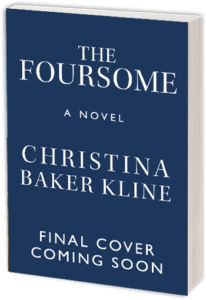
COMING MAY 2026: THE FOURSOME

A literary historical novel set in Civil War-era North Carolina, based on a true family story and told from the perspective of Sarah Bunker, one of two sisters who married Chang and Eng, the famous conjoined twins…learn more

Follow on Substack

Subscribe

Connect with Christina

Contact
  • Facebook
  • Instagram
  • Twitter

Copyright © 2025 Christina Baker Kline · Site design: Ilsa Brink