This was never the way she planned — not her intention. But journalist Cindy Schweich Handler wrote some fiction. And she liked it.
I can’t remember a time when I didn’t want to be a writer. And since I was an avid reader of fiction as a kid, that meant being a novelist. I was in fourth grade when I wrote the vaguely titled “Castle of Things,” a blatant rip-off of “Alice in Wonderland.” A year later, I followed this up with “Queen Elizabeth Alive,” a “Bewitch”-inspired imagining of the Tudor ruler coming forward in time to hang with a grade-schooler who happened to be a lot like me. Writing for fun was … well, a lot of fun.
 As I neared college-age, though, and considered how I would eventually make a living, I decided to become a journalist. That way, I reasoned, I could consistently get paid to write, I’d experience the relatively instant gratification of seeing my work and byline in print, and I would learn about a variety of subjects while covering them. I ended up working in magazines for years and freelancing for them after starting a family, and I never regretted the decision.
That is, until years later, when I wearied of reading the final, heavily edited versions of my service pieces—those articles in women’s and parenting magazines that tell you, in strictly formatted, nearly style-free prose, how to raise a child, budget your time, or achieve any number of perennially visited objectives. Writing them paid well, and (before the market crash and digital revolution smacked the publishing industry) there was a demand for them. But I started to feel as if my writing was merely meat fed into a hamburger grinder. And it wasn’t satisfying.
It was at this point that I started hungering for a more enriching writing experience. Coincidentally, a friend who’s a successful fiction writer suggested that I attend a class for beginning novelists she was teaching in her home. With some trepidation, I took her up on her offer.
That was four years ago. Since then, I’m gratified to report, I’ve written one novel and nearly completed a second, scored a world-class agent whom I adore, and I continue to meet with my extremely supportive fellow students of fiction. (I wish I could say I’ve sold my first novel, but despite three near-misses, I haven’t. Yet.) What I’ve learned during this time, with the guidance of my excellent teacher, is that the leap from nonfiction to fiction is less about blind faith, and more about understanding what all good writing has in common. Among the observations I’ve internalized are:
- What Stephen King observed in his wonderful guide, On Writing, is true: the magic of writing lies in successfully transferring a thought as it exists in your head into someone else’s. That is, when you visualize an image or scene, no matter what genre you’re writing in, you need to convey it exactly the way you see it, as economically as possible for maximum clarity.
- Always keep your theme in mind. This is true whether you’re writing an essay on, say, why cell phones are evil, or a novel about a woman who discovers that her dead son was a sperm donor (my current project). Your writing is an argument, basically, and you’re trying to persuade your audience of something. With non-fiction, of course, you do your research upfront, whereas with fiction, it’s an ongoing process of discovery that takes place in the course of the writing itself. But in both instances, there’s a lot of trial and error before it’s clear what’s extraneous and what gets you closer to your goal. The longer the work, the more arduous this process will be. Which brings me to:
- Trust the process. A short story might be comparable in length to a long non-fiction piece, but a commercial novel probably averages around 90,000 words. It can take so long to write that first draft that it’s easy to look at the thing, after a year or two of effort, and think, “Wow, this sucks.” Maybe it’s helpful to remember an analogy I read by an online writer. The first draft, he said, is akin to your kitchen sink after you’ve washed off the Thanksgiving dishes: After a thorough going-over, there are bits and pieces that survive, and you go on from there. Sounds harsh — but it’s not, because that realization makes it easier to continue, and the next draft will work itself out a lot faster.
Commercially, fiction is harder to sell, since fewer people read it. And in my experience, it requires more focus and attention to write, because it’s more personal. But in that respect, I find it more rewarding. And not a mysterioso, you’re-born-with-it-or-you’re-not phenomenon, but rather a process that can be learned, and savored.
Cindy Schweich Handler is a former magazine editor whose nonfiction has been published in The New York Times, Newsweek, O: The Oprah Magazine, Redbook, and many other print and online publications. She writes about politics for The Huffington Post and is currently at work on her second novel, Disaster Recovery.


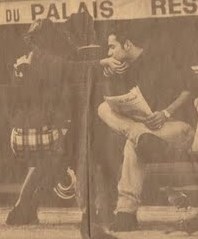 More than a decade ago, leafing through The New York Times, I came across this image as I was beginning to work on a new novel. I assume that it was part of an advertisement, but I cut it out carefully around the edges, so I don’t know for sure. I don’t even know when it appeared in the paper, though from what I’ve deduced from articles on the back side it seems to have been some time in the spring of 1998. (An ad for a wine store says “Prices effective through April 30, 1998.”)