Sign up for Christina’s Newsletter

Christina Baker Kline

Author Website

  • Books
    • The Foursome
    • Please Don’t Lie
    • The Exiles
    • A Piece of the World
    • Orphan Train
      • Orphan Train Girl: The Young Readers’ Edition of Orphan Train
    • Other Novels
      • Bird in Hand
      • The Way Life Should Be
      • Desire Lines
      • Sweet Water
    • Nonfiction
      • Always Too Soon
      • About Face
      • Child of Mine
      • Room to Grow
      • The Conversation Begins
  • Events
  • NEWS
  • Other Writing
  • About
    • Bio
    • FAQs
    • Contact
    • Photos
  • Newsletter

September 27, 2010 By bakerkline

Beast of Burden

You may have noticed that I haven’t posted much lately.  Keeping a blog is like having a pet — it requires constant maintenance.  And when I wasn’t deep into writing my novel, I derived a lot of pleasure from it (and still do, in sporadic bursts).  But working on a novel is like having a newborn baby.  It keeps you up at night, it needs constant feeding, it’s unpredictable and exhausting.  And like new parents who find that the frisky puppy that brought them  so much pleasure before the baby came along has begun to feel like a burden, with its manic energy and constant need for attention, I find myself wishing that someone else would feed and walk this bloggy beast for me.

So I’ve decided — as I work toward my early 2011 novel deadline — to give myself a break.  I’ll still post when I’m inspired, most likely once or twice a week, and when other writers send me fabulous pieces.  (I have a few in the hopper now.)  If you subscribe by email — see the button at right — you’ll be alerted when there’s a new post. And I’ll point my readers toward other blogs by writers that I love.  Alice Elliott Dark, wise woman/fiction guru, has only posted twice so far, but her new blog, Walks with Dogs (appropriately enough), is already on my list of favorites.  Louise DeSalvo, memoirist and mentor, provides thoughtful meditations on writing at WritingaLife.  And I stumbled on novelist Janet Fitch’s wonderful blog when someone sent me her “Ten Writing Tips that Can Help Almost Anyone” (yes, it’s true, they can).

Meanwhile I’ll continue to feed and walk my own blog-dog, just not so often or with such guilt when I don’t.  And in the spring, when the baby is sleeping through the night, I’ll have more energy for the beast.  For now, he can sleep at my feet while I’m writing, dreaming bloggy dreams.

Filed Under: Blog, Real Life Tagged With: Alice Elliott Dark, best-laid plans, Discipline, fiction writing, Inspiration, Janet Fitch, Louise DeSalvo, Real Life, writing a novel

September 9, 2010 By bakerkline

A New Twist to a Familiar Story

Karen Essex talks about how she reclaimed — and reframed — the vampire myth by exploring its female origins in her new novel, Dracula in Love:

From the first time I read Bram Stoker’s Dracula in my teens, I just knew that Mina was not satisfied with her role as the quintessential Victorian virgin. Little did I dream that many years later, I would actually revise the story, retelling it from Mina’s perspective.

Though Stoker’s Dracula was a brilliant creation and a haunting story, when it came to the women, he wrote like a man of his time, constructing the typical paradigm of bad girl (Lucy Westenra, who succumbs to the vampire’s seduction) versus the good girl (Mina Harker, who does not).  The vampire’s kiss was a thinly veiled metaphor for—you guessed it—sex.   In the pre-feminist construct, the bad girl is punished; the good girl rewarded.

My ambition for Dracula in Love was to turn the original story inside out. I wanted to give Mina and Lucy rich, full lives, as well as plausible inner lives that made sense in the era in which they lived, but also reflected the breadth of women’s desires. I researched late Victorian art, culture, costume, design, sexual and social mores, religious beliefs, and laws concerning the rights, or lack thereof, of women.  I moved to London so that I could haunt its streets and its museums, breathing in the atmosphere as I wrote.  Walking in the footsteps of the characters is a crucial part of my process, so I also traveled to southern Austria and the west coast of Ireland, where I set Mina’s birthplace.

Those who have read Dracula know that a good portion of the book takes place in an insane asylum.  This is also true of Dracula in Love, but I wanted to recreate the asylum as it would have been in the late Victorian era—not inhabited by an insect-eating vampire slave like Stoker’s Renfield, but full of women, committed for having what we today would consider normal sexual attitudes and desires.  Because these asylum scenes are crucial to both the plot and the themes of my book, I scoured the archives of late 19th century insane asylums.  I also studied the Victorian fascination with the metaphysical.

In the process of my research, I unearthed a wealth of information that became a major theme: vampires have a long history dating back to pre-biblical times, and many of the blood drinkers of myth were female, symbolic of feminine magic and power.

Digging deeper into world mythologies, I became fascinated by these bloodsucking goddesses and monsters.  These are the bad girls of mythology—the fearsome Indian goddess Kali who punished and possessed her enemies by drinking their blood; the vengeful, child-eating, blood-drinking Lamia of Greece and North Africa; Lilith, Adam’s Mesopotamian wife who drank blood in vengeance; and the blood-lusting warrior fairy queens of Ireland.

So if the original blood-drinkers were females, then why was Stoker’s Dracula male?  For one thing, mythological stories rarely follow a straight line.  Myths are reinvented in every culture, adapted to the needs and beliefs of the people and the times.  Through the millennia, concepts of vampires shape-shifted.  They were thought to be spirits of women who had been witches; angry plague victims risen from the dead; victims of crime come back to suck the blood of the perpetrators; and succubi who visited men in the night, draining them of their life force (the male spirits who did similar harm to slumbering females are known as incubi).

But power, supernatural or otherwise, was the last thing the Victorians wanted women to possess.  In the Victorian mind, women were pure and innocent creatures who must remain protected, shielded from worldly life.  To accommodate this mentality, writers like Bram Stoker turned the predatory vampire into a male, giving him preternatural powers, while women became his victims.

Suddenly it was the male vampire roaming the foggy, narrow streets of London threatening lovely young ladies.  With Dracula in Love, it was my joy and privilege to give Mina deep hidden desires and a paranormal past of her own to discover and embrace.  The good girl has some very “bad” moments for which she is not punished.  The old paradigms turn upside down, returning the women to that place of power lost somewhere in the centuries since Lilith and the Lamia roamed the earth, taking their bloody revenge and causing men to quake with fear – and quiver with excitement.

Karen Essex is the author of Kleopatra, Pharaoh, Stealing Athena, and the international bestseller Leonardo’s Swans, which won Italy’s prestigious 2007 Premio Roma for foreign fiction.  She graduated from Tulane University, attended graduate school at Vanderbilt, and received an MFA from Goddard College.  An award-winning journalist and a screenwriter, she lives in London and Los Angeles.

Filed Under: Blog, Guest Blogs, Inspiration Tagged With: Bram Stoker, creative process, Dracula, Dracula in Love, Inspiration, Kali, Karen Essex, Lilith, Mina Harker, writing a novel

July 16, 2010 By bakerkline

Great Writing

Justin Kramon didn’t think he was qualified to call himself a writer. And then he thought about his favorite books, and had a change of heart:

For some reason, I used to have the perception that writers should be interesting, well-rounded, generally knowledgeable people. I got this idea before I’d met any writers, and certainly before I started trying to become one. In fact, my perception of writers was a big obstacle to writing, because – and I have to be completely honest here – I’m not that interesting, am poorly rounded, and most of what I have to offer in the way of knowledge concerns the time it takes to heat various foods in the microwave.

A few years ago, I’d started working on a novel, but it hadn’t come alive. The voice was wooden and the characters seemed predictable, too polite with each other. It was like watching my novel through a window. I wanted to get in there and tickle everyone.

The problem, I realized, was that I wanted to be a good writer. I wanted to sound like the writers everyone had been telling me were great writers, the best writers, the important writers. A lot of these writers happened to be men, and happened to write in wise, commanding, and slightly formal styles. Reading them made me feel like a slow runner in sixth-grade gym, sweating and hyperventalating while everyone else rushed by. They were doing something I could never do, that I wasn’t built to do.

But these great writers were not actually the writers I most enjoyed reading. Picking up their books was more of a responsibility than a pleasure. The writers I loved, the writers who had meant most to me, who had entertained me and stuck with me and let me lose myself in their books – this was a completely different list.

So one morning, when I couldn’t face my own fledgling novel, I decided to make a list of writers I loved. One of the writers that immediately jumped to mind was Alice Adams, who died in the late-1990’s and unfairly seems to have fallen off the map. She wrote some of the most entertaining and insightful books I’ve read, including the novel Superior Women and a story collection called To See You Again. I can’t think of many writers I’d rather sit down and read than Alice Adams. Her books are so absorbing that I feel like I’m reading gossip from a close friend, about people I actually know, except the writing is so much funnier and clearer and more beautiful than any gossip I’ve ever read. John Irving is another one. I love his intricate plots, the slightly larger-than-life characters, the comic set pieces, and the sense of bigness and adventure in all his novels. I think of Irving’s books, as I do of Charles Dickens’s, as treasure chests of ideas and characters and funny moments.

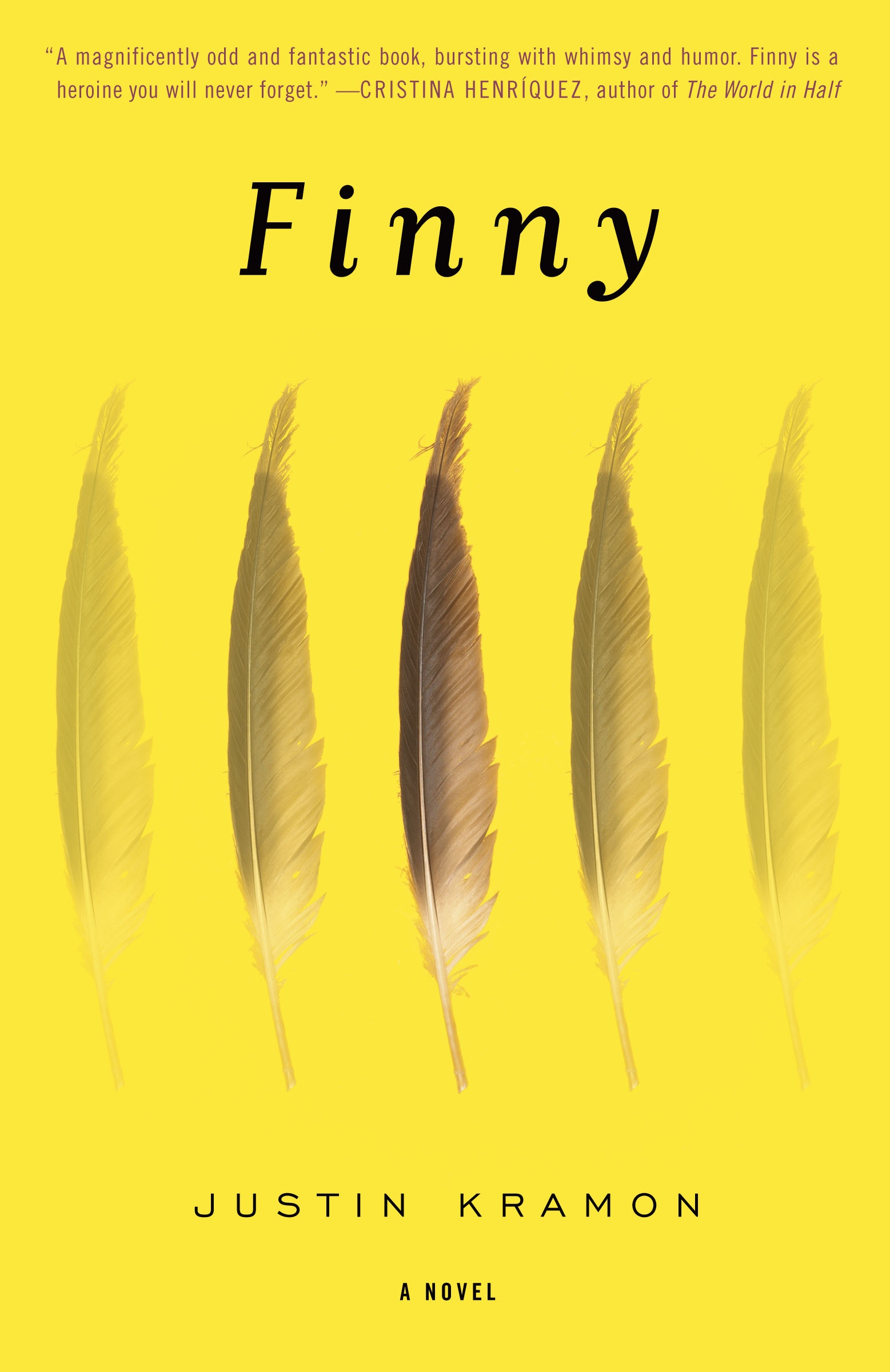
Making this list helped me let go a little bit of the desire to be important. I realized that these are the kinds of books I want to write – books filled with unforgettable characters, books that give me an almost childlike sense of wonder. I started a new novel, Finny, with a narrator whose voice is informal, quirky, a little devilish. Finny’s voice made me laugh, and I honestly cared about her and wanted to see what would happen to her, the people she’d meet, the man she would fall in love with.

Part of the process of becoming a writer has been acknowledging my own limitations, the things I don’t know about. And also being honest: about what I like, what I enjoy, what moves me. To be truthful, I don’t enjoy research. I’m not all that interested in history, and even though I try to stay informed, I’m not ardent about politics. I don’t get a huge kick from philosophical or intellectual discussions. I’m interested in psychology, food, loss, sex, death, awkward social situations, and I’m passionate about the subject of why people are as annoying as they are. I may not win a Nobel Prize for this, but it’s the only kind of novel I can write. Making my list, I saw that what I wanted to do was write books that people love reading, that make them laugh and cry, and that allow me to bring a little of myself into the world.

Justin Kramon is the author of the novel Finny (Random House), which was published on Tuesday. Now twenty-nine years old, he lives in Philadelphia. You can find out more about Justin and contact him through his website, www.justinkramon.com. You can watch a book trailer for Finny here, and you can access Justin’s blog for writers here.


Add to FacebookAdd to DiggAdd to Del.icio.usAdd to StumbleuponAdd to RedditAdd to BlinklistAdd to TwitterAdd to TechnoratiAdd to Yahoo BuzzAdd to Newsvine

Filed Under: Guest Blogs, Inspiration Tagged With: Alice Adams, Charles Dickens, creative process, fiction writing, Finny, Inspiration, John Irving, Justin Kramon, Superior Women, Thoughts, writing a novel

June 28, 2010 By Steffen Rasile

What We Don’t Know We Know

The novelist Gayle Brandeis wrote about a traumatic and terrible event.  And then it happened to her in real life.

Several months ago, as I was proofreading my new novel, Delta Girls, a sentence I wrote last year kicked me in the gut:

“My mother killed herself, you know.”

It took me a moment to remember how to breathe again. I had not recalled writing that sentence, had not recalled that this was part of a character’s history, part of that character’s motivation. I wanted to slap myself for writing that sentence so off-handedly, for forgetting it so easily.

My own mother had killed herself about a month before I received the page proofs, one week after I had given birth, and I was still reeling. “My mother killed herself, you know” was way too casual a sentence for someone to utter. I could barely say “My mother killed herself,” and couldn’t imagine tacking on “you know” as if it was common knowledge, something easy to understand. I don’t think I’ll ever fully understand her suicide. But my character had already had years to process and learn how to talk about the loss, so those words had a different context in the story.

Sometimes we don’t know what we know until we write it. I don’t believe I foresaw my mom’s death as I wrote that scene—her suicide was unexpected although she had been suffering from paranoid delusions off and on (mostly off—most of the time she appeared to be fine) for several years and was especially fearful the last two weeks of her life. Even though my initial reaction to the sentence during proofing was shock, some part of me must have wondered what it was like to lose a parent that way when I first wrote it. Some part of me must have known my mom was capable of such an action, even though she had the strongest sense of self preservation of anyone I knew. As writers, we often have to go to dark, painful places in our work; perhaps this can serve as a kind of rehearsal for the more difficult moments in life we haven’t experienced yet.

Sometimes, of course, life teaches us that we got it all wrong on the page, that we were naïve or misguided when we wrote about something we hadn’t lived, that what we wrote pales in comparison to real experience. That is certainly my experience with Delta Girls; there are depths to the aftermath of a mother’s suicide that I couldn’t have foreseen when I wrote that simple sentence.  But sometimes, somehow, we are lucky enough to tap into some collective human database of emotion, some authentic vein. I love this quote from Terence, 190-158 BC: “I am human. Nothing human is alien to me.” Writers have to come from that place of openness, of readiness to explore humanity in all its surprising contradictions, shallow and deep and strange. I know that I have a different relationship with my Delta Girls character now, and feel more compassion as a result of going through a similar loss. And I understand that character’s actions in a way I couldn’t have before (so maybe part of me did kind of know what I was writing, after all).

“My mother killed herself, you know” is still not a sentence I can say easily. I can say “My mother killed herself” now, perhaps almost too readily—I can’t seem to stop talking or writing about her death – but the “you know” still feels too pat. Perhaps it was glib in my character’s mouth, as well. It’s true that often we don’t know what we know until we write it, but sometimes even then, that knowledge is just a glimmer, just the beginning hint of insight. We write towards what we need to understand.

In addition to Delta Girls, Gayle Brandeis is the author of the novels Self Storage and The Book of Dead Birds, which won Barbara Kingsolver’s Bellwether Prize for Fiction. She recently published her first novel for young readers, My Life with the Lincolns, and is also the author of the creativity guide Fruitflesh. She lives in Riverside, CA and is mom to one college student, one high school student, and one seven month old.

Add to FacebookAdd to DiggAdd to Del.icio.usAdd to StumbleuponAdd to RedditAdd to BlinklistAdd to TwitterAdd to TechnoratiAdd to Yahoo BuzzAdd to Newsvine

Filed Under: Blog Tagged With: character, creative process, Delta Girls, fiction writing, Gayle Brandeis, Real Life, suicide, writing a novel

June 20, 2010 By Steffen Rasile

Inventing Characters from History

When novelist Laurie Albanese and art historian Laura Morowitz began collaborating on a novel about the 15th-century painter Fra Filippo Lippi, they discovered that their biggest challenge was to make the truth seem believable.  Laurie Albanese explains:

When my good friend Laura first handed me a book of Fra Filippo Lippi’s 15th-century paintings three years ago, she opened the door to a world as intriguing as it was unknown to me.

The paintings and frescoes were vivid and arresting: A stunning blonde Madonna surrounded by irascible young angels who looked as if they’d been plucked from the cobbled streets of Florence.  A cloaked man handing an infant to a maid in a hidden doorway, two women whispering to one another as John the Baptist’s head was carried into the room on a platter.

“They had a love affair,” Laura said. “Fra Lippi, the painter-priest, and the young nun who posed for the Madonna painting.”

Laura brought years of art history scholarship, boundless energy and skills, and a zest for research to our collaboration for our novel The Miracles of Prato. But the task of the novelist is markedly different than that of the historian.

Imagining myself in Fra Lippi’s Prato 1456 studio, I was faced with a variety of challenges:  First, to conceive and convey the internal life of a man who was both a celebrated painter and a scandalous monk.  Second, to put myself into his mind as he created the enduring fresco series in Prato that reflected his inner and external turmoil, his natural talent, his faith, his pride, his arrogance and his fears. Third, to understand how Fra Lippi, an orphan who’d been sent to a Carmelite monastery before his tenth birthday, might feel about the church as his protector, his sustainer, and his jailer … not to mention how he might actually find the place, the time, the nerve and the charm to successfully seduce a beautiful young nun.

Sometimes truth is stranger than fiction:  Lippi had done things that were implausible and even unimaginable. But he’d really done them, and so we had to make them seem believable.

Laura and I had no diaries, no journals, only a few scant letters, and no definitive record of the painter’s life. Everything but the barest outline of the story had to be invented.

It was equally challenging to imagine what would drive the gorgeous Lucrezia Buti into the arms of a painter-priest who was twice her age and nowhere near as attractive. What would compel her to risk scandal and scorn? How would she deal with the opposing tugs of sin and virtue, love and duty?  We could hardly ignore the fact that in Renaissance Italy, as elsewhere in Europe at that time, a woman had few options once she left her father’s home: she could be a wife, a nun, or a whore. Lucrezia Buti would not have been in a position to envision any other trajectory for her life. And yet, she found one.

In literary fiction, plot grows out of character. If your readers don’t believe that your characters would act the way you’ve imagined them acting, your novel will be as thin as a piece of deli Swiss cheese, and as full of holes.

Laura and I wrote long, imagined histories for Fra Lippi and Lucrezia – passages from their childhoods, stories and details that never made it into the book but that allowed us to get to know them better. We wrote lengthy scenes of internal dialogue and reflection, trying to puzzle out what they might have been thinking – this nun and this priest – when they recognized their mutual attraction.

We studied Fra Lippi’s paintings for clues to his psyche. To imagine his young life, we visited a monastery in New Jersey and the Santa Maria del Carminchurch in Florence where Lippi had lived and studied under the famed early Renaissance painter, Masaccio.

For clues to Lucrezia’s interior and exterior reality, we read up on daily life in Florence and devoured a nonfiction book, Iris Origo’s The Merchant of Prato, based on the life of a prosperous 13th century Pratese, Francesco Datini, then visited Datini’s well-preserved palazzo (now a museum and archive) in Prato.  We imagined we were nineteen again, with all the hopes and aspirations a nineteen-year-old girl might have for a happy future that is suddenly snatched away.

We climbed to the top of the bell tower in the Cathedral of Santo Stefano – the same bell tower that stood over the city when Lucrezia and Lippi lived there. We would have liked to visit the Convent Santa Margherita and Lippi’s studio, but those places have been swallowed by time and so we had to build them in our minds and map them out on paper, literally drawing out the convent grounds as we imagined them, acting as architects for Lippi’s simple studio quarters – the kitchen hearth here, the curtain across his studio chamber there, the sack of egg yolks, chemicals and powdered dyes for mixing paints on a crude wooden shelf beside his easel.

At some point we began thinking in archetypes: Fra Lippi as the passionate, tormented artist and Lucrezia as the vulnerable virgin beauty. From there we invented two other fictional characters who rounded out the dramatic action and also served as counterpoints to our characters.

These were Sister Pureza – a wise woman/crone – and Prior General Saviano, a corrupt patriarch.   We gave Pureza an herb garden to tend, and Saviano an appetite for rich wines and other things.  (I spent many pleasant afternoons wandering the paths of the medieval medicinal garden at the Metropolitan Museum of Art’s Cloisters in the Bronx.)

Once we knew that Lucrezia loved blue silk and had learned the art of silk dying from her father; that Fra Lippi understood the relationship of sinew, muscle, bones, flesh and spirit from early years in his father’s butcher shop; that Sister Pureza had taught herself the many natural properties of rosemary, thyme, nettle and so on under great personal distress; we had our characters. And then we were ready to let them tell their stories.

The Miracles of Prato is a Summer 2010 Reading Group List selection of IndieBound, the American independent booksellers group.  Laurie Albanese talks about writing, life, and walking at her blog My Big Walk.

Add to FacebookAdd to DiggAdd to Del.icio.usAdd to StumbleuponAdd to RedditAdd to BlinklistAdd to TwitterAdd to TechnoratiAdd to Yahoo BuzzAdd to Newsvine

Filed Under: Blog Tagged With: creative process, fiction writing, Fra Filippo Lippi, IndieBound, Inspiration, Italy, Laura Morowitz, Laurie Albanese, My Big Walk, Real Life, The Miracles of Prato, writing a novel

  • 1
  • 2
  • 3
  • …
  • 17
  • Next Page »

COMING MAY 2026: THE FOURSOME

A literary historical novel set in Civil War-era North Carolina, based on a true family story and told from the perspective of Sarah Bunker, one of two sisters who married Chang and Eng, the famous conjoined twins…learn more

Follow on Substack

Subscribe

Connect with Christina

Contact
  • Facebook
  • Instagram
  • Twitter

Copyright © 2026 Christina Baker Kline · Site design: Ilsa Brink