Sign up for Christina’s Newsletter

Christina Baker Kline

Author Website

  • Books
    • The Foursome
    • Please Don’t Lie
    • The Exiles
    • A Piece of the World
    • Orphan Train
      • Orphan Train Girl: The Young Readers’ Edition of Orphan Train
    • Other Novels
      • Bird in Hand
      • The Way Life Should Be
      • Desire Lines
      • Sweet Water
    • Nonfiction
      • Always Too Soon
      • About Face
      • Child of Mine
      • Room to Grow
      • The Conversation Begins
  • Events
  • NEWS
  • Other Writing
  • About
    • Bio
    • FAQs
    • Contact
    • Photos
  • Newsletter

July 31, 2009 By bakerkline

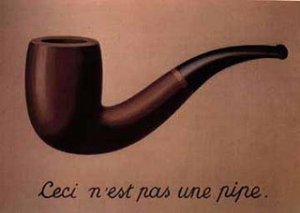
Language Geek, #3: Semiotics

Magritte's pipe - semioticsSemiotics is the study of signs, and a sign is anything that stands for something else. It took me a long time to understand this seemingly simple idea.

The argument goes like this: it is a myth to believe there is any such thing as an objective reality; ‘reality,’ in fact, is a system of signs. As Proust has said, “Everything can be several things at the same time.” Or, to put a finer point on it: the art historian Ernst Gombrich says, “There is no reality without interpretation.”

The British semiotician Daniel Chandler suggests that studying semiotics can make us “more aware of reality as a construction and of the roles played by ourselves and others in constructing it. Meaning is not ‘transmitted’ to us – we actively create it according to a complex interplay of codes or conventions of which we are normally unaware. Becoming aware of such codes is both inherently fascinating and intellectually empowering.”

The process of creating literary fiction, I would argue, is the practice of semiotics. It’s all about signs. Our characters’ reality – an artificial construct to begin with – is freighted with meaning, conscious and unconscious, for the writer, the characters themselves, and ultimately for the reader.

In his preface to The Picture of Dorian Gray, Oscar Wilde wrote, “All art is at once surface and symbol. Those who go beneath the surface do so at their peril.”  But these signs and symbols, the dual or multiple meanings, must be subservient to the story, and not the other way around.  Otherwise the fictional trance will be broken; the characters will be types and not individuals. The novel will become a treatise.
Filed Under: Language Geek Tagged With: character, creative process, Daniel Chandler, Ernst Gombrich, fiction writing, literary fiction, Proust, semiotics, signs

July 10, 2009 By bakerkline

Language Geek, #2: Bildungsroman

“No road offers more mystery than that first one you mount from the town you were born to, the first time you mount it of your own volition, on a trip funded by your own coffee tin of wrinkled up dollars – bills you’ve scrounged and saved for … ” begins Mary Karr’s memoir Cherry.

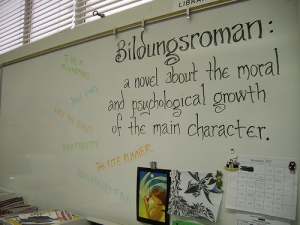
It’s been said that there are only two stories in the world: a stranger comes to town and a man sets off on a journey.  The German word bildungsroman, or “novel of formation,” is a version of the latter:  a young person (traditionally a boy) undertakes an epic journey, during which he confronts inner and outer demons, and in the process becomes an adult.  (When I think of this word I am reminded of the German poet Holderlin’s line in “The Journey”: “Reluctantly that which dwells near its origin departs.”)  Think Tristram Shandy, The Adventures of Huckleberry Finn, Portrait of the Artist as a Young Man, The Catcher in the Rye.bildungsroman

In some ways, it seems to me, every story contains elements of the bildungsroman.  A story must contain a moment of change, internal or external or both, often experienced as part of a (literal or metaphorical) journey.  This change usually involves a ‘coming of age’: the central character is enlightened or disillusioned; if he doesn’t yet understand the enormity of his experience, the reader knows that soon enough he will.

Filed Under: Language Geek Tagged With: A Catcher in the Rye, bildungsroman, character, creative process, Inspiration, Mary Karr, Portrait of the Artist as a Young Man, The Adventures of Huckleberry Finn, Tristram Shandy, writing a novel

June 14, 2009 By bakerkline

Language Geek, #1: Wendepunkt

Wendepunkt is a German word that means turning point.  In Modernism, Ray Bradbury defines wendepunkt as the moment in a novel “in which there is an unexpected yet in retrospect not unmotivated turn of events, a reorientation which one can see now is not only wholly consistent but logical and possibly even inevitable.”  This moment often involves a reversal of the protagonist’s fortunes.  Aristotle called it peripeteia, the crisis action of a tragedy.

wendepunkt In her masterful guide to narrative craft, Writing Fiction, Janet Burroway says, “A reversal of some sort is necessary to all story structure, comic as well as tragic. Although the protagonist need not lose power, land, or life, he or she must in some significant way be changed or moved by the action.”  This internal and external change, when it comes, may surprise the reader, but should be organic to the plot. Whether shocking or confusing or exhilarating, it should feel intrinsic to the story.
Filed Under: Language Geek Tagged With: Aristotle, creative process, fiction writing, Inspiration, Janet Burroway, literary, peripeteia, Ray Bradbury, Thoughts, writing a novel

COMING MAY 2026: THE FOURSOME

A literary historical novel set in Civil War-era North Carolina, based on a true family story and told from the perspective of Sarah Bunker, one of two sisters who married Chang and Eng, the famous conjoined twins…learn more

Follow on Substack

Subscribe

Connect with Christina

Contact
  • Facebook
  • Instagram
  • Twitter

Copyright © 2025 Christina Baker Kline · Site design: Ilsa Brink