Sign up for Christina’s Newsletter

Christina Baker Kline

Author Website

  • Books
    • The Foursome
    • Please Don’t Lie
    • The Exiles
    • A Piece of the World
    • Orphan Train
      • Orphan Train Girl: The Young Readers’ Edition of Orphan Train
    • Other Novels
      • Bird in Hand
      • The Way Life Should Be
      • Desire Lines
      • Sweet Water
    • Nonfiction
      • Always Too Soon
      • About Face
      • Child of Mine
      • Room to Grow
      • The Conversation Begins
  • Events
  • NEWS
  • Other Writing
  • About
    • Bio
    • FAQs
    • Contact
    • Photos
  • Newsletter

July 2, 2009 By bakerkline

Guest Blog: Pamela Redmond Satran on Naming Characters

Novelist and naming expert Pam Satran writes:

There’s a character named Billie in the novel I’ve been working on since the invasion of Iraq.  But Billie wasn’t always in the book: Until this spring, she was Lily.

Well, she wasn’t really Lily, but the character who played her role in the plot was named Lily until the most recent draft.  Lily was older – 23 to Billie’s 19 – a college graduate already living on her own in New York.  Billie rides cross country with a stranger, her backpack full of her father’s ashes and a handgun.26names
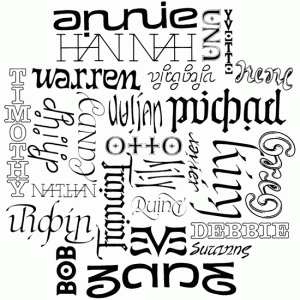
I changed my character’s name (and persona) after reading Kate Atkinson’s When Will There Be Good News? Sixteen-year-old Reggie is alone in the world, yet winning and resourceful.  I admired the way Atkinson wrote from Reggie’s point of view – third person, but intimate – and decided I wanted my character, Lily, to be more like Reggie.

To be, in other words, Billie.

I’m still not certain Billie is the right name for her.  It feels a little obviously like the name of a scrappy tomboy, which is exactly what Billie is.  Maybe it would be more interesting if her name were something ultra-feminine, like Seraphina?  Plus one of my other main characters, whom Billie spends a lot of time with, also has a name that starts with a B, Bridget, and that name is carved in stone.  As a reader, I hate it when character’s names or physical descriptions, even their hair colors, are too similar.

As the author of ten name books, I should have an easier time of naming my characters. But it’s just like naming children: No matter how much expertise you have, no matter how much thought you’ve put into it, it can still be difficult to settle on the perfect name for someone you love and cherish.

It’s easy for me to give certain kinds of name advice to fellow novelists.  A girl born in the 1950s with sisters named Joanne and Debbie would more likely be Carolyn than Caroline, I recently told one friend, pointing to the popularity charts on my site Nameberry.  Caroline was rarely used outside of the upper classes before the Kennedys popularized it in the early 1960s.  Another character, born in the 1930s, might have been Lillian or Louise, but certainly not LeeAnn.

Yet I feel less certain about my own poor Billie. I’m going to take one more swing through the book, looking closely at that character, still wobbly.  I hope that once Billie’s inner workings and story feel more solid to me, so will my decision about her name.

Pamela Redmond Satran is the author of five novels and ten bestselling baby name books, including Beyond Ava & Aiden.  Her blog How Not to Act Old is becoming a book in August.
Filed Under: Guest Blogs, Inspiration Tagged With: character, creative process, fiction writing, How Not to Act Old, Inspiration, Kate Atkinson, Nameberry, naming characters, Pamela Redmond Satran, Thoughts, writing a novel

June 25, 2009 By bakerkline

Writer vs. Editor

I used to agonize over each word and phrase in a first draft, doubtful that when I came back to it, weeks or months later, I would be able to see, much less fix, the things that didn’t work. But while I was writing my third novel, The Way Life Should Be – and editing other people’s manuscripts at the same time – I had an epiphany.

(Yes, it took three novels to figure this out.)

Here’s what I realized: My editor-self is surprisingly clear-headed, even ruthless.  Hyper-critical and exacting, she is capable of transforming a freewheeling, messy draft into clear and lucid prose. And she likes doing it. red_pencil

This realization freed my writer-self to have more fun. My first drafts have become more spontaneous and energetic; I feel free to try out a range of ideas, follow tangents in odd directions, write a scene of dialogue three different ways – all with the knowledge that my editor-self will step in when needed.  With a red pencil and a roll of the eyes:  What was she thinking?

Filed Under: The Creative Process Tagged With: creative process, Discipline, editing, fiction writing, The Way Life Should Be, Thoughts, writing a novel

June 16, 2009 By bakerkline

It’s the Writing, Stupid – Part 2

The words on the page are the only things that count. (See “It’s the Writing, Stupid,” below.)

That’s all well and good. But novelist Debra Galant poses an interesting question: what about those non-writing writing days? Does it count, for example, if you’re sketching notes about a character, doing historical research at the library or online, or creating an outline for the story? Does it count if you’re mulling things over while washing the breakfast dishes (what if the secret the brother is hiding from the family involves the mysterious neighbor; what if it turns out, in fact, that he is intimately involved in the mystery…) or taking a brisk walk?reading-tarot-cards

Deb says, “I always keep a process journal for whatever novel I’m working on. Today I did a tarot reading for my character Hugo. Took notes, thought about him, mused a bit, saw the need for new character to be developed. But no pages added to the manuscript. I’m at very early stages. What do you think? Does note-taking count as writing?”

Well — since you asked! — here’s what I think.  For me, note-taking does not count.  It’s a necessary part of the process, of course – like research and planning and ruminating in the shower. All of it is part of creating a novel.  But it’s not writing.

In order to get those words on the page, I have to remind myself that I can fill notebooks with musings about my characters’ motivations; I can research the history of the orphan trains until the proverbial cows come home; I can plan and strategize and plot. But none of it actually means anything until it becomes part of the story.

Filed Under: Discipline, The Creative Process Tagged With: creative process, Debra Galant, fiction writing, Inspiration, Thoughts, writing a novel

June 14, 2009 By bakerkline

Language Geek, #1: Wendepunkt

Wendepunkt is a German word that means turning point.  In Modernism, Ray Bradbury defines wendepunkt as the moment in a novel “in which there is an unexpected yet in retrospect not unmotivated turn of events, a reorientation which one can see now is not only wholly consistent but logical and possibly even inevitable.”  This moment often involves a reversal of the protagonist’s fortunes.  Aristotle called it peripeteia, the crisis action of a tragedy.

wendepunkt In her masterful guide to narrative craft, Writing Fiction, Janet Burroway says, “A reversal of some sort is necessary to all story structure, comic as well as tragic. Although the protagonist need not lose power, land, or life, he or she must in some significant way be changed or moved by the action.”  This internal and external change, when it comes, may surprise the reader, but should be organic to the plot. Whether shocking or confusing or exhilarating, it should feel intrinsic to the story.

Filed Under: Language Geek Tagged With: Aristotle, creative process, fiction writing, Inspiration, Janet Burroway, literary, peripeteia, Ray Bradbury, Thoughts, writing a novel

June 11, 2009 By bakerkline

Novel on the Brain

When I am working – really working – on a novel, I only pretend to be human. Though I may act relatively normal, in actuality I have transformed into an enormous, squishy head attached to a floaty, immaterial body, useful only because it transports my head around.  Everything I come into contact with gets absorbed in the spongy matter and either ferments or turns into something else.

squishy headToday, for example, I am at a Verizon store unraveling the mysteries of my new Blackberry.  A hip young sales associate named Dawn has been dispatched to teach me how to download ring tones and other “apps.”  Part of my brain is paying attention (as much attention as is possible for me ever in these situations, which is to say not much), but mostly I am focused on other things.  What brought this girl to this particular Verizon store in a strip mall on Route 3 in Clifton, New Jersey?  Is she really passionate about electronics?  Was it a bond she shared with, say, her gay older brother or alcoholic ex-boyfriend?  What does her tattoo of a purple rose signify?  How does she manage to keep her fingernails so long and yet manipulate the tiny keypad so well?
(There’s a character in my novel, a 17-year-old juvenile delinquent named Michelle ….)

Dawn’s fruity breath mint clicks against her teeth, and as she leans closer to show me how to click and drag, I smell her jasmine-scented shampoo.  All of this sensory and physical detail seeps into the sponge in my head, where it quickly becomes absorbed.  And meanwhile I try to act normal – though it’s pretty clear that by the way Dawn is treating me that I’m not fooling her at all.

Filed Under: The Creative Process Tagged With: creative process, fiction writing, Inspiration, Thoughts

  • « Previous Page
  • 1
  • …
  • 9
  • 10
  • 11
  • 12
  • Next Page »

COMING MAY 2026: THE FOURSOME

A literary historical novel set in Civil War-era North Carolina, based on a true family story and told from the perspective of Sarah Bunker, one of two sisters who married Chang and Eng, the famous conjoined twins…learn more

Follow on Substack

Subscribe

Connect with Christina

Contact
  • Facebook
  • Instagram
  • Twitter

Copyright © 2025 Christina Baker Kline · Site design: Ilsa Brink