Sign up for Christina’s Newsletter

Christina Baker Kline

Author Website

  • Books
    • The Foursome
    • Please Don’t Lie
    • The Exiles
    • A Piece of the World
    • Orphan Train
      • Orphan Train Girl: The Young Readers’ Edition of Orphan Train
    • Other Novels
      • Bird in Hand
      • The Way Life Should Be
      • Desire Lines
      • Sweet Water
    • Nonfiction
      • Always Too Soon
      • About Face
      • Child of Mine
      • Room to Grow
      • The Conversation Begins
  • Events
  • NEWS
  • Other Writing
  • About
    • Bio
    • FAQs
    • Contact
    • Photos
  • Newsletter

March 8, 2010 By bakerkline

Letting Go

Katharine Davis just finished writing a novel.  Now comes the hard part:

Writing a novel is a long journey.  From the simple physical endurance of turning out all those pages to the emotional ups and downs of the creative act—it’s an enormous endeavor, consuming one’s life for years at a time.

Writers often talk about the difficulty of getting started.  How do you find the voice, where to begin, which point of view, the time frame, the setting?  There are thousands of questions to consider, big and small. Then there is the problem of sticking to it, finding the time to write, getting blocked.  Oh, the agony of finally understanding a character in the thirteenth chapter and having to re-write the previous 200 pages.  How painful it is to discover you’ve gone off on a tangent, another 60 pages.  You love every word, but you have to take them all out.

Eventually, you do the tedious revisions.  Sentence by sentence, word by word, the work of getting the prose just right.  Some days it’s nothing but a pleasure to revise, working on the rhythm, having the perfect metaphor seem to land in your lap.  You might experience the thrill of coming up with that one word that changes everything.  But, the countless hours spent on dialogue that clunks along like the rattle in your car that the mechanic can’t fix, or the flashback that’s brought your narrative drive to a halt – these trials are part of the process too.

Yet, to me, one of the hardest parts of writing a novel is letting it go. You type ‘the end’ in all caps.  You send it out.  You want to celebrate, drink champagne, eat an enormous chocolate cupcake and tell all your friends, “I did it.  I’m done. It’s the best book ever!”  And then, wham.  What have I written?  I didn’t get deeply enough into that character’s head.  Did I tell enough about the mother?  Oh God.  That part’s too sappy.  I should have made it better. These thoughts come at 3 AM, thanks to the champagne, the cupcake, or both.  At that moment, the initial thrill of finding the story, and the enthusiasm of bringing it to the page is like some prehistoric event.

The next day, I feel somewhat better.  There’s that scene where . . . and, remember when . . . , and the ending that can still make me cry.  I find a paragraph I truly love.  When did I write that?  The next few weeks bring a combination of highs and lows.

Letting go of a novel is like sending children off to college.  They’ve spent the last few years of high school driving you crazy, but also bringing you joy and delight. You experience the relief of getting them out from under your roof, to deep sadness.  You miss them.  You want your child to have his own life, to succeed.  But it’s no longer up to you.  Your baby is gone.  Still, you’ve created something with love and hard work.

Months later, when your carefully worked-on manuscript pages have become an actual book, you have the satisfaction of knowing that your story, like your grown child, is out in the world at last.  The joy of connecting with readers and contributing one more piece to the human experience lifts your spirits and brings you the courage to reach for your pen to start writing again.

Katharine Davis’s novels include East Hope and Capturing Paris. Recommended in Real Simple Spring Travel 2007, Capturing Paris was also included in the New York Times suggestions for fiction set in Paris. Davis’s new novel, A Slender Thread, is coming out later this year. She is an Associate Editor at The Potomac Review.  She can be reached at www.katharinedavis.com.

Add to FacebookAdd to DiggAdd to Del.icio.usAdd to StumbleuponAdd to RedditAdd to BlinklistAdd to TwitterAdd to TechnoratiAdd to Yahoo BuzzAdd to Newsvine

Filed Under: Guest Blogs, Real Life Tagged With: A Slender Thread, best-laid plans, Capturing Paris, creative process, East Hope, fiction writing, Inspiration, Katharine Davis, letting go, Thoughts, writing a novel

March 4, 2010 By bakerkline

The Curse of Multitasking

Waiting to pick up my son after his play rehearsal, I sit in the car and grade student essays. I listen to podcasts as I drive over the George Washington Bridge to work. When the phone rings at home and it’s my sister, I get up from my desk to make beds, put in a load of laundry, start the dishwasher.  I make sandwiches for school lunches while fixing dinner.

I have come to realize that I rarely do one thing at a time.  And that’s the problem.

When you write, you can only write.  You can’t do laundry or wash dishes.  You can’t make sandwiches or talk on the phone.  You can’t even listen to music (or I can’t – unless I’m in a coffee shop, where for some reason ambient noise doesn’t usually bother me).  It’s just you and the lined paper – or blank screen – in front of you, and any distraction will not only affect your writing that day, it may change the course or the tenor of the work you’re trying to do.

But multitasking is a hard habit to break, even temporarily.  I sit down to write and items for a “to do” list march through my head.  I suddenly remember that I never called the dentist; I forgot to pick up a package at the post office; we’re out of milk.

In almost every other aspect of my life, my ability to multitask is a good thing.  Doing several things at once is how I’ve learned to juggle my various responsibilities:  mother, wife, editor, teacher, volunteer.  It’s the only way to keep all the balls in the air.

But writing is not about keeping the balls in the air.  It’s about letting them drop.  To unspool a story is to inhabit a different space altogether. You have to let the world in your head grow until it becomes more important than the world you inhabit.  You have to calm your heartbeat, slow your skipping brain, become comfortable with silence.  You have to accept that you will get nothing done except this one thing – this one paragraph or page or, perhaps, on a good day, a chapter – and possibly not even that.

You have to stop worrying about the fact that you’re wasting time.  Of course you are.  That’s what writers do.

And when you emerge from your writing fog you will have accomplished nothing tangible.  You will have checked nothing off your list.  Your teeth still need cleaning.  The package awaits at the post office.  There’s no milk in the fridge.  And your book isn’t finished – far from it.

But perhaps you had a moment of clarity, of insight, about your story.  Maybe you understand it a little better.  And if you really want to be a writer, these moments are more than enough to keep you going, to give you strength to push back against the many-headed hydra of tasks and responsibilities that threatens to devour the precious time you have to create something. Something light-years removed from your ordinary life.

Add to FacebookAdd to DiggAdd to Del.icio.usAdd to StumbleuponAdd to RedditAdd to BlinklistAdd to TwitterAdd to TechnoratiAdd to Yahoo BuzzAdd to Newsvine

Filed Under: Real Life Tagged With: best-laid plans, creative process, Discipline, Inspiration, multitasking, Real Life

March 1, 2010 By bakerkline

Why Do I Even Want to Write a Novel?

With a challenging, fulfilling job and a satisfying personal life, Anne Burt questions her desire to write a novel – and finds the answer in an unexpected place:

Thomas Roma, Untitled, 1984

Motivation has always been as cruel to me as it has been – well – motivating. I’ve been motivated to write because: I imagine glory when the world reads my masterpiece; I need to act out some childhood revenge fantasy about surpassing my father; I have a contorted sense that immortality is achievable through words on a page.  Any analysis of my past motivations leaves me thinking I’m either a narcissist or an idiot or both.

I’ve won enough self-awareness through experience and therapy over the years to dispel the notion that any of my three aforementioned motivations for writing are a) possible, or b) matter.  I’m over it, and I sleep better at night and enjoy my life far more as a result.

The truth is, I have a creative, absorbing job I love that uses my skills and education, puts me in the company of artists each day and takes care of my family of four.  I have a meaningful career as a writer and editor as well; while I haven’t published a novel, I’ve published books and essays on subjects that move me and have given me great pride and sense of accomplishment.

My old demons don’t scare me into action anymore – for better (who needs the agitation?) or for worse (the agitation drove me to my writing desk, after all).

But a nagging question remains: do I need to recapture the negativity of these old motivations in order to see the writing of a novel all the way through from beginning to end, or has general life happiness turned my old desire to write a novel into phantom-limb syndrome?

Last week I attended an artist talk, one in a series I oversee as part of my job, by photographer and Columbia University School of the Arts professor Tom Roma. I know Tom, so I was prepared to be entertained by his banter, and I know his photographs, so I was prepared to hear about the extreme care with which he approaches every level of the process.  I was unprepared, however, to find the answer to my question.

Discussing his teaching philosophy, Tom described an assignment he gives his undergraduate and grad students in which he sends them to the library or a bookstore.  “I tell them to scan the shelves, feel the spines, look at the size and shape and heft of the books,” he said. “Then I tell them to pull out the one that speaks to them as an object.  Subject doesn’t matter; what matters is how it feels in their hands, how satisfied they are by holding this thing, whether they feel they need this object in their lives.  When they find the book, they must check it out of the library, or buy it from the store, and that will be the inspiration for the size and feel of their book of photographs.  Whenever they get lost in the middle of the work, or feel directionless or confused, I send them back to hold and feel the book because that book is their goal and will motivate them to create.”

And that was it.  I realized that I was missing something so obvious, so straightforward that it was not only staring me in the face but spilling out over every surface in my home, weighing down my shoulder bag week after week, keeping me up late at night reading, making me miss subway stops, informing my favorite conversations, and even creating the best moments spent with my children:  novels are the book for me.  Novels are my goal, and motivate me to create.  The the-ness of a novel matters to me; I run my hands over its spine and feel its weight and size and heft. Essay collections, careers, articles – not so much.

I want to create something I am truly passionate about, and until I commit myself to seeing a novel through, beginning to end, I won’t have done it. My true motivation is as simple, and as complicated, as that.

Anne Burt is Director of Communications for Columbia University School of the Arts. She is the editor of My Father Married Your Mother: Dispatches from the Blended Family and co-editor with Christina Baker Kline of About Face: Women Talk About What They See When They Look in the Mirror.  Anne received Meridian Literary Magazine’s Editors’ Prize in Fiction in 2002.

Add to FacebookAdd to DiggAdd to Del.icio.usAdd to StumbleuponAdd to RedditAdd to BlinklistAdd to TwitterAdd to TechnoratiAdd to Yahoo BuzzAdd to Newsvine

Filed Under: Guest Blogs, Real Life Tagged With: Anne Burt, beginning, Columbia University School of the Arts, creative process, fiction writing, Inspiration, Thomas Roma, Thoughts, writing a novel

October 26, 2009 By bakerkline

Book Learning

AnneBelovMonicaReadingLike most writers, I read all the time.  Much of this reading is for work:  at the moment I’m immersed in several  historical accounts of the orphan trains as research for my new novel; I’m reading stories and essays for the classes I teach, as well as – of course – a mountain of student papers; last weekend I read two bound galleys from publishers.  And I’m on Chapter 5 of  “The Lemonade Wars” with my nine-year-old, Eli.

So it can be hard to make time to read for pleasure – though I know that this reading fuels my own writing like nothing else.  I’ve discovered that it helps to belong to a community of readers who impose deadlines, promise unexpected insights and spirited discussion, and passionately love books.

I belong to two book clubs, and I love them equally for completely different reasons. The first is comprised of about a dozen women who came together more than a decade ago in my town of Montclair, New Jersey, when our children were in diapers. We were substance-starved new mothers, overwhelmed by life’s demands and delighted to have an excuse to get out of the house one evening a month to engage in real conversation about something other than our offspring (adorable though they were).

The mandate of my Montclair club – never explicitly stated, but clear from the beginning – was to read the most talked-about books of the moment:  books we’d feel silly not knowing about at a party.  We tend to favor novels and memoirs, but occasionally choose books in psychology, economics, and current events.  From The Tipping Point to Eat Pray Love, we’ve read more than 150 books, often bestsellers and usually award-winners, with an occasional classic thrown in for good measure. (Our current pick, for example, is Olive Kitteridge.) We meet at members’ houses every fifth Monday (excepting holidays), eat cheese straws and grapes, drink sauvignon blanc, chat about our kids, our trips, and yoga, and eventually settle in to discuss the book.  For a while we had some rules: each person brought in three ideas and the group voted; the person who chose a book was responsible for introducing it, etc.  But that didn’t last long.  Now we come to consensus as a group, throwing out ideas and letting the conversation dictate our selections. If someone feels strongly about a book, we almost always read it.  Discussion focuses on the stories, the writers themselves, the hype surrounding the book, and, in the case of nonfiction, the true story, time period or historical event the book is based on.

This group has survived the breakup of several marriages, illnesses including cancer and chronic fatigue, falling outs between members, and many child-related heartaches (learning disabilities, anxiety attacks, broken limbs, and now, as our babies become teenagers, all kinds of nerve-wracking experimentation).  Over the years, some members have dropped out for a variety of reasons – for one thing, the urgent need to have an evening to oneself is gone, and with homework, sports and other pressures it can be hard to get away for a non-essential meeting.  But a hardy band of book lovers remains, and new members have come in to fill the gaps.

My second book club doesn’t call itself a book club.  It’s a group of about eight published novelists and memoirists, several of whom teach creative writing on college campuses. We live in Manhattan, Brooklyn, and New Jersey, and gather three or four times a year in NYC to discuss a writer’s work over dinner.

The New York group is closer to a class, in some ways, except that we all lead the discussion.  We talk about books that have influenced us as writers, or that we’re embarrassed to say we’ve never read – books we consider significant for one reason or another.  After taking more than a year to read Remembrance of Things Past, we moved on to Sue Miller’s The Good Mother, Jane Smiley’s A Thousand Acres, Tolstoy’s Anna Karenina, and are now reading Chekhov’s short stories.  What we’re looking at, primarily, is how the writer does what he or she does. How does she pull it off?  We analyze craft and theme, characterization and pacing.  We pinpoint moments of change and look at how and why characters are introduced and discarded and where the climax originates.  We examine the arc of the narrative and look closely at moments that, to paraphrase Hemingway, teeter on the edge of sentimentality without going over.

It takes a lot of planning to coordinate the schedules of eight busy writers in several states.  So after chatting over wine and cheese about our own latest books and other projects, we get down to business fairly quickly.  Conversations tend to be fast-paced and energetic; we push each other to dig deeper and explore further than we might have done on our own. Each book is a learning tool, a rich text brimming with ideas and inspiration.  I always leave these gatherings with a heady sense of having gained insights and connections that will help me in my own writing.  (I wrote about one of these moments of insight here.)

My two book clubs serve entirely different purposes. The Montclair group provides a way to stay in touch with a circle of friends and read current books; it’s socializing with a literary excuse. And the writers’ group is equivalent to a welders’ convention – a place to exchange ideas about our trade.  It’s literary analysis with a socializing bonus.  I feel lucky to belong to both.   Because the truth is that sometimes I want to read for pleasure, to get swept up in the magic of a story.  And sometimes I want to learn from a book, to figure out how the magic tricks are done.

This essay, in a slightly different form, originally appeared in BookClubGirl.

Filed Under: Real Life Tagged With: book clubs, reading groups

October 15, 2009 By bakerkline

Quick Link: A Tale of Two Book Clubs

book club girlWhen Book Club Girl, a site “dedicated to sharing great books, news and tips with book club girls everywhere,” asked me to write a guest post, I knew exactly what I wanted to talk about.  For over a decade I’ve belonged to a wonderful group of book lovers in Montclair, NJ, where I live, and several years ago I became part of very different reading group of writers in New York.  As I write in the post, “My two book clubs serve entirely different purposes.  The Montclair group provides a way to stay in touch with a circle of friends and read current books … And the writers’ group is equivalent to a welders’ convention – a place to exchange ideas about our trade.”  And they’re equally useful to me as a writer and reader.  You can read the rest of the post here.

Filed Under: Quick Links, Real Life Tagged With: book club, book club girl, Montclair, NJ

  • « Previous Page
  • 1
  • 2
  • 3
  • 4
  • …
  • 6
  • Next Page »

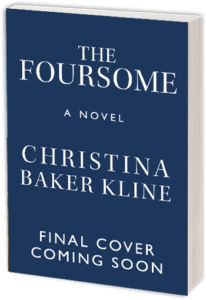
COMING MAY 2026: THE FOURSOME

A literary historical novel set in Civil War-era North Carolina, based on a true family story and told from the perspective of Sarah Bunker, one of two sisters who married Chang and Eng, the famous conjoined twins…learn more

Follow on Substack

Subscribe

Connect with Christina

Contact
  • Facebook
  • Instagram
  • Twitter

Copyright © 2026 Christina Baker Kline · Site design: Ilsa Brink