Sign up for Christina’s Newsletter

Christina Baker Kline

Author Website

  • Books
    • The Foursome
    • Please Don’t Lie
    • The Exiles
    • A Piece of the World
    • Orphan Train
      • Orphan Train Girl: The Young Readers’ Edition of Orphan Train
    • Other Novels
      • Bird in Hand
      • The Way Life Should Be
      • Desire Lines
      • Sweet Water
    • Nonfiction
      • Always Too Soon
      • About Face
      • Child of Mine
      • Room to Grow
      • The Conversation Begins
  • Events
  • NEWS
  • Other Writing
  • About
    • Bio
    • FAQs
    • Contact
    • Photos
  • Newsletter

June 14, 2009 By bakerkline

Language Geek, #1: Wendepunkt

Wendepunkt is a German word that means turning point.  In Modernism, Ray Bradbury defines wendepunkt as the moment in a novel “in which there is an unexpected yet in retrospect not unmotivated turn of events, a reorientation which one can see now is not only wholly consistent but logical and possibly even inevitable.”  This moment often involves a reversal of the protagonist’s fortunes.  Aristotle called it peripeteia, the crisis action of a tragedy.

wendepunkt In her masterful guide to narrative craft, Writing Fiction, Janet Burroway says, “A reversal of some sort is necessary to all story structure, comic as well as tragic. Although the protagonist need not lose power, land, or life, he or she must in some significant way be changed or moved by the action.”  This internal and external change, when it comes, may surprise the reader, but should be organic to the plot. Whether shocking or confusing or exhilarating, it should feel intrinsic to the story.

Filed Under: Language Geek Tagged With: Aristotle, creative process, fiction writing, Inspiration, Janet Burroway, literary, peripeteia, Ray Bradbury, Thoughts, writing a novel

June 11, 2009 By bakerkline

Novel on the Brain

When I am working – really working – on a novel, I only pretend to be human. Though I may act relatively normal, in actuality I have transformed into an enormous, squishy head attached to a floaty, immaterial body, useful only because it transports my head around.  Everything I come into contact with gets absorbed in the spongy matter and either ferments or turns into something else.

squishy headToday, for example, I am at a Verizon store unraveling the mysteries of my new Blackberry.  A hip young sales associate named Dawn has been dispatched to teach me how to download ring tones and other “apps.”  Part of my brain is paying attention (as much attention as is possible for me ever in these situations, which is to say not much), but mostly I am focused on other things.  What brought this girl to this particular Verizon store in a strip mall on Route 3 in Clifton, New Jersey?  Is she really passionate about electronics?  Was it a bond she shared with, say, her gay older brother or alcoholic ex-boyfriend?  What does her tattoo of a purple rose signify?  How does she manage to keep her fingernails so long and yet manipulate the tiny keypad so well?

(There’s a character in my novel, a 17-year-old juvenile delinquent named Michelle ….)

Dawn’s fruity breath mint clicks against her teeth, and as she leans closer to show me how to click and drag, I smell her jasmine-scented shampoo.  All of this sensory and physical detail seeps into the sponge in my head, where it quickly becomes absorbed.  And meanwhile I try to act normal – though it’s pretty clear that by the way Dawn is treating me that I’m not fooling her at all.

Filed Under: The Creative Process Tagged With: creative process, fiction writing, Inspiration, Thoughts

June 9, 2009 By bakerkline

Writing Tip #2: Four Basic Elements

writing spaceA novelist friend has an index card with these four words on it taped to the wall above the computer in his study:

CHARACTER
CONFLICT
CHOICES
CONSEQUENCES

Sometimes it helps to remember: it’s that simple.

Filed Under: Writing Tips Tagged With: character, conflict, creative process, Discipline, fiction writing, plot, writing a novel

June 5, 2009 By bakerkline

Deny the Accident

Jackson Pollock once said,pollock.untitled#3 in answer to an interviewer’s question about how he composed his paintings out of “accidental” splatterings, “I don’t use the accident.  I deny the accident.”
The sheer bravado of this is thrilling, and as a writer I find it a useful way to think about my work-in-progress.  When I’m putting words on the page it’s easy to second guess, to question the often unconscious choices I make as I go: the trajectories of characters’ lives, shifts in direction and focus, minor characters who gain traction as the story moves forward.  The editor in my head starts whispering: You’re going in the wrong direction.  Why are you spending so much time on that character?  You need to focus, get back to the story you originally envisioned, stick to the plan.

Over time I’ve learned to trust my impulses.  Whatever else they may be, these unanticipated detours are fresh and surprising; they keep me interested, and often end up adding depth to the work.  Not always, of course – sometimes an accident is just an accident.  But believing that these splatterings on my own canvas are there for a reason, as part of a larger process of creation, gives me the audacity to experiment.

Filed Under: Inspiration, The Creative Process Tagged With: artist, creative process, Inspiration, Jackson Pollock, Writing

June 2, 2009 By bakerkline

The Artist’s Eye

Recently, in an impulsive moment, I offered to do the flower arrangements for a big party for a close friend. Other than cutting off the ends of the stems when you bring them home and avoiding spray-painted carnations, I don’t know much about flowers, but I figured how hard can it be?

Then the teak boxes, glass vases, hard green floral foam, clear glass marbles, and mountains of Gerber daisies, long-stemmed roses, and greenery arrived. LizMurphyflowers

I called my friend Liz in a panic. Liz is an artist not only by profession – she is a painter and illustrator – but in every aspect of her life. I knew she’d be able to help. Sure enough, she quickly made sense of the chaos in my kitchen. She soaked the floral foam in water, crushed the ends of the roses (with a hammer; who knew?), artfully trimmed the spiky leaves. She filled the teak boxes in a way that looked both sophisticated and natural, as if the flowers had arranged themselves. When I professed amazement at her artistry, she looked up from her work with genuine puzzlement. “What do you mean? Anybody can do this. It’s not brain surgery.”

Well, yes, Liz, actually it is. If you don’t have an intuitive visual artistic sense, arranging flowers can seem as daunting as cutting into someone’s cranium with a scalpel.

We all have areas of proficiency we take for granted. Liz makes arranging gorgeous bouquets look easy because she has a natural inclination for it, takes genuine pleasure in it, and has honed her artistic vision with years of practice.  Recognizing and nurturing your natural creative inclinations is, I think, an important step in the process of taking yourself seriously as an artist (or musician or poet or novelist).  I write fiction because I love it. I love it because it allows me to express what seems inexpressible, to weave stories that reveal larger truths about the way people relate to each other. This desire colors everything; it is the way I see the world.

Needless to say, the flowers were a hit. I tried to give my Cyrano credit when possible, but sometimes simply smiled and nodded and reaped the praise. What I was really taking credit for, of course, was my own genius in recognizing my limitations.

Filed Under: Inspiration, The Creative Process Tagged With: artist, creative process, fiction writing, flower arranging, Liz Murphy, writing a novel

  • « Previous Page
  • 1
  • …
  • 20
  • 21
  • 22
  • 23
  • Next Page »

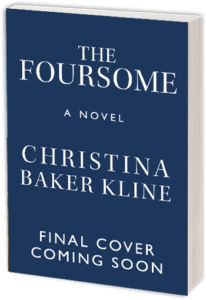
COMING MAY 2026: THE FOURSOME

A literary historical novel set in Civil War-era North Carolina, based on a true family story and told from the perspective of Sarah Bunker, one of two sisters who married Chang and Eng, the famous conjoined twins…learn more

Follow on Substack

Subscribe

Connect with Christina

Contact
  • Facebook
  • Instagram
  • Twitter

Copyright © 2026 Christina Baker Kline · Site design: Ilsa Brink