Sign up for Christina’s Newsletter

Christina Baker Kline

Author Website

  • Books
    • The Foursome
    • Please Don’t Lie
    • The Exiles
    • A Piece of the World
    • Orphan Train
      • Orphan Train Girl: The Young Readers’ Edition of Orphan Train
    • Other Novels
      • Bird in Hand
      • The Way Life Should Be
      • Desire Lines
      • Sweet Water
    • Nonfiction
      • Always Too Soon
      • About Face
      • Child of Mine
      • Room to Grow
      • The Conversation Begins
  • Events
  • NEWS
  • Other Writing
  • About
    • Bio
    • FAQs
    • Contact
    • Photos
  • Newsletter

September 2, 2009 By bakerkline

“Frequently Bought Together”

To be linked even tangentially, even as part of an amazon.com promotion, with Richard Russo and Pat Conroy, two writers whose work and careers I admire (who also happen to be men) makes my day.  No, week.  Okay, it makes my year.  Is that so wrong?

Frequently Bought Together

Bird in Hand + That Old Cape Magic + South of Broad
Price For All Three: $48.53

Show availability and shipping details

  • This item: Bird in Hand by Christina Baker Kline
  • That Old Cape Magic by Richard Russo
  • South of Broad by Pat Conroy

Filed Under: Bird in Hand, The Writing Biz Tagged With: Bird in Hand, Pat Conroy, Richard Russo

August 31, 2009 By bakerkline

Anatomy of a Book Cover: Bird in Hand

Everyone says that you shouldn’t judge a book by its cover, but of course we all do. Presented with an overwhelming array of options, a reader has limited ways to figure out which book on the shelf is worth $20+ – not to mention hours of precious time. The best covers, I think, reveal much about the tenor and style of the book while stimulating the browser’s curiosity.  (Recent covers that spring to mind include Lush Life, by Richard Price; Eat, Pray, Love, by Elizabeth Gilbert; The Story of Edgar Sawtelle, by David Wroblewski; and memoirist and book designer Julie Metz’s cover for her own book, Perfection.)

Some of my own book covers have been more successful than others. “Cover consultation” is a standard part of most writers’ book contracts, which means, essentially, that the publisher presents the writer with one or two options, and if the writer strenuously objects they may be willing to try again. Ultimately, though, the publisher usually makes the final decision, saying – with justification – that they have more experience, understand the market better, and are, after all, in the business of selling books.  With my own covers, I won some and lost some; usually there was some kind of compromise. (You can see the covers here and judge for yourself. Which ones work best?)

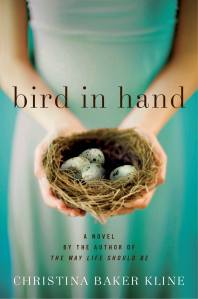
When my editor and I began talking about the cover of Bird in Hand, I didn’t have a specific thought in mind. We’d recently changed the title, and I was still stuck on ideas that had to do with metaphorical representations of a four-way stop.  So without any input from me, they came up with this option:Bird.in.Hand.cover.world

Isn’t this a beautiful image?  The saturated colors are lovely; the typeface is strong but simple, and the picture is arresting. But I felt that it was too, well, female – and perhaps a bit literal (yep, those birds are indeed in her hands).  My editor wrote, “Our sales force likes this jacket very much; they feel that, as a marketing tool, as a way to catch people’s attention and get them to pick it up from tables at bookstores, it’s very effective.” And I completely understood that. But I still didn’t think it was right for this book.  Bird in Hand is about four people with complex and clashing emotions, and I wanted the image to convey unrest.  The sales force disagreed, but my editor was willing to go back to the drawing board. (This image is now the cover of the international edition.)

The next three covers they sent were wrong for all different reasons:

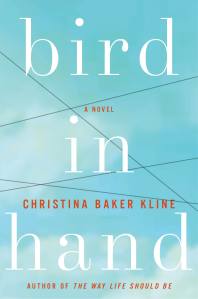
BIH.cover.wireI understood what they were doing here: four characters, four relationships, crossed wires. But as a friend asked, “Is this book about a concentration camp?”  Here’s the next one:BIH.cover.barn

My novel takes place in New York and its suburbs.  To me, this looks like a bucolic Midwestern building in a field.  And then there’s this:BIH.cover.trees

Which I admit is a bit better. The problem, ultimately, was that these covers struck me as generic.  They didn’t convey anything in particular about my novel.

What often happens is that the writer may not have a clear idea of what she wants at first, but being presented with ideas that don’t seem right clarifies her opinion.  (This is, of course, no fun for any art director.)  So after getting all these options, I put some hard work into figuring out what I did want, as opposed to what I didn’t.  Bird in Hand is about the dissolution of a marriage (among other things), so I wanted to picture a domestic scene with something slightly awry.  I envisioned a marital bed in the foreground—but with an unsettling component, something “off.” I imagined a window with a surprising view or an odd picture on the wall.

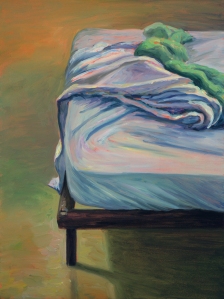
I was inspired by two paintings that hang on the walls in my study:  “Beginning” by Laura Tryon Jennings, a rendering of the room I stay in at my parents’ house in Bass Harbor, Maine, in the summer – and “Rumpled Sheets” by Jessica Dunne, which depicts a bed at the VCCA, the artists’ colony where I met this wonderful artist.  (She did this painting while we were there.)DunneJennings, LT

After discussing all of this with my editor, she went to the art director.  Several weeks later, they came back with this:BIH.final.cover

I knew immediately that this was the one. It retains the color palette and typeface of the first cover but has a whole different feel. I love the bed, with its carefully folded back covers, as if someone got up and out. These sheets clearly aren’t rumpled in passion.  I love the odd little Audubon-like photo-realist picture high on the wall.  (What’s it doing there?) I love the juxtaposition of the soft orange blanket with the cool, shadowed sheets. This cover, to me, has mystery and drama and strangeness, and perfectly conveys the mood of my novel.

But what do you think?  I’d love to know!

Filed Under: Bird in Hand, The Writing Biz Tagged With: "Lush Life", Bird in Hand, Book Cover, creative process, Inspiration, Jessica Dunne, Laura Tryon Jennings, Perfection, The Story of Edgar Sawtelle, VCCA

August 29, 2009 By bakerkline

Guest Blog: Christina Baker Kline on Writing/Life

radio microphoneHow can I be a guest on my own blog, you ask?  Over the past few weeks, with the publication of Bird in Hand, I’ve been busy guest blogging for other sites and doing Q&A’s, radio interviews, and podcasts.  (And more are coming up.)  Now and then, if a particular posting or discussion strikes me as pertinent to issues here, I’ll post it as well. Hence my own guest blog.
This is the first.  (And after this I’ll dispense with the silliness of calling it a guest blog!)

When the poet and novelist Lori A. May interviewed me for her blog – Musings, Reviews, News – she pushed me to talk about the themes of Bird in Hand, why I think achieving balance is an impossible goal, the fluky way I got started as a writer, and my advice to new writers.  Below are edited excerpts from that interview.  (You can read the original, longer version here.)

Bird in Hand is about a car crash that changes the lives of four people.  But what’s it really about?

That’s a good (and hard!) question.  At one point in the book a character wonders, “Who breaks the thread, the one who pulls or the one who hangs on?” I wanted to write about love and loss and betrayal and renewal. I wanted to write about characters who don’t know quite what they want, or how to get it, and are pushed into decisions by circumstances beyond their control.  One of my epigraphs is a quote from The Age of Grief, by Jane Smiley: “Confusion is perfect sight and perfect mystery at the same time.”  This holds true for all of my characters in different ways.

Why do you write both novels and non-fiction?
Writing novels is my passion, but writing is, by definition, a solitary pursuit.  Another side of me wants to be out in the world, interacting with people and exchanging ideas. All of my nonfiction books have been, in a sense, collaborations — I wrote a book about feminist mothers and daughters with my mother; I’ve edited or co-edited four essay collections. I realized the other day that my own blog on writing fulfills this social/intellectual need. I can share my thoughts about writing with other people, and work with guest bloggers on their own ideas. I love doing it.

You are Writer-in-Residence at Fordham, have three kids, and write novels.  How do you balance it all?
I rarely feel that I achieve balance.  What I’ve learned over the years is that sometimes things will be out of balance, and that’s okay. Sometimes I don’t have time to work on my fiction (like now, while I’m in London teaching and working on nonfiction articles and interviews). And sometimes I’m focused on my family and just want to be in the moment with them. I’m not sure whether it’s my nature or whether I’ve learned to do this because I have a complicated life, but I’m pretty good at hunkering down and working on my novel when I need to. When I’m consumed with writing, other parts of my life suffer — laundry piles up, for example, and we do a lot of takeout. My family is pretty understanding; they know it’s all part of the process, and will be over before long. They all have their own passions as well.

Tell us a bit about your journey as an author.
In my senior year of college a visiting novelist took my short stories to her literary agency, and a young agent (Beth Vesel, who is still my agent) called me up and said she wanted to represent me. This gave me confidence at an early age — the idea someone believed in me and cared about my work. Though I know this is pretty unusual, and I was lucky, I always tell my students that what’s most important is that they find someone — a mentor if possible, a friend, even a parent — who believes in their work and encourages them to move forward. After college I went to graduate school in literature and didn’t write a creative word, but this agent called every few months, just checking in: “Are you thinking about your novel yet? How are you going to carve out time to make that happen?” She encouraged me to apply for MFA fellowships so that I’d have two free years to write. And that’s what I did — I went to the University of Virginia, did an MFA in Fiction Writing, and wrote my first novel.

What have been some of the challenges in your writing career?
The biggest challenge for me came after I’d written my second novel and was working on a third. A lot of things changed at once — I moved from New York to the suburbs; I had three children in fairly quick succession; I started a full-time teaching job. As a result, I lost the thread of the novel I was working on and couldn’t figure out how to find it. Eventually I abandoned that novel and wrote another very quickly, The Way Life Should Be, which was lighthearted and funny and had recipes. Writing it was a pleasure! After that, I had the clarity to return to the novel that became Bird in Hand. Though it was a long and difficult process, I learned a lot about myself and my writing in those years. And I think that ultimately Bird in Hand is much stronger for it.

What’s up next for you? What can readers look forward to?
I’m working on a new novel that traces the journey of Vivian Daly, a now-90-year-old woman, from a small village in Ireland to the Lower East Side to the Midwest to the coast of Maine. In 1929, after a fire in a New Y tenement destroys her family, nine-year-old Vivian is sent on an orphan train to Minnesota. Stripped of her identity, she has to learn how to survive on her own. She never tells anyone the whole story of what happened to her — until a 17-year-old troubled girl comes into her life when she is an old woman. As Vivian begins to face the truth about what happened long ago, the past becomes more and more present for her.  This novel (working title: Orphan Train), should be out in 2011.

What advice do you have for writers starting out?
Well, as I said before, find someone who encourages your writing. Avoid people who are “toxic,” to use an old self-help phrase — people who are competitive with you or otherwise sabotage your writing. Set clear goals for yourself (“I will write a draft of a novel in one year,” “I will write one short story a month”) with daily goals as well. When I’m writing a novel I set myself the task of four pages a day. Sometimes I write more, sometimes less, but that’s always the goal.

Filed Under: Bird in Hand, Inspiration Tagged With: Bird in Hand, creative process, fiction writing, Inspiration, Lori A. May, Thoughts, writing a novel

August 18, 2009 By bakerkline

What If: The Fear that Inspired My Novel, Bird in Hand

antigoneWriting and blogging and talking in interviews about my new novel this week, I keep encountering the same question:  What inspired it?   There are many answers to this, of course, and I’ve talked in different places about various sources for the story.  But the deepest reasons are hard to articulate.  So I decided to write about them here.
At first it looked like every mother’s worst nightmare:  Several weeks ago a 36-year-old mother of two, driving her own kids and three nieces home from a camping trip in her Ford Windstar minivan, went the wrong way on the Taconic Parkway and crashed head-on into an SUV carrying three men.  Everyone died except the woman’s five-year-old boy.  At the funeral, mourners wept when the woman’s brother, the father of her nieces, sobbed, “Love your children. Cherish your children. Kiss your children.”

It appeared to be a tragic accident.  This woman entered the highway from an exit ramp, and, apparently disoriented, drove 1.7 miles before the crash.  She’d called her brother from a rest stop an hour before, the papers said, complaining of fatigue and sounding confused.  A police officer speculated that maybe she thought she was in the slow lane on the correct side of the road; others suggested that perhaps she was on prescription drugs that impaired her judgment.  Or maybe she was exhausted from being on a camping trip with all of those children, or distracted by their bickering or crying.

But as it turns out, the woman was drunk.  Not just drunk — she was blind drunk, with twice the legal limit in her bloodstream and fresh alcohol in her stomach.  A bottle of vodka was found in the car and she tested positive for marijuana.

How could this happen?  Specifically, how could this woman ingest alcohol and drugs, knowing that she was responsible for the lives of five children — not to mention any strangers who got in her path?  Why didn’t she pull over?  Her recklessness suggests that she may have been suicidal.  But it’s one thing to take your own life, and quite another to put others at such appalling risk.

And there are other questions:  What did she actually say to her brother at the rest stop?  Did he, or her husband, know she’d been drinking or smoking pot?  Had there been an argument?  Did she have a drinking problem; had she ever done anything like this before?

These questions, prurient as they may be, matter to us because we want to make sense of the unthinkable. And I think they’re particularly resonant for mothers.  This woman’s behavior at the furthest edges of comprehension.  And yet every mother I know has feared her own capacity – through accident or neglect or worse – for doing harm to her child.

When my first child was born I joined a group of new mothers, and we joked with the blackest of humor about exactly these fears.  One woman said that late at night, lying in bed, waking nightmares would come unbidden about the things that she might do wrong: what if, what if, what if. Another read shaken-baby stories obsessively, worried about her own impatience and anger at her colicky child.  Yet another admitted that post-partum depression had once rendered her apathetic and unresponsive, more concerned with her own needs than those of her (neglected) child.  I admitted that I was terrified of getting in a car crash that was my own fault and being responsible for maiming, or killing, my child or – god forbid – someone else’s.

This quiet terror propelled me into writing my new novel, Bird in Hand. I began to tell the story of a woman, a mother, who has several drinks and gets into an accident in which a child dies.  As I started writing, though, I found that it was like staring directly into the sun; I had to squint and turn away. I put the manuscript in a drawer and only came back to it after several years, when my children were older and my own fears had subsided.  And I changed the focus of the novel: the accident became a catalyst for the larger story rather than the story itself.

Writing this book was a way of exploring my deepest fears around this subject.  I wanted to follow my character through her grief and guilt to some place on the other side. In Sophocles’ Oedipus at Colonus, Antigone says, “Now the finish comes, and we know only in all that we have seen and done bewildering mystery.” I wasn’t looking for answers, only for a way to comprehend the mystery.

Like Greek tragedy, the terrible accident last week goes straight to the darkest places within us.  It makes manifest our deepest fears, vividly revealing what the unimaginable looks like.  What if, what if, what if.

Filed Under: Bird in Hand, The Creative Process Tagged With: Bird in Hand, Christina Baker Kline, Christina Baker Kline blog, creative process, fiction writing, Inspiration, Thoughts, writing a novel

August 12, 2009 By bakerkline

Quick Link: Four-Way Stop a Literary Inspiration

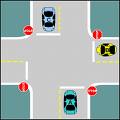
four-way stopBaristanet, a “hyperlocal” citizen-journalism blog in northern New Jersey run by veteran journalists Debbie Galant and Liz George, featured a piece this week on the original inspiration for Bird in Hand, which used to be called Four Way Stop.

Here’s the story — part of it, anyway — of the title change:

When my husband and I moved to Montclair after years of living on the Upper West Side, one of our first purchases was a minivan.  I hadn’t driven in years, much less an unwieldy, seven-seat bus, and I was filled with anxiety.  Traffic can be fast and unforgiving; caught in the maze of unfamiliar roads, I was constantly losing my bearings.  My children’s lives were in my hands – my white-knuckled hands, that is, gripping the steering wheel.

This quiet terror propelled me into writing my new novel, which was called, until recently, Four Way Stop.  Four-way stops had always struck me as quaint, something you might find out in farm country, but I began to see them all over the place in New Jersey.  (In fact, Montclair recently installed them near many schools.)  As traffic situations go, they strike me as oddly ambiguous: they require not only manners and mutual respect to work as they must, but a basic knowledge of the rules.  What happens when someone doesn’t understand – or follow – the rules?

In my novel the central character, Alison, gets into an accident at a four-way stop in which a child dies.  This accident changes the (interconnected) lives of four people.  Somewhere along the way I realized that I was writing this book as a way of exploring my deepest fears around this subject – and that those fears were too close. I put the manuscript in a drawer and only came back to it after several years, when my children were older and my worries had subsided. (For one thing, I’d become a fairly competent driver.) And I broadened the scope of the novel: the accident became a catalyst for the larger story rather than the story itself.  As the book took shape, I replaced the title with one that better fit the emerging story: Bird in Hand.  I’d come to terms with the four-way stop.  It was time to move on.

Filed Under: Bird in Hand, Real Life Tagged With: Baristanet, Baristaville, Bird in Hand, Debbie Galant, four-way stop, Inspiration, Montclair

  • « Previous Page
  • 1
  • 2
  • 3
  • 4
  • 5
  • Next Page »

COMING MAY 2026: THE FOURSOME

A literary historical novel set in Civil War-era North Carolina, based on a true family story and told from the perspective of Sarah Bunker, one of two sisters who married Chang and Eng, the famous conjoined twins…learn more

Follow on Substack

Subscribe

Connect with Christina

Contact
  • Facebook
  • Instagram
  • Twitter

Copyright © 2026 Christina Baker Kline · Site design: Ilsa Brink