Sign up for Christina’s Newsletter

Christina Baker Kline

Author Website

  • Books
    • The Foursome
    • Please Don’t Lie
    • The Exiles
    • A Piece of the World
    • Orphan Train
      • Orphan Train Girl: The Young Readers’ Edition of Orphan Train
    • Other Novels
      • Bird in Hand
      • The Way Life Should Be
      • Desire Lines
      • Sweet Water
    • Nonfiction
      • Always Too Soon
      • About Face
      • Child of Mine
      • Room to Grow
      • The Conversation Begins
  • Events
  • NEWS
  • Other Writing
  • About
    • Bio
    • FAQs
    • Contact
    • Photos
  • Newsletter

September 8, 2009 By bakerkline

Guest Blog: Novelist Yona Zeldis McDonough on Two Pages A Day …

… or What I Learned About Writing from Eating Candy
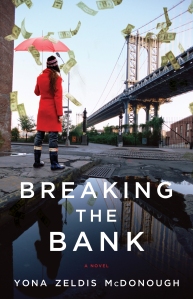
Breaking the bank - 12-22-08A long time ago, before I wrote my first novel, I despaired of ever having the time to undertake such a large and arduous project.  I had two small children and my days (nights too, come to think of it) seemed hopelessly fractured; my time, or what there was of it, felt like it had been broken into the small, useless increments: fifteen minutes here, twenty there.  An hour that was all my own was a rare and prized occurrence.  How I was to cobble together a writing life from all these pieces was inconceivable to me.  I could not work in shards, I thought.  I needed some great and unbroken expanse of time, time like a freshly opened bar of chocolate:  smooth, rich, and mine, mine, mine.  But it was not to be, not then, and maybe not ever.  If I wanted to write, I was going to have to readjust my thinking and my expectations.  Instead of that glorious, unblemished chocolate bar, I had a bag of M & Ms:  discrete nuggets of time that I would have to learn to use.

And I did. While my kids were at school or sports or play dates, I worked on a novel. I did plenty of other things too:  wrote for magazines and the occasional newspaper, did freelance editing, worked on a children’s book.

But my mantra was two pages a day, five days a week. Two pages a day was manageable and doable; two pages was bite sized, like a Raisinette.  And even though it didn’t seem like much, two pages would begin to add up:  to ten pages a week, forty pages a month.  Eventually a novel, which was published in 2002.

My children are older now; one is off to college this fall and the other will be a freshman in high school. Yet the chunks of time are still M & M-sized: small and finite.  It doesn’t matter.  Two pages a day is all I need.

Yona Zeldis McDonough is the author of the novels The Four Temperaments and In Dahlia’s Wake; her third novel, Breaking the Bank, is coming out today from Pocket Books.  Yona has written 18 books for children, the most recent of which are also being published this month: The Doll Shop Downstairs (Viking) and Louisa: The Life of Louisa May Alcott (Henry Holt).  [Ed. note: I think that’s called a hat trick!]  Visit her at www.yonazeldismcdonough.com.
Filed Under: Guest Blogs, Inspiration Tagged With: beginning, creative process, deadlines, Discipline, fiction writing, Inspiration, Thoughts, writing a novel, Yona Zeldis McDonough

September 3, 2009 By bakerkline

Guest Blog: Alexandra Enders on Claiming Authority as a Writer

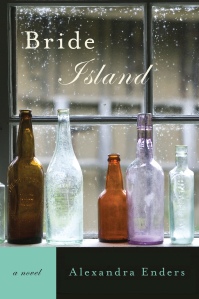
brideislandWhat do you say when someone asks, “And what do you do?”

When someone asks what I do, I say I’m a writer, or sometimes a novelist, but I never say I’m an author. Most writers I know are the same way. It sounds humbler, I suppose, more like what we do instead of what we are. And yet perhaps there’s more to it. To be an author, after all, means to have authority. Doesn’t it?

Years ago, I sat next to a well-respected literary publicist at dinner. When I introduced myself as a “beginning writer,” she gave me a piece of advice: “Act like you’re already the successful writer you intend to become.”  Her words were revolutionary to me—how could I do that, when it was all in my own head?  Then, in 2007, my first novel came out and suddenly I had not only a book but also a new persona as published author.  The hard physical evidence of a book conveys authority unlike anything else, makes it easier to speak to a group of students about writing or answer questions from the audience at a reading—or even tell the person next to you at dinner that you’re a writer.  But as I work on a new novel I’ve come to realize that the struggle for authority is not only a question of publication, but is in fact present every time we sit down to write.  Each act of writing is an act of self assertion.

There’s a famous story of Toni Morrison telling an audience of writers, “If any of you feel you need permission to write, I’m giving it to you.” The problem is this permission, this authorization, isn’t something you receive once; it must be claimed over and over. Writing is such a strange thing to do, sitting alone in a room, making stuff up. There are no guarantees, of any kind. And no matter what you’ve already accomplished, with each new project you must start afresh. We need authority when we begin to write, but we also need it to continue to write when we get stuck or lose our way or our confidence.

Recently I found a group of my old stories.  Well, the beginnings of them. Each story ended abruptly about a page and a half in. I was surprised, not because they were well written (though they were fine) or because they were compelling (though I did want to know what came next), but because each had a distinct tone of authority. These stories had the right to be told. But they were truncated, I knew, because of my lack of confidence, my insecurity about my status as an author. I didn’t feel authorized to tell them. As a young and inexperienced writer, I sometimes confused the act of writing—the hard, uncertain work of inventing—with the ease of reading. I thought stories should just come.  Now I know better, and I know the process better.

The motto for my MFA program was, “I will try.” My friend and I cracked up when we discovered the words written in gold on the back of a Windsor chair in the lounge one night. How unassuming, how un-ambitious, how, well, pathetic, we thought. And yet. It’s not a bad motto for a writer. Authority isn’t always about force or might or conviction. It’s also about faith, in the process and in oneself. It’s about doing what feels uncomfortable, acting as if you’re confident when you’re not, continuing the scene or story or novel even when you’d rather read someone else’s beautiful, seamless, apparently effortless (and already published) book.

Alexandra Enders worked as a magazine editor and writer before getting an MFA in Writing from Vermont College.  She has published stories in iBOMB, Hunger Mountain, and Critical Quarterly, and is the author of the novel Bride Island.  She lives with her husband, daughter, and dachshund in New York.  Visit her at her website www.alexandraenders.com.

Filed Under: Guest Blogs, Real Life Tagged With: Alexandra Enders, Bride Island, fiction writing, identity, Real Life, Thoughts, writing a novel

August 20, 2009 By bakerkline

Guest Post: Chad Taylor on Why Writers Should Care about Twitter

Tips on Networking 140 Characters at a Time, From the Guy Who Brought Me Pizza Oncetwitter_logo

(Not really.  I began following Chad Taylor on Twitter after reading his witty repartee with writer Susan Orlean.  Awed by his ability to be insightful, pithy, and clever within Twitter’s haiku-like restraints, I invited him to write a post revealing the secret of his success.)

I’m not a writer.

Well, using this blog as Exhibit A, a pretty strong case could be made to the contrary.  It’s true: I do write and it could even be argued that I don’t write badly.  But I’ve never published.  Nothing with a by-line or anything, at least.  I’m working on a book (who isn’t these days, right?) but I haven’t actually added anything meaningful to it in almost a month.  So, seriously, the guy who makes a living delivering pizzas is the last person who should be writing a guest blog trying to tell you anything about being a writer.  This irony is not lost on me.

What I am qualified to talk about, however, is why writers should use networking sites like Twitter, how they should use it to maximize its potential for them and what average Joes like me look for when we’re searching out new people to follow (read: new writers to read).

Everyone—or, everyone who isn’t delusional with self interest, that is—feels a little silly using Twitter at first because you’re walking the fine line between inundating your followers with every tiny detail of your lives (Carlos Mencia, I’m looking in your direction), or deciding that nothing you have to say is quite important enough, and not doing it at all.  But there are some easy guidelines.

First: Don’t resort to license plate shorthand or drastic measures like eliminating pronouns just to make a thought fit into 140 characters. In my own Twitter feed, I’ll often take an extra minute or two to restructure and re-write an update in a way that fits, rather than resort to a single “2” or “u.”  Iowa Senator Chuck Grassley‘s approval rating (perhaps coincidentally, perhaps not) dropped 15 points since the beginning of the year, which is about the same time that he started Twittering things like:

“We in congress hv been agitating china for Tibet for decades Right! We need to b just as agitated abt Chinese treatnent of Uighurs NOW” (8/9/09)

and

“Saw Glenn Beck on Fox last and got his pt abt govt and the missing airplane engine but I need explanation photograghic dishonestyWhere engin” (8/2/09)

and

“Plsnt conv. w sotomyr. 1 hr mtg. Look frwd 2 hrg and mre details abt recrd.” (6/8/09)

Great for the “unintentional hilarity” file; not so great for much of anything else.  Which brings us to the first reason that Twitter is good for the writer:  Twitter forces us to think and write succinctly.  In his book On Writing, Stephen King likes to say that a 2nd Draft = a 1st Draft – 10%, which is a quasi-mathematical way of saying that every idea can lose a little weight.  There are few real-world situations where a writer can hone the skill of economical communication and make professional and personal connections at the same time.  Hello, Twitter.  Compare the Senator’s updates above with San Francisco monologuist Josh Kornbluth: “I am feeling overwhelmed by the prospect of being away from my family – trying to breathe, listen to music, avoid pull of narcoleptic bed.” (8/6/09)

Or (is this even allowed?) from my own Twitter feed: “Putting coupons on doors. They could literally train a monkey to do this job, but don’t because a trained monkey would cost more.” (8/12/09)

Another tip for effective Twittering (I refuse to call the updates ‘tweets’) is to remember that people are following you not only because you’re (ideally) funny and interesting, but because you’re you. The good thing about Twitter from a follower’s point of view is that it’s a way for people who might otherwise never come in contact with you to get to know more about you.  The good thing from the Twitterer’s standpoint is that you have control over how deep that access goes.  The more you allow your followers to see, the more successful you’ll be.  Giving the people following you insight into your thought process; taking a self-deprecating look at minor faults; even just venting personal frustration all open you up to readers and allow them to connect more intimately than a dust jacket bio or blog interview could.

Great examples of this can be seen from New York based memoirist Janice Earlbaum: “FINALLY finished a long-overdue freelance piece; doing a smug little happy dance in my chair. Lunchtime!” (6/5/09)

The New Yorker’s Susan Orlean: “Spent last night talking to a nice editor of HuffPost, thinking she worked for Daily Beast & gossiping accordingly. She looked…puzzled.”

And MSNBC’s Rachel Maddow: “I think I might be the only Real Time with Bil Maher guest to have ever brought mom and dad as entourage to the backstage party.” (8/1/09)

Which, finally, brings us to the second big reason a writer should want to use Twitter: if applied properly, the networking possibilities are enormous. For beginning writers, Twitter can introduce you publishers, editors, other writers, fans, potential readers, reviewers…you see what I’m getting at.  For established writers, Twitter is an additional medium to advertise a new novel being released or, as in the case of our gracious host, to link to your own blog or website.  Each person who finds your Twitter feed is potentially a new set of eyes to look over a draft of that manuscript.  Or someone who knows someone at Harper Collins.  Or someone who might wind up loving your last novel and now can’t wait for the next one.  There’s work involved (when isn’t there?) but by following the right people and—more importantly—getting the right people to follow you, Twitter can be a powerful addition to your networking repertoire.  For an excellent example of this, look no further than this very page: this blog post is a result of a connection made over Twitter.

Chad Taylor (33, Capricorn)  has spent time as a pizza delivery guy, security officer, telephone salesperson and itinerant malcontent.  He is widely viewed as one of the great underappreciated writers of our time (citation needed) and is a frequent contributer to both his Facebook status bar and ESPN.com’s “user comments” section.  Voted “Great Catch” by his mother for 22 non-consecutive years.

Filed Under: Guest Blogs, The Writing Biz Tagged With: Chad Taylor, commercial, HarperCollins, networking, On Writing, Stephen King, Susan Orlean, Tweets, Twitter

August 17, 2009 By bakerkline

Guest Blog: New York Times Bestselling Author …

Pamela Redmond Satran on Making “The List”:

HowNotActOldBookWhen Christina asked me to write a guest blog about how it feels to be on the New York Times Bestseller List — my new humor book, How Not To Act Old, is #7 on the Paperback How To, Advice, and Miscellaneous for August 23 – all I could think was: I better write this fast.
Although I am determined not to be one of those people who complains about her success -“My book tour was so exhausting, and why was I #7 instead of #1?” – I have to admit that the experience of landing on The List for the first time in 17 books (or maybe 18 or 19; I really have lost track) is not total finger-snapping and blue skies.

Maybe that’s because I’m not really sure what this amounts to. Is it an extremely nice accolade that I will forevermore be entitled to couple with my name: New York Times Bestselling Author, kind of like Duchess, or Oscar winner? Or it is the first step – okay, the eighth or twenty-ninth – in the trajectory of the kind of book that changes not just your career, but your life?

I’m trying to stay in the moment here, but I can’t help looking at my company on the Bestseller List – at the skinny bitches and the guys who hope they serve beer in hell – and think: Jesus, those people cashed in. Their books are famous, they made wheelbarrows full of money, and maybe that will happen to me.

And then I have to go throw some salt over my shoulder, knock on some wood, and kiss the fang of a sabertooth tiger – whatever it takes to ward off the juju you attract by daring to think something good might really happen.

On the other hand, isn’t this one of those moments I should seize by being smart about my career, figuring out how to build on this success by doing the right book proposal, taking the right chances, making the most of this amazing piece of luck?

I’ve heard other people who made The List say it was the result of concerted effort over a long time by a lot of people, but I wouldn’t say that was true for me. The editor who bought my book and indeed my whole publishing division was disappeared mere months before my book came out. There was a protracted struggle over the cover of the book (I won), which made me question whether my publisher even understood the property and the market. I was assigned to a publicist who was on maternity leave until just a few months before the pub date, missing the deadline for all the long-lead magazines.

But the publicist turned out to be well worth the wait, the best I have ever worked with. I made a key first-serial sale myself, to the amazing Lesley Jane Seymour and Judy Coyne at More Magazine, the perfect venue for the book. Attention for the blog that launched the book – HowNotToActOld.com – sparked online sales that helped catapult the book onto the bestseller list right out of the gate.

And so now I have three more full days to enjoy having a book on the New York Times Bestseller List. And even if How Not To Act Old falls off the list on Wednesday evening, when the new roster is announced, it will still show up on the Bestseller List that’s in the actual newspaper next Sunday, which will give it a whole new boost and fresh visibility among thousands of book lovers and potential readers.

Ultimately I feel proud that this project, which I started because no one was interested in the magazine article, which I sold for a low advance to the only publisher who bid on it, which was orphaned and battered before rising to these heights, has achieved one of the most impressive commercial feats possible for a book. I plan to take full advantage of that feeling, for as long as it lasts.

Pamela Redmond Satran is the author of 18 books, including five novels (Younger, The Man I Should Have Married) and ten bestselling baby-naming books (Beyond Jennifer & Jason, Cool Names for Babies) coauthored with Linda Rosenkrantz.  She and Linda are also the developers of baby-naming site nameberry.  Pam cowrites The Glamour List, writes for The Daily Beast and The Huffington Post, and is the author of a book called 1000 Ways To Be A Slightly Better Woman. And, oh yes, she runs an 800-member social networking group called MEWS.

Filed Under: Guest Blogs, Real Life Tagged With: bestseller list, How Not to Act Old, humor, More magazine, New York TImes, New York Times Bestseller, Pamela Redmond Satran

August 6, 2009 By bakerkline

Guest Blog: Debra Galant on Being Between Novels

Exploring the Process of Coming up with the Next Big Idea

I am between novels. I’ve been between novels for close to seven months now, which is typical for me. I am a slow germinator. I’m not devoid of ideas – that’s not the problem – I’m just devoid of an idea that I think I want to spend several thousand hours wrestling with. Having written three novels, I know exactly what the commitment is.

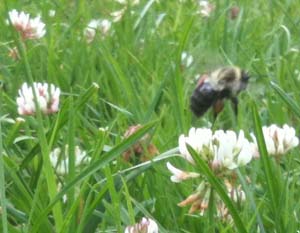
bumblebeeThis is what happens when I’m between novels.
The first few months, I don’t even try to get the Big Idea. I revel in the things that I’ve given up during the writing of my previous novel. I read prodigiously. I start diets and gym regimens. I fantasize about cleaning the entire house and settle for a closet. I go through entire weekends without feeling guilty. I enjoy being a civilian.

Once I get that out of my system, I start to wonder if I’ll ever write another novel. Fueled by anxiety, ideas begin to percolate. They appear in dreams. They’re triggered by odd encounters with strangers or obits and other chance juxtapositions.

I chase them breathlessly, bringing candy and flowers. Sometimes I’ll even get to know them, start thinking about introducing them to my family. Finally, a few days or a few weeks into my infatuation, I begin to discover their flaws. The voice is wrong or the subject is wrong or perhaps the idea is good but the project is beyond my power to execute. I retreat sheepishly.

I was actually 13 pages into one idea before I decided that I had no business creating a protagonist who was a Puerto Rican man in his 20’s. But first I had to agonize about whether I was being wise or lazy in deciding to give up the project. It was like a breakup. I asked various people for their opinions – my husband tried to convince me to stick with the idea – until my therapist mercifully gave me permission to stop.

We decided – my therapist and I – to go back to the idea-chasing stage with a little less desperation.

I picked up two of my favorite books about writing, Jane Smiley’s Thirteen Ways of Looking at a Novel and Annie Dillard’s The Writing Life, and allowed myself to fall in love again with the idea of being a writer. I also decided to embrace the pace of summer. I bicycled to the park with Smiley’s book and a notebook. The brilliance of the sun brought me back to the summer of ’79, when I was a cub reporter in North Carolina. I scribbled some notes. And then, just because I could, I used the video camera on my iPhone to record a bumblebee parachuting from clover to clover.

My mother used to worry about my bookish ways. “All work and no play makes Debbie a dull girl,” she would say. Julia Cameron, in How to Avoid Making Art (Or Anything Else You Enjoy),  says the same thing: “For most people creativity is a serious business. They forget the telling phrase ‘the play of ideas’ and think that they need to knuckle down and work more. Often, the reverse is true. They need to play.”

Novelists are good worker bees. Writing a manuscript of 80,000 or 100,000 words requires it. But maybe before a worker bee can make honey, she must first drift lazily from clover to clover, sucking the sweet nectar and getting drunk on the fullness of summer.

Debra Galant has written three novels. The first two, Rattled and Fear and Yoga in New Jersey, are comic novels about suburban life in New Jersey. Her forthcoming Cars from a Marriage, coming out next year from St. Martin‘s, follows a 20-year marriage through a series of car trips told by both the husband and the wife. In addition to writing novels, Galant is a new media pioneer. Baristanet, which she founded in 2004, was named the best placeblog in America in 2007.

//

Filed Under: Guest Blogs, Real Life Tagged With: Annie Dillard, beginning, best-laid plans, creative process, Debra Galant, fiction writing, Inspiration, Jane Smiley, Julia Cameron, Thoughts, writing a novel

  • « Previous Page
  • 1
  • …
  • 6
  • 7
  • 8
  • 9
  • 10
  • Next Page »

COMING MAY 2026: THE FOURSOME

A literary historical novel set in Civil War-era North Carolina, based on a true family story and told from the perspective of Sarah Bunker, one of two sisters who married Chang and Eng, the famous conjoined twins…learn more

Follow on Substack

Subscribe

Connect with Christina

Contact
  • Facebook
  • Instagram
  • Twitter

Copyright © 2026 Christina Baker Kline · Site design: Ilsa Brink