Sign up for Christina’s Newsletter

Christina Baker Kline

Author Website

  • Books
    • Please Don’t Lie
    • The Foursome
    • The Exiles
    • A Piece of the World
    • Orphan Train
      • Orphan Train Girl: The Young Readers’ Edition of Orphan Train
    • Other Novels
      • Bird in Hand
      • The Way Life Should Be
      • Desire Lines
      • Sweet Water
    • Nonfiction
      • Always Too Soon
      • About Face
      • Child of Mine
      • Room to Grow
      • The Conversation Begins
  • Events
  • NEWS
  • Other Writing
  • About
    • Bio
    • FAQs
    • Contact
    • Photos
  • Newsletter

June 5, 2009 By bakerkline

Deny the Accident

Jackson Pollock once said,pollock.untitled#3 in answer to an interviewer’s question about how he composed his paintings out of “accidental” splatterings, “I don’t use the accident.  I deny the accident.”

The sheer bravado of this is thrilling, and as a writer I find it a useful way to think about my work-in-progress.  When I’m putting words on the page it’s easy to second guess, to question the often unconscious choices I make as I go: the trajectories of characters’ lives, shifts in direction and focus, minor characters who gain traction as the story moves forward.  The editor in my head starts whispering: You’re going in the wrong direction.  Why are you spending so much time on that character?  You need to focus, get back to the story you originally envisioned, stick to the plan.

Over time I’ve learned to trust my impulses.  Whatever else they may be, these unanticipated detours are fresh and surprising; they keep me interested, and often end up adding depth to the work.  Not always, of course – sometimes an accident is just an accident.  But believing that these splatterings on my own canvas are there for a reason, as part of a larger process of creation, gives me the audacity to experiment.

Filed Under: Inspiration, The Creative Process Tagged With: artist, creative process, Inspiration, Jackson Pollock, Writing

June 2, 2009 By bakerkline

The Artist’s Eye

Recently, in an impulsive moment, I offered to do the flower arrangements for a big party for a close friend. Other than cutting off the ends of the stems when you bring them home and avoiding spray-painted carnations, I don’t know much about flowers, but I figured how hard can it be?

Then the teak boxes, glass vases, hard green floral foam, clear glass marbles, and mountains of Gerber daisies, long-stemmed roses, and greenery arrived. LizMurphyflowers

I called my friend Liz in a panic. Liz is an artist not only by profession – she is a painter and illustrator – but in every aspect of her life. I knew she’d be able to help. Sure enough, she quickly made sense of the chaos in my kitchen. She soaked the floral foam in water, crushed the ends of the roses (with a hammer; who knew?), artfully trimmed the spiky leaves. She filled the teak boxes in a way that looked both sophisticated and natural, as if the flowers had arranged themselves. When I professed amazement at her artistry, she looked up from her work with genuine puzzlement. “What do you mean? Anybody can do this. It’s not brain surgery.”

Well, yes, Liz, actually it is. If you don’t have an intuitive visual artistic sense, arranging flowers can seem as daunting as cutting into someone’s cranium with a scalpel.

We all have areas of proficiency we take for granted. Liz makes arranging gorgeous bouquets look easy because she has a natural inclination for it, takes genuine pleasure in it, and has honed her artistic vision with years of practice.  Recognizing and nurturing your natural creative inclinations is, I think, an important step in the process of taking yourself seriously as an artist (or musician or poet or novelist).  I write fiction because I love it. I love it because it allows me to express what seems inexpressible, to weave stories that reveal larger truths about the way people relate to each other. This desire colors everything; it is the way I see the world.

Needless to say, the flowers were a hit. I tried to give my Cyrano credit when possible, but sometimes simply smiled and nodded and reaped the praise. What I was really taking credit for, of course, was my own genius in recognizing my limitations.

Filed Under: Inspiration, The Creative Process Tagged With: artist, creative process, fiction writing, flower arranging, Liz Murphy, writing a novel

May 31, 2009 By bakerkline

The Daily Battle

In the morning, when I sit down to write, I think of this depiction of the creative process from the novel The Waves by Virginia Woolf :

freefoto.com

“I took my mind, my being, the old dejected, almost inanimate object, and lashed it about among these odds and ends, sticks and straws….  It is the effort and the struggle, it is the perpetual warfare, it is the shattering and piecing together — this is the daily battle….  The trees, scattered, put on order; the thick green of the leaves thinned itself into a dancing light.”

Filed Under: Inspiration, The Creative Process Tagged With: creative process, The Waves, Virginia Woolf, writing a novel

May 27, 2009 By bakerkline

If You Don’t Put it In …

I’m curious about how literary writers whose work is also commercial balance two often conflicting objectives:  telling a good story and exploring setting, theme, and character. One day this wee1118759_32303519k I was privileged to spend time with two terrific novelists, Alison Larkin and Marina Budhos, who had very different and equally useful takes on this question.

Alison told me that she reads the thriller writer Harlan Coben for plot. Coben is a master of building and maintaining suspense, she said; you can’t help turning the pages. Paying attention to how he withholds and reveals information has been instructive for her. Marina said that, for her, “a first draft is all about exploration, but at a certain point that exploration has to stop.” She talked about the challenges of revision: taking a first draft and pulling the threads of plot and character all the way through, while at the same time ruthlessly cutting and repositioning the prose so the story has immediacy and urgency. In a first draft, then, the writer should feel free to experiment and digress – and I would argue that the literary writer must do so, to remain open to the unanticipated byways of the creative process – but in a second draft the writer has to remember that the prose exists solely in service to the story.  As the writer Honor Moore says, “If you don’t put it in, you can’t take it out.”

Filed Under: Inspiration, The Creative Process Tagged With: Alison Larkin, Christina Baker Kline blog, commercial, Harlan Coben, Honor Moore, literary, Marina Budhos, revising, Writing

May 24, 2009 By bakerkline

Memorial Day

DSCN7684When you’re working on a novel, not writing is part of the writing process.  At least that’s what I told myself today.  It was a gorgeously mild and sunny day — Memorial Day; the park across the street from our house was filled with people biking, strolling, and listening to a military band that played for hours.  (The music wafted across the pond: muted patriotism.)  The kids were home from school, milling aimlessly around the house, and eventually I abandoned all thought of work and took them to a lake for the afternoon, where I sat in an Adirondack chair and read Anna Karenina.
Tolstoy’s exacting descriptions — his careful parsing of behaviors and attitudes, woven gracefully into the narrative — made me think of my own character, a 90-year-old woman with complicated responses to and relationships with everyone around her.  From Tolstoy I am learning (re-learning; I read this novel once before, in my early twenties) how to give an omniscient narrator immediacy and warmth.  And I wonder about the perspective I’m employing in my own novel-in-progress, alternating first-person and third-person limited chapters.  Perhaps the third-person perspective should be broader?  That would allow me to bring in other points of view — one in particular that I haven’t been sure how to convey.  I’ll be thinking hard about this question of perspective in the coming weeks.

Filed Under: Inspiration, Real Life Tagged With: Anna Karenina, Christina Baker Kline blog, Family, Memorial Day, Tolstoy, Writing

  • « Previous Page
  • 1
  • …
  • 5
  • 6
  • 7

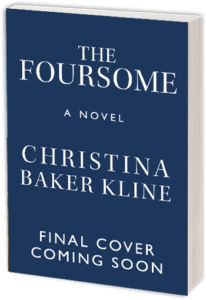
COMING MAY 2026: THE FOURSOME

A literary historical novel set in Civil War-era North Carolina, based on a true family story and told from the perspective of Sarah Bunker, one of two sisters who married Chang and Eng, the famous conjoined twins…learn more

Follow on Substack

Subscribe

Connect with Christina

Contact
  • Facebook
  • Instagram
  • Twitter

Copyright © 2025 Christina Baker Kline · Site design: Ilsa Brink