Sign up for Christina’s Newsletter

Christina Baker Kline

Author Website

  • Books
    • The Foursome
    • Please Don’t Lie
    • The Exiles
    • A Piece of the World
    • Orphan Train
      • Orphan Train Girl: The Young Readers’ Edition of Orphan Train
    • Other Novels
      • Bird in Hand
      • The Way Life Should Be
      • Desire Lines
      • Sweet Water
    • Nonfiction
      • Always Too Soon
      • About Face
      • Child of Mine
      • Room to Grow
      • The Conversation Begins
  • Events
  • NEWS
  • Other Writing
  • About
    • Bio
    • FAQs
    • Contact
    • Photos
  • Newsletter

July 7, 2009 By bakerkline

Guest Blog: Julie Metz – Some Thoughts on Memoir and Fiction

Metz, PERFECTIONThe memoirist Julie Metz, who is now working on a novel, writes:

When I wrote my memoir, Perfection, the story of my discovery of my husband’s secret life only after his sudden death, my focus was on careful recall aided by journals and letters.  And yet, since I love reading fiction, I wanted my memoir to “read” like a novel.  After many failed attempts, I found a structure for the factual narrative that allowed me to recapture my own state of mind at the moment of my husband’s death and the early months of widowhood.  The primary inspiration for my book was the fictional memoir Jane Eyre, in which an innocent narrator’s life is changed by a devastating revelation.

During this last year, while Perfection was in the final stages of publication, I began working on a new project, a novel.  I am finding it to be a very different process.  I began with a snippet of a story I’d been kicking around in my head for years, but as I got into the project in a deep way, the original story fell away as the characters became more vivid. Very little remains of the original idea except for locations and some back story.  The day I realized I had to quit forcing my original idea into the book was both sad and liberating. My attempts to direct the plot were those of a classroom bully who tries to force other kids to play by his or her rules. No one wants to play with a bully.

Now that I spend my days conjuring rather than exclusively researching my past, I frequently think of Anne Lamott’s advice in Bird by Bird: to focus not on plot but on character. I try to sit with my (mostly) made up characters and hope that if I am quiet and patient I will get to know them as well as the real people in my life, and that they will tell me what they need to do and say.

Julie Metz is a graphic designer (she co-designed the cover of her memoir), artist, and freelance writer whose work has appeared in publications including The New York Times, Glamour, and Publisher’s Weekly. Perfection: A Memoir of Betrayal and Renewal, is her first book.

Filed Under: Guest Blogs, The Creative Process Tagged With: Anne Lamott, beginning, Bird by Bird, creative process, fiction writing, Inspiration, Jane Eyre, Julie Metz, memoir, Perfection, plot, Thoughts, writing a novel

July 6, 2009 By bakerkline

Making Conversation

Dialogue is hard to get right.  It has to sound like natural speech, when in fact it’s nothing like it.

I like to send my creative-writing students out to cafes and parks with notebooks to transcribe bits of overheard conversations.  Then I ask them to type up these transcripts and turn them into dialogue between characters.hopper 1

Inevitably their written dialogue little resembles the overheard conversations.  When you write dialogue, you have to eliminate niceties and unnecessary patter and cut to the core of the exchange — unless the patter is crucial to the story, conveying a dissembling, depressed, incoherent, or boring personality.  (The writer George Garrett called this “dovetailing.”)  At the same time, it has to sound natural, like something someone would really say.

Richard Price, in his recent novel Lush Life, allows his characters to talk and talk and talk. Price maintains a delicate balancing act; his characters’ words matter.  What they say changes the direction of the story.  But he never burdens his dialogue with exposition or forces it to convey plot points that don’t come up naturally.  In Writing Fiction, Janet Burroway says, “In order to engage us emotionally in a disagreement, the characters must have an emotional stake in the outcome.”  Price’s characters are nothing if not emotionally invested.

Price’s dialogue is vital to the story because it moves the action forward.  He constantly puts his characters in conflict with each other.  Their conversations are full of surprises – self-revelation, inadvertent admissions, hearsay, evidence.  But it sounds real: his characters’ speech has kinetic energy; it crackles with life. Real life.

Filed Under: Inspiration Tagged With: "Lush Life", creative process, dialogue, fiction writing, George Garrett, Inspiration, Janet Burroway, Richard Price, writing a novel

July 2, 2009 By bakerkline

Short Chapters

Anna Karenina is more than 800 pages long. So why does it feel shorter than many 300-page books?

Anna KareninaAs I read this novel recently I noticed that Tolstoy cuts his long scenes into short chapters, usually no more than two or three pages. He often ends a chapter in a moment of suspense – a door opens, a provocative question is asked, a contentious group sits down to dinner, characters who’ve been circling each other finally begin to talk – which propels the reader forward into the next chapter.

The psychological effect of these short chapters is that this huge book is fairly easy to get through. Reading in bed late at night (as I tend to do), I’d be tempted to put it down, but then I’d riffle ahead to find that the next chapter was only three pages long.

Three pages – I can do that. And I really want to find out who’s behind that door …

Filed Under: Inspiration Tagged With: Anna Karenina, creative process, fiction writing, literary, plot, short chapters, Thoughts, writing a novel

July 2, 2009 By bakerkline

Guest Blog: Pamela Redmond Satran on Naming Characters

Novelist and naming expert Pam Satran writes:

There’s a character named Billie in the novel I’ve been working on since the invasion of Iraq.  But Billie wasn’t always in the book: Until this spring, she was Lily.

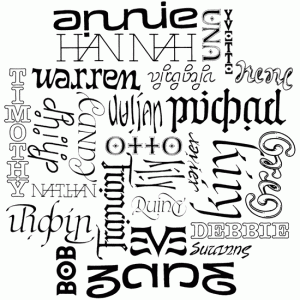
Well, she wasn’t really Lily, but the character who played her role in the plot was named Lily until the most recent draft.  Lily was older – 23 to Billie’s 19 – a college graduate already living on her own in New York.  Billie rides cross country with a stranger, her backpack full of her father’s ashes and a handgun.26names

I changed my character’s name (and persona) after reading Kate Atkinson’s When Will There Be Good News? Sixteen-year-old Reggie is alone in the world, yet winning and resourceful.  I admired the way Atkinson wrote from Reggie’s point of view – third person, but intimate – and decided I wanted my character, Lily, to be more like Reggie.

To be, in other words, Billie.

I’m still not certain Billie is the right name for her.  It feels a little obviously like the name of a scrappy tomboy, which is exactly what Billie is.  Maybe it would be more interesting if her name were something ultra-feminine, like Seraphina?  Plus one of my other main characters, whom Billie spends a lot of time with, also has a name that starts with a B, Bridget, and that name is carved in stone.  As a reader, I hate it when character’s names or physical descriptions, even their hair colors, are too similar.

As the author of ten name books, I should have an easier time of naming my characters. But it’s just like naming children: No matter how much expertise you have, no matter how much thought you’ve put into it, it can still be difficult to settle on the perfect name for someone you love and cherish.

It’s easy for me to give certain kinds of name advice to fellow novelists.  A girl born in the 1950s with sisters named Joanne and Debbie would more likely be Carolyn than Caroline, I recently told one friend, pointing to the popularity charts on my site Nameberry.  Caroline was rarely used outside of the upper classes before the Kennedys popularized it in the early 1960s.  Another character, born in the 1930s, might have been Lillian or Louise, but certainly not LeeAnn.

Yet I feel less certain about my own poor Billie. I’m going to take one more swing through the book, looking closely at that character, still wobbly.  I hope that once Billie’s inner workings and story feel more solid to me, so will my decision about her name.

Pamela Redmond Satran is the author of five novels and ten bestselling baby name books, including Beyond Ava & Aiden.  Her blog How Not to Act Old is becoming a book in August.

Filed Under: Guest Blogs, Inspiration Tagged With: character, creative process, fiction writing, How Not to Act Old, Inspiration, Kate Atkinson, Nameberry, naming characters, Pamela Redmond Satran, Thoughts, writing a novel

July 1, 2009 By bakerkline

More Monkey Business

A writer friend, Cindy Handler, asks: “A few posts back [Writing Tip #3: Use a Monkeywrench] you mentioned that you like to give your characters a trait that goes counter to their basic nature and makes it harder for them to get what they want (if I understand correctly).  Could you give an example?  The main character in my novel is so controlling that it works both for and against her, but I don’t think that’s the same thing.”monkey-reading book

So here’s an example.  In my novel-in-progress there’s a 17-year-old tattooed, pierced, tough kid named Michelle who’s in trouble for stealing.  But she steals books.  She loves to read; libraries became a refuge when her home life was in chaos. And her love of reading gives me access to a more interesting inner life for her.

I don’t mean, necessarily, that this kind of contradiction makes it harder for characters to get what they want, only that by working against type I can deepen and expand who they are.  I find, especially at the beginning, that the more complexity I add, the more my characters surprise and intrigue me and the more I have to say about them.

Cindy adds, “And the more real it makes them seem, because real people are full of contradictions.”

Filed Under: Writing Tips Tagged With: beginning, Books, character, characterization, Cindy Handler, creative process, fiction writing, writing a novel

  • « Previous Page
  • 1
  • …
  • 12
  • 13
  • 14
  • 15
  • 16
  • Next Page »

COMING MAY 2026: THE FOURSOME

A literary historical novel set in Civil War-era North Carolina, based on a true family story and told from the perspective of Sarah Bunker, one of two sisters who married Chang and Eng, the famous conjoined twins…learn more

Follow on Substack

Subscribe

Connect with Christina

Contact
  • Facebook
  • Instagram
  • Twitter

Copyright © 2026 Christina Baker Kline · Site design: Ilsa Brink