Sign up for Christina’s Newsletter

Christina Baker Kline

Author Website

  • Books
    • The Foursome
    • Please Don’t Lie
    • The Exiles
    • A Piece of the World
    • Orphan Train
      • Orphan Train Girl: The Young Readers’ Edition of Orphan Train
    • Other Novels
      • Bird in Hand
      • The Way Life Should Be
      • Desire Lines
      • Sweet Water
    • Nonfiction
      • Always Too Soon
      • About Face
      • Child of Mine
      • Room to Grow
      • The Conversation Begins
  • Events
  • NEWS
  • Other Writing
  • About
    • Bio
    • FAQs
    • Contact
    • Photos
  • Newsletter

January 25, 2010 By bakerkline

“People Don’t Do Such Things!”

The writer Bonnie Friedman considers what it means to create ‘realistic’ fictional characters:

“People don’t do such things!” is the last line of Ibsen’s Hedda Gabler — words cried out by the scandalized judge after Hedda has shot herself off-stage.  His words echo in our ears as the curtain rings down and as the actors gradually emerge to take their bows, and as we shuffle out onto the street and back into our lives.

People don’t do such things! Well, if the blowhard who exclaims these words had actually believed it possible that the stymied Hedda might do what she threatens, maddened by the asphyxiating, conformity-bound society in which she lived . . . all might have ended differently.

Do people do such things? I’ve often wondered, reading about heroically outspoken or shockingly rude or tin-eared or laughably selfish or otherwise outrageous people in fiction. Yes, they’re great for the story, but do people in real life actually do such things?  I’ve often wondered about this because I wanted to write characters who confronted one another, who weren’t as nice as I was, who weren’t as cowed by convention, who had an edge, had bite – and yet it was hard for me to actually perceive such people in my life.  And I couldn’t write them if I didn’t believe in them.  I wanted to write realistic fiction.  Why couldn’t I perceive such people if they did exist?

One thing I’ve found about writing is that if you ask a question, the answers appear.  The main thing is to formulate the question.  Life starts supplying the answers.

In this case, I immediately heard a doctor say to a nurse, “You dress like a clown.  Don’t come to work dressed like that!”  I grabbed my notebook and scrawled his words.  I was sitting in a clinic in Iowa City.  I don’t recall what was wrong with me.  But I do recall thinking: “Oh, my gosh!  People actually do say such things.”  How could that doctor be so mean? How could he be so ridiculing?  What did he mean, “dress like a clown”?  Surely the nurse didn’t have a red rubber nose on (although in fact I pictured that she did).  Both were down the hall and my door was open.  A moment later the doctor appeared to treat me; he was a brusque, starchy person with a peremptory manner.  All these years – twenty years – later, I recall him.

And just yesterday I wrote in my notebook something else I wanted to remember because it, too, was so strange that my sense of reality wanted to subsume it, to deny it.  A man and his date slid into seats my husband and I were about to sit down in.  “Why don’t you see if you can move somebody else over?” said the man when I protested. Rather than argue, my husband and I raced to find other available seats, which were vanishing fast.  “What exactly were his words?” I asked my husband a moment later, and I wrote them.  This man was a handsome-ish man who’d stood near us in line, and had given away the whole end of “Up in the Air.”  Fortunately he’d said loudly, before doing this: “Did you expect that ending?” and I’d flung my fingers into my ears.   But the man talked on and on about the ending, while I pressed my fingers hard in my ears and hummed.  Now I thought: sociopathic people do exist!  And they are sometimes handsome, and obdurately oblivious or purposely uncaring of others, and they are real, and sometimes even steal your seat.

Such people exist in my blind spot.  As do many other people so rude or infuriating I automatically tell myself I misperceived.  So now I make an effort to notice when I stumble across them or they stumble across me, and when I find them occupying my seat.  One of the uses of writing, it seems to me, is to broaden our perspective, to wake us up, to end our innocence.  And one aspect of this, for me, is to behold what a fabulous world we live in, with the most stupendous people living here with us, and grand stories springing up all around.  How dull to be confined only to what we expect! I want to keep finding out what lives in my blind spot, what I tell myself can’t be true, isn’t real.  How tired I am of my own limited vision!  How eager I am to allow myself to see the unacknowledged aspects of my reality, and, alas, of my own quite flawed, loud, offensive, mistaken self.

I make it a practice now to record the unexpected, what makes me want to gawp and say, “People don’t do such things!” Contemplate the indigestible, the it-can’t-be-so, the but-people-don’t-do-such-things, I tell myself.  Because I don’t want to be that conventional judge crying his verdict in amazement at the last instant.   It benefits my writing to allow such characters in, and it benefits, as well, my vision of reality.

This is the second in a series of three essays Bonnie Friedman is writing for this blog this month.  The first was “The Novel Terminable and Interminable.”

Add to FacebookAdd to DiggAdd to Del.icio.usAdd to StumbleuponAdd to RedditAdd to BlinklistAdd to TwitterAdd to TechnoratiAdd to Yahoo BuzzAdd to Newsvine

Filed Under: Guest Blogs, The Creative Process Tagged With: Bonnie Friedman, character, creative process, fiction writing, Hedda Gabler, Ibsen, writing a novel

January 21, 2010 By bakerkline

To Tell the Truth …

Three great writers consider the concept of “truth” as it relates to the creative process:

“The hero of my tale – whom I love with all the power of my soul, whom I have tried to portray in all his beauty, who has been, is, and will be beautiful – is Truth.” — Tolstoy,”Sevastopol in May 1855″

“Truth is various; truth comes to us in different disguises; it is not with the intellect alone that we perceive it.” — Virginia Woolf, “On Not Knowing Greek”

“I shall try to tell the truth, but the result will be fiction.” — Katherine Anne Porter

Add to FacebookAdd to DiggAdd to Del.icio.usAdd to StumbleuponAdd to RedditAdd to BlinklistAdd to TwitterAdd to TechnoratiAdd to Yahoo BuzzAdd to Newsvine

Filed Under: Inspiration Tagged With: creative process, fiction writing, Inspiration, Katherine Anne Porter, Tolstoy, truth, Virginia Woolf

January 18, 2010 By bakerkline

What’s the Big Idea?

How do you come up with an idea that’s big enough to sustain a novel or memoir?  And how do you know when you’ve got it?

As a teacher of creative writing, I get asked this question a lot – and as a novelist, I can tell you that it torments every one of my beginnings.  A few days ago I put this question to the writer Katharine Weber, whose new novel, True Confections, was hailed by the Times Book Review this weekend as “a great American tale.”  (“It’s got everything,” Jincy Willett raved: “Humor, treachery, class struggle, racism, murder, capitalism and mass quantities of candy.”)

And here’s what Katharine Weber said:

I have been thinking about this for a few days since you asked me to consider this intriguing question, Christina. I am grateful to you for forcing me to think directly about something which is present in me as a writer but is intuitive and a bit organic, so I have to rummage a bit to explain it (which is always helpful to me as a writer, explaining what I do habitually without necessarily having full awareness).

I always have too many ideas. The question for me really isn’t ever Where do you get your ideas so much as How do you identify your best idea?

E.M. Forster wrote: “The king died and then the queen died is a story. The king died and the queen died of grief is a plot. The queen died and no one knew why until they discovered it was of grief is a mystery, a form capable of high development.”

So how do we know when we have moved from story to plot to something we can develop? This is the critical and significant kind of self-editing and revision and expansion necessary if one is going to write and publish novels in which the world is going to take an interest.

I think about the number one problem I encounter in writing I see in workshops: Often, a story or a novel manuscript will have sentences that are good, page to page, and the writing is “good enough” too, overall, yet there is something wrong, something not working. And that flaw can usually be characterized in this way: there is something about this writing, even if I am not sure what it is — plot, character, sensibility, key details, events — something, that means a great deal more to the writer than it can ever possibly mean to any reader. The specific details of what that is, only the writer may ever fully understand, but it signifies a serious discrepancy between the writer’s overly personal relationship to the material and any reader’s possible way of finding enough meaning in the material to want to keep turning the pages. So that’s crucial. You cannot fill your novel with personal elements that signify enormously to you and expect those things to glow with meaning for anyone else unless you have made them glow.

But I suppose the only real test for me of whether or not an idea for a novel is enough in every sense of the word — big enough, interesting enough to me first and foremost, nuanced enough, original enough, rich enough for me to write interestingly — is that usually I have dwelled with it for quite a while before I start to write. It has sustained me imaginatively as I dwell in the world of the novel that lies ahead. And that original idea may have in that time shifted and mutated into something different or tangential as I worked it imaginatively and strategically. It would be unlikely, in fact, if the original kernel of a really good idea did not expand in some direction, perhaps a surprising direction, befoe the actual writing began.

And you just have to learn for yourself what works for you, and be willing to trust your instinct even as you develop your instinct, so that over time, experience will tell you when your ideas are enough to sustain a novel, more than enough to sustain a novel, or on the verge of way too much — too much going on, too many disconnected ideas — which can be the mark of insecurity. You have to be able to make decisive choices. Everything in the novel should be necessary to the novel. So for me it is sometimes as much about throwing elements and ideas overboard as it is about finding ideas.

Katharine Weber is the author of five novels: Objects in Mirror Are Closer Than They Appear, The Music Lesson, The Little Women, Triangle, which takes up the notorious Triangle Waist company factory fire of 1911, and the brand-new True Confections, the story of a chocolate candy factory in crisis. She is working a memoir about family stories and the narrative impulse, Symptoms of Fiction. You can learn more at www.katharineweber.com.  Also, follow her brilliant blog: http://staircasewriting.blogspot.com.

Add to FacebookAdd to DiggAdd to Del.icio.usAdd to StumbleuponAdd to RedditAdd to BlinklistAdd to TwitterAdd to TechnoratiAdd to Yahoo BuzzAdd to Newsvine

Filed Under: Guest Blogs, The Creative Process Tagged With: beginning, best-laid plans, creative process, fiction writing, Inspiration, Katharine Weber, The Big Idea, Thoughts, True Confections, writing a novel

January 15, 2010 By bakerkline

The Novel Terminable and Interminable

Bonnie Friedman writes about the lure of (and cure for) the endless novel:

I just finished my first novel.  This isn’t the first novel I tried to write.  Before publishing a book of essays and then a memoir, I’d been a devoted fiction writer.  I’d written hundreds of pages of two vast novels, one when I was in my twenties and one in my thirties.  But this last one is the first novel I’ve finished.  Those other novels were a great pleasure and torment to work on — I got to explore internal states that haunted me, and I got to wander amongst skeins of gossamer prose sticky as butterfly wings, and I got to understand (among other things) aspects of my childhood with my sister, who had been a grand volcanic, wounded girl.  But I didn’t know how to finish either of the books I started.

They were all middle and no end.  They were all sprawling, surging second act.

I didn’t know that I was allowed to figure out where my characters ought to end up, and then explore how they might get there. I didn’t know how conscious I was allowed to be during the writing process.  I didn’t know that if I focused on one particular problem that a character was trying to solve, myriad others would snap into clarity.

I’d grown up reading experimental writers — Woolf, Stein, Barnes, Joyce — and really didn’t understand the least thing about novel structure. For me, reading a novel was a state of immersion.  I read slowly, savoring the serif type and the glow of the linen page (I’m thinking of a certain paperback of Mrs. Dalloway that I was given for my 21st birthday, and which I read munching Mint Milanos and sipping sweet instant coffee from a tin).  “How true!” I’d write in the margins with a coal-soft pencil.  I’d assumed that to write a book one must simply get immersed.  And I liked immersion.  It was less scary than decision.  “Discover, discover!” I told myself — the mantra of writing schools in those days.

I wrote in order to set on the page certain internal states.  I wanted to see what they meant.  I didn’t yet know how useful it is to give one’s traits to a character who is a bolder version of oneself.  I didn’t yet know that a novel must involve a character who changes by the end. At a certain point I recognized with this last novel that it too might go on forever accumulating pages and becoming less and less publishable if I didn’t impose a bit of discipline on myself.

I bought screenplay writing books, playwriting books, and even a novel-writing book or two — those dreaded texts I was convinced would flatten all my originality, what there was of it, to mere formula.  And all proved useful.  I hadn’t understood that the effect that a novel creates isn’t the same as the technique used to create that book.  Nor had I understood how entirely I merely loved the dream-state of adding to my novel.

Now what’s thrilling is pacing through other people’s novels and seeing how they’re hinged and braced.  Noticing the decision points.  And allowing my own characters to make decisions.

Gone — I hope — is some of that sticky enthrallment that kept me caged in mammoth manuscripts for so long.  Each writing temperament, I’m convinced, has its own perils.  The peril of mine was to remain for epochs in a prolonged inchoate state of mazy inconclusiveness.  The heroine of my novel altered, as did I by writing her.  Now I see a book as a device to discover more than one could have known beforehand.  And that acquiring technique is essential.  It is the artifice that, like eyeglasses, lets the world become clearer.  I’m all for it now, when once upon a time it was anathema to me.

Bonnie Friedman is the author of the Village Voice bestseller Writing Past Dark, Envy, Fear, Distraction, and Other Dilemmas in the Writer’s Life, a widely anthologized book of essays.  She is also the author of the memoir The Thief of Happiness: The Story of an Extraordinary Psychotherapy.  Her essays have been included in The Best American Movie Writing, The Best Writing on Writing, The Best Spiritual Writing, and the Best of O., the Oprah Magazine.

Add to FacebookAdd to DiggAdd to Del.icio.usAdd to StumbleuponAdd to RedditAdd to BlinklistAdd to TwitterAdd to TechnoratiAdd to Yahoo BuzzAdd to Newsvine

Filed Under: Guest Blogs, The Creative Process Tagged With: best-laid plans, Bonnie Friedman, creative process, Discipline, fiction writing, Inspiration, The Thief of Happiness, writing a novel, Writing Past Dark

January 13, 2010 By bakerkline

What a Story Intends for Itself

Lorrie Moore is one of my favorite authors (Like Life and Birds of America, her story collections, are on my shelf of prized books), but I did not love her new novel, The Gate at the Stairs.  I found it emotionally arid, the dialogue too clever by half, the twists, when they come, both unsurprising and unearned.  I think it was a mistake for Moore to graft her own distinctive, sardonic voice onto the college-aged farm girl who narrates the story.

And yet.  Moore is undeniably a good writer, a real writer.  I marveled at her language, from the sound and simile of “In the sky the returning geese were winging over, their honking alto bark like the complaining squawk of a cart” to a starkly vivid “hot lemony sun.”  The novel contains observations so acute and thoughtful that I had to restrain myself from underlining them in my borrowed book.  (I used Post-Its instead.)  Moore captures small moments in all their fibrous complication, as when the narrator catches a little girl before she tumbles to the ground:  “Her face seemed to smile and sob at the same time, a look that said That may be fun for some people but not for me, and I placed her securely on my hip, feeling the biceps in my arm already beginning to strengthen and my jutted hip on its way to socket stress and limpage.”

Toward the end of the book, Moore makes a quiet, incisive comment about authorial intent that resonated with me, one that I think many writers can relate to.  The narrator muses that “in literature — perhaps as in life — one had to speak not of what the author intended but of what a story intended for itself.  The creator was inconvenient — God was dead.  But the creation itself had a personality and hopes and its own desires and plans and little winks and dance steps and collaged intent.  In this way Jacques Derrida overlapped with Walt Disney.  The story itself had feet and a mouth, could walk and talk and speak of its own yearnings!”

As a writer, I find it freeing to remember that my conscious intentions for my work are only one part of it, that a fully realized story takes on a life of its own beyond the will and intent of the creator.  This moment of insight – one of many such illuminations – redeemed the book for me.

Add to FacebookAdd to DiggAdd to Del.icio.usAdd to StumbleuponAdd to RedditAdd to BlinklistAdd to TwitterAdd to TechnoratiAdd to Yahoo BuzzAdd to Newsvine

Filed Under: The Creative Process Tagged With: best-laid plans, creative process, fiction writing, Lorrie Moore, The Gate at the Stairs, writing a novel

  • « Previous Page
  • 1
  • …
  • 4
  • 5
  • 6
  • 7
  • 8
  • …
  • 16
  • Next Page »

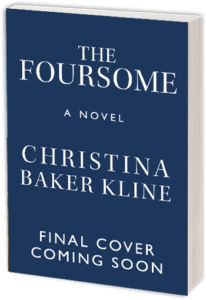
COMING MAY 2026: THE FOURSOME

A literary historical novel set in Civil War-era North Carolina, based on a true family story and told from the perspective of Sarah Bunker, one of two sisters who married Chang and Eng, the famous conjoined twins…learn more

Follow on Substack

Subscribe

Connect with Christina

Contact
  • Facebook
  • Instagram
  • Twitter

Copyright © 2026 Christina Baker Kline · Site design: Ilsa Brink