Sign up for Christina’s Newsletter

Christina Baker Kline

Author Website

  • Books
    • The Foursome
    • Please Don’t Lie
    • The Exiles
    • A Piece of the World
    • Orphan Train
      • Orphan Train Girl: The Young Readers’ Edition of Orphan Train
    • Other Novels
      • Bird in Hand
      • The Way Life Should Be
      • Desire Lines
      • Sweet Water
    • Nonfiction
      • Always Too Soon
      • About Face
      • Child of Mine
      • Room to Grow
      • The Conversation Begins
  • Events
  • NEWS
  • Other Writing
  • About
    • Bio
    • FAQs
    • Contact
    • Photos
  • Newsletter

January 29, 2010 By bakerkline

Three Ways to Push Through When You’re Stuck

Writer Julie Metz offers some hard-won advice:

Like many of you, I am working on a new writing project, a novel. What made me think I could do this, anyway? But here I am, too far in to let go, committed to my characters. Some days are thrilling, but lately I often find myself stuck, wondering how I will push out the next sentence.

My first book, published last year, was a memoir titled Perfection. The great thing about writing a memoir is that you know the story; the art is in the writing. With fiction one has that same challenge but in addition the pesky problem of not really knowing where it’s all going to end, or, for that matter, what’s happening in the beginning or middle either.

So here’s what keeps me going on the dark writing days:

1.  Reading a very good novel. At first, as I am reading the very good novel, I’m filled with self-loathing and fear of failure. Wow, this book is so effing amazing, I’ll never be able to write anything like this! But then I relax and begin to enjoy and finally adore the world the author has created, and to see that we all can create our own worlds. I won’t be writing a novel about the day a tightrope walker crossed the space between the World Trade Towers, but I might be able to write a good book about something else. Like a demanding but inspiring teacher, a good book elevates my day-to-day language and my life.

2.  Exercise. While I might tell myself that I don’t have time to take care of my body, because I should be busy writing, taking time to keep fit helps my mind work so much better.  I have begun the year with frequent trips to the gym, which I hope will help me through the winter doldrums. It’s a cliché that our body is our home.  Right now I feel like my body is my home office. If I can keep it clean and tidy, there is room for clearer thinking and perhaps some inspiration.

3. Accidental moments of insight. Just when I think it can’t get worse, that I’ll never write a decent sentence again, that my first book was a weird fluke and now I am doomed, doomed, doomed to utter failure, I’ll have some odd revelatory moment about my story and characters. Often it’s feedback from one of my readers that I have been resisting (grumpily), but suddenly realize is fantastically clear and true. Other times there’ll be some small moment out in the world, a scene at the grocery store or an encounter with a friend in my neighborhood, that allows me to understand a character or scene. These moments help me clarify a point, and then I can move on. Not at the pace I wish, but I move on nonetheless.

Julie Metz, a memoirist, book designer, and soon-to-be novelist, is a frequent contributor to this blog.

Add to FacebookAdd to DiggAdd to Del.icio.usAdd to StumbleuponAdd to RedditAdd to BlinklistAdd to TwitterAdd to TechnoratiAdd to Yahoo BuzzAdd to Newsvine

Filed Under: Uncategorized Tagged With: creative process, fiction writing, Inspiration, Julie Metz, literary, reading a great book, Thoughts, writing a novel

January 21, 2010 By bakerkline

To Tell the Truth …

Three great writers consider the concept of “truth” as it relates to the creative process:

“The hero of my tale – whom I love with all the power of my soul, whom I have tried to portray in all his beauty, who has been, is, and will be beautiful – is Truth.” — Tolstoy,”Sevastopol in May 1855″

“Truth is various; truth comes to us in different disguises; it is not with the intellect alone that we perceive it.” — Virginia Woolf, “On Not Knowing Greek”

“I shall try to tell the truth, but the result will be fiction.” — Katherine Anne Porter

Add to FacebookAdd to DiggAdd to Del.icio.usAdd to StumbleuponAdd to RedditAdd to BlinklistAdd to TwitterAdd to TechnoratiAdd to Yahoo BuzzAdd to Newsvine

Filed Under: Inspiration Tagged With: creative process, fiction writing, Inspiration, Katherine Anne Porter, Tolstoy, truth, Virginia Woolf

January 18, 2010 By bakerkline

What’s the Big Idea?

How do you come up with an idea that’s big enough to sustain a novel or memoir?  And how do you know when you’ve got it?

As a teacher of creative writing, I get asked this question a lot – and as a novelist, I can tell you that it torments every one of my beginnings.  A few days ago I put this question to the writer Katharine Weber, whose new novel, True Confections, was hailed by the Times Book Review this weekend as “a great American tale.”  (“It’s got everything,” Jincy Willett raved: “Humor, treachery, class struggle, racism, murder, capitalism and mass quantities of candy.”)

And here’s what Katharine Weber said:

I have been thinking about this for a few days since you asked me to consider this intriguing question, Christina. I am grateful to you for forcing me to think directly about something which is present in me as a writer but is intuitive and a bit organic, so I have to rummage a bit to explain it (which is always helpful to me as a writer, explaining what I do habitually without necessarily having full awareness).

I always have too many ideas. The question for me really isn’t ever Where do you get your ideas so much as How do you identify your best idea?

E.M. Forster wrote: “The king died and then the queen died is a story. The king died and the queen died of grief is a plot. The queen died and no one knew why until they discovered it was of grief is a mystery, a form capable of high development.”

So how do we know when we have moved from story to plot to something we can develop? This is the critical and significant kind of self-editing and revision and expansion necessary if one is going to write and publish novels in which the world is going to take an interest.

I think about the number one problem I encounter in writing I see in workshops: Often, a story or a novel manuscript will have sentences that are good, page to page, and the writing is “good enough” too, overall, yet there is something wrong, something not working. And that flaw can usually be characterized in this way: there is something about this writing, even if I am not sure what it is — plot, character, sensibility, key details, events — something, that means a great deal more to the writer than it can ever possibly mean to any reader. The specific details of what that is, only the writer may ever fully understand, but it signifies a serious discrepancy between the writer’s overly personal relationship to the material and any reader’s possible way of finding enough meaning in the material to want to keep turning the pages. So that’s crucial. You cannot fill your novel with personal elements that signify enormously to you and expect those things to glow with meaning for anyone else unless you have made them glow.

But I suppose the only real test for me of whether or not an idea for a novel is enough in every sense of the word — big enough, interesting enough to me first and foremost, nuanced enough, original enough, rich enough for me to write interestingly — is that usually I have dwelled with it for quite a while before I start to write. It has sustained me imaginatively as I dwell in the world of the novel that lies ahead. And that original idea may have in that time shifted and mutated into something different or tangential as I worked it imaginatively and strategically. It would be unlikely, in fact, if the original kernel of a really good idea did not expand in some direction, perhaps a surprising direction, befoe the actual writing began.

And you just have to learn for yourself what works for you, and be willing to trust your instinct even as you develop your instinct, so that over time, experience will tell you when your ideas are enough to sustain a novel, more than enough to sustain a novel, or on the verge of way too much — too much going on, too many disconnected ideas — which can be the mark of insecurity. You have to be able to make decisive choices. Everything in the novel should be necessary to the novel. So for me it is sometimes as much about throwing elements and ideas overboard as it is about finding ideas.

Katharine Weber is the author of five novels: Objects in Mirror Are Closer Than They Appear, The Music Lesson, The Little Women, Triangle, which takes up the notorious Triangle Waist company factory fire of 1911, and the brand-new True Confections, the story of a chocolate candy factory in crisis. She is working a memoir about family stories and the narrative impulse, Symptoms of Fiction. You can learn more at www.katharineweber.com.  Also, follow her brilliant blog: http://staircasewriting.blogspot.com.

Add to FacebookAdd to DiggAdd to Del.icio.usAdd to StumbleuponAdd to RedditAdd to BlinklistAdd to TwitterAdd to TechnoratiAdd to Yahoo BuzzAdd to Newsvine

Filed Under: Guest Blogs, The Creative Process Tagged With: beginning, best-laid plans, creative process, fiction writing, Inspiration, Katharine Weber, The Big Idea, Thoughts, True Confections, writing a novel

January 15, 2010 By bakerkline

The Novel Terminable and Interminable

Bonnie Friedman writes about the lure of (and cure for) the endless novel:

I just finished my first novel.  This isn’t the first novel I tried to write.  Before publishing a book of essays and then a memoir, I’d been a devoted fiction writer.  I’d written hundreds of pages of two vast novels, one when I was in my twenties and one in my thirties.  But this last one is the first novel I’ve finished.  Those other novels were a great pleasure and torment to work on — I got to explore internal states that haunted me, and I got to wander amongst skeins of gossamer prose sticky as butterfly wings, and I got to understand (among other things) aspects of my childhood with my sister, who had been a grand volcanic, wounded girl.  But I didn’t know how to finish either of the books I started.

They were all middle and no end.  They were all sprawling, surging second act.

I didn’t know that I was allowed to figure out where my characters ought to end up, and then explore how they might get there. I didn’t know how conscious I was allowed to be during the writing process.  I didn’t know that if I focused on one particular problem that a character was trying to solve, myriad others would snap into clarity.

I’d grown up reading experimental writers — Woolf, Stein, Barnes, Joyce — and really didn’t understand the least thing about novel structure. For me, reading a novel was a state of immersion.  I read slowly, savoring the serif type and the glow of the linen page (I’m thinking of a certain paperback of Mrs. Dalloway that I was given for my 21st birthday, and which I read munching Mint Milanos and sipping sweet instant coffee from a tin).  “How true!” I’d write in the margins with a coal-soft pencil.  I’d assumed that to write a book one must simply get immersed.  And I liked immersion.  It was less scary than decision.  “Discover, discover!” I told myself — the mantra of writing schools in those days.

I wrote in order to set on the page certain internal states.  I wanted to see what they meant.  I didn’t yet know how useful it is to give one’s traits to a character who is a bolder version of oneself.  I didn’t yet know that a novel must involve a character who changes by the end. At a certain point I recognized with this last novel that it too might go on forever accumulating pages and becoming less and less publishable if I didn’t impose a bit of discipline on myself.

I bought screenplay writing books, playwriting books, and even a novel-writing book or two — those dreaded texts I was convinced would flatten all my originality, what there was of it, to mere formula.  And all proved useful.  I hadn’t understood that the effect that a novel creates isn’t the same as the technique used to create that book.  Nor had I understood how entirely I merely loved the dream-state of adding to my novel.

Now what’s thrilling is pacing through other people’s novels and seeing how they’re hinged and braced.  Noticing the decision points.  And allowing my own characters to make decisions.

Gone — I hope — is some of that sticky enthrallment that kept me caged in mammoth manuscripts for so long.  Each writing temperament, I’m convinced, has its own perils.  The peril of mine was to remain for epochs in a prolonged inchoate state of mazy inconclusiveness.  The heroine of my novel altered, as did I by writing her.  Now I see a book as a device to discover more than one could have known beforehand.  And that acquiring technique is essential.  It is the artifice that, like eyeglasses, lets the world become clearer.  I’m all for it now, when once upon a time it was anathema to me.

Bonnie Friedman is the author of the Village Voice bestseller Writing Past Dark, Envy, Fear, Distraction, and Other Dilemmas in the Writer’s Life, a widely anthologized book of essays.  She is also the author of the memoir The Thief of Happiness: The Story of an Extraordinary Psychotherapy.  Her essays have been included in The Best American Movie Writing, The Best Writing on Writing, The Best Spiritual Writing, and the Best of O., the Oprah Magazine.

Add to FacebookAdd to DiggAdd to Del.icio.usAdd to StumbleuponAdd to RedditAdd to BlinklistAdd to TwitterAdd to TechnoratiAdd to Yahoo BuzzAdd to Newsvine

Filed Under: Guest Blogs, The Creative Process Tagged With: best-laid plans, Bonnie Friedman, creative process, Discipline, fiction writing, Inspiration, The Thief of Happiness, writing a novel, Writing Past Dark

January 11, 2010 By bakerkline

A Little-Known Occupational Hazard Affecting Writers

Gretchen Rubin, New York Times bestselling author of The Happiness Project, talks about the thrill and the perils of trying something new:

There’s a common occupational hazard that affects writers, but I’ve never heard anyone talk about it: the desire to write outside your main field.

I know a journalist who took a sabbatical to write a novel, which turned into a short story. I know a science writer who is writing a play. I know a novelist who is writing a memoir.

This change can be exhilarating and fun, because it’s a new creative challenge – and that contributes to a happy life.  But it can also be a bit of a pain, because these projects can feel … oppressive. With writing, often, there’s a strange feeling of compulsion. You just have to write about something. I remember hearing Kathryn Harrison remark on a panel, when asked how she chose her topics, “You really have surprisingly little control about what you want to write about.” I knew exactly what she meant. I had to write a book about power, money, fame and sex — when I was clerking for Justice O’Connor, I was writing that book on the weekends. A few years later, I felt I couldn’t go another day without working on a biography of Churchill.

Of course, you can choose what you write about. You just can’t choose what you want to write about.

For the last few years, for example, I’ve been desperately fighting the urge to write a book about St. Therese of Lisieux. I have a lot to say, and I think most of her biographers seriously mis-read her writing, and I’d love to set everyone straight. But I resist because I’m not Catholic, I have no doctrinal expertise, I don’t even speak French! No one would read my book – but how I would love to lay roses at the feet of my spiritual master, St. Therese.

Although I write non-fiction, three times in my life I’ve had an uncontrollable urge to write a novel. My problem is that I’m not much of a storyteller, and these were “novels of ideas.” Which, I know quite well, is not a good way to write a novel. One novel was about the apocalypse, one was about why people destroy their own possessions (I later wrote a non-fiction book, Profane Waste, on this subject, in collaboration with artist Dana Hoey, and it worked much better in that form), and most recently, I wrote a novel-in-a-month about the happiness consequences of two people having an affair. (I describe this experience in The Happiness Project book.)

For a writer, it can be a gigantic distraction, and therefore a work liability, to have these projects press on you. They get in the way of the work you really need to get done. They can be fun, creative, and satisfying, yes, but writers, like everyone, need to be productive in the work for which they’re paid.

This has happened to me, yet again. I have this idea for a novel – but for once, in a nice change, it’s not a novel of ideas. Well, it is a little bit. But it has more plot than usual. And it actually has some real characters in it. It’s also a young-adult novel, which I’ve never tackled before, although I’m a huge fan of children’s and young-adult literature.

But what’s the point of view? I imagine it like a movie, with a distant third-person narrator, but I need to locate it in my main character’s point of view…and then how to handle the gradual reveal of the secrets I want to emerge slowly?

I really don’t have time to be fussing with this right now!

I mentioned this dilemma to a friend who is an editor and a YA writer herself, and she said, “You should just write it! That’s the happiness project thing to do!”

She’s absolutely right. It would make me very happy to write that novel. But while it would be fun, it would also be draining and difficult and distracting. Plus, I would really try to make it good, but it probably wouldn’t end up being good – and if I go to the trouble to write a book, I really want it to be good. It would be “play,” in that I’d be doing it for fun, but it would use up precisely the same energy that I use for “work.” More time at the keyboard, can I stand it? Of course, it might energize me as well.

I know that I’m extraordinarily lucky to be a working writer, debating whether to do this extra project for fun. For now I think I’ll hold on to my idea, and promise myself that I’ll make a start on this novel this summer, if I still feel the urge.

Add to FacebookAdd to DiggAdd to Del.icio.usAdd to StumbleuponAdd to RedditAdd to BlinklistAdd to TwitterAdd to TechnoratiAdd to Yahoo BuzzAdd to Newsvine

Filed Under: Guest Blogs, The Creative Process Tagged With: creative process, fiction writing, Gretchen Rubin, Inspiration, The Happiness Project

  • « Previous Page
  • 1
  • …
  • 5
  • 6
  • 7
  • 8
  • 9
  • …
  • 19
  • Next Page »

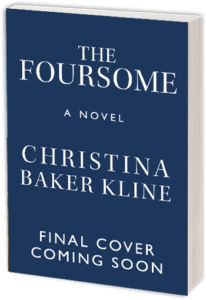
COMING MAY 2026: THE FOURSOME

A literary historical novel set in Civil War-era North Carolina, based on a true family story and told from the perspective of Sarah Bunker, one of two sisters who married Chang and Eng, the famous conjoined twins…learn more

Follow on Substack

Subscribe

Connect with Christina

Contact
  • Facebook
  • Instagram
  • Twitter

Copyright © 2026 Christina Baker Kline · Site design: Ilsa Brink