Sign up for Christina’s Newsletter

Christina Baker Kline

Author Website

  • Books
    • The Foursome
    • Please Don’t Lie
    • The Exiles
    • A Piece of the World
    • Orphan Train
      • Orphan Train Girl: The Young Readers’ Edition of Orphan Train
    • Other Novels
      • Bird in Hand
      • The Way Life Should Be
      • Desire Lines
      • Sweet Water
    • Nonfiction
      • Always Too Soon
      • About Face
      • Child of Mine
      • Room to Grow
      • The Conversation Begins
  • Events
  • NEWS
  • Other Writing
  • About
    • Bio
    • FAQs
    • Contact
    • Photos
  • Newsletter

June 10, 2011 By bakerkline

Literary Names: Do Characters Name Themselves?

On Sunday — June 12 — I’ll be on a panel called “Going Beyond ‘Tom, Dick and Mary’: Naming and Giving Your Characters Dimension” at Books NJ: A Celebration of Books and the Readers who Love Them, 1-5 p.m. at the Paramus Public Library.  (Stop by and say hello!)  Consequently I’ve been thinking a lot about character names this week.

So has novelist and playwright Joanne Lessner, author of Pandora’s Bottle and Critical Mass, who wonders whether she names her characters….or they name themselves:

In my alternate life (the one where I’m a jet-setting opera singer based in London), I have a clutch of children with fabulous names. The girls are called Tessa, Lily, Francesca and Imogen, and the boys are Sebastian, Phineas, Jasper and Colin. In my actual life, I’m a New York-based writer and performer with two kids who got my first round draft picks: Julian and Phoebe. But as a writer, surely I can pepper my work with those other glorious, un-exercised gems, right?

Well, not exactly.

J.K. Rowling has famously said that Harry Potter just strolled into her head, fully formed. I understand what she means. My characters have a habit of knocking on my mental door wearing nametags. Even names that carry hints of significance are often a chicken and egg situation. For example, the hero of my novel, Pandora’s Bottle, is named Sy Hampton.  I don’t recall consciously choosing his name, but one reader asked if it was meant to illustrate a “sigh” of disappointment (he’s having a mid-life crisis.) Another suggested that “Hampton” indicates a yearning for the finer things in life epitomized by those exclusive Long Island enclaves. Those are certainly reasonable assumptions, but I can’t say honestly whether Sy grew more melancholy and striving because of his name, or if, when I named him, my subconscious instinctively know where he was heading. However, I do know that when my editor floated the possibility of changing his name – feeling that Sy suggested someone of a slightly older generation – I just couldn’t.

The anti-heroine of a novel I’m working on now is named Katelyn. I must confess, I’ve never been a fan of that name or its multiple spellings, so imagine my surprise when that’s what my fingers typed. Her last name is Marx, which I also don’t recall selecting, but have since recognized has political overtones in line with Katelyn’s schemes. The success of her plans will hinge on her ability to remain chameleon-like and forgettable. What better way to illustrate that quality than with a name with multiple, hard-to-keep-track-of spellings? Except that, again, I gave it no thought whatsoever. Katelyn Marx just showed up for work the day I started writing and politely introduced herself.

Still, it doesn’t always work that way. Minor characters, in particular, can be more reticent, and as they blink patiently at me in the doorway, I try to let my mind free associate until something clicks. Even so, these characters often don’t live and breathe in quite the same way as the ones who are instinctive. But giving serious thought to a name is not necessarily a bad thing, and when you hit it right, you know. As one writer friend told me recently, a simple change from Lily to Billie made her character come alive.

One situation that does require special care is naming for the stage, where the sound is more important than the way it looks on the page. In my play, Critical Mass, a character named Stefano Donato kept my cast’s tongues twisted. It looks neat and symmetrical in print, but the actors had to remind themselves where the accents were every time they said it. Lesson learned.

In a musical, names that rhyme are a boon.

I’m currently adapting Wilkie Collins’s gothic novella The Haunted Hotel. The heroine’s name is Agnes – not much joy there. But make her Alice, and suddenly we’ve got malice, callous and palace, which happens to be the name of the eponymous hotel. Her faithless lover? Collins named him Herbert. But rechristened Edward, he can lure another woman bedward. Even here, though, where active choice is involved, expedience takes precedence over all those names I’d love to employ.

An acting teacher of mine once said that your gut is a better actor than your brain, and I think the same holds true for writers, particularly when choosing the right names for characters. I’ve had the experience of reading others’ work and being distracted by a name that’s too fussy, unrealistic, or forced in some intangible way, and I find myself wondering if that person was mining his or her well of untapped baby names hoping to press an old favorite into active service. So for now I’ll have to hope that I get a surprise visit someday from Tessa, Francesca, Phineas or Jasper – unless I can come up with some good rhymes for them. Until then, I’ll continue to let my subconscious do the work, opening my door to whoever knocks, and eagerly asking that character his or her name.

Joanne Sydney Lessner is the author of Pandora’s Bottle, a novel inspired by the true story of the world’s most expensive bottle of wine (Flint Mine Press, 2010). This post originally appeared on Pamela Redmond Satran’s Nameberry blog.


Filed Under: Guest Blogs, The Creative Process Tagged With: character names, J. K. Rowling, Joanne Lessner, Nameberry, naming characters, Pamela Redmond Satran

April 1, 2010 By bakerkline

Reinventing the Novel

My friend Pamela Redmond Satran is a novelist, New York Times bestselling author, ninja web developer, and one-time magazine editor. Now she’s embarking on something entirely new:

Two things inspired me to write my new novel, Ho Springs, online, day by day, instead of writing it for a conventional publisher the way I did my first five novels.  Well, two things that are easy to explain.

The first was my husband, after watching the DVD of American Gangster, telling me he found the movie good enough but ultimately unsatisfying.   “It was a movie,” he explained, “so you knew from the beginning that everything really interesting was going to happen to Denzel Washington and Russell Crowe, and that it was going to build to this big climax at the end.”

That was the problem with conventional novels too, I thought.  They were predictable, limited and finite in form and scope.  Wouldn’t it be more interesting to write – and read – a novel that unfolded in a way that was both more leisurely and more compelling, the way TV shows like Mad Men and The Wire did?

The second influence was creating my blog How Not To Act Old after no one wanted to buy it as a magazine article, turning it into a book and making that book a New York Times bestseller.  That experience taught me that not only was it more fun and exciting to write without an editor between me and my readers, but my own creative instincts were often better than those of the traditional publishing world.

My experience writing five “real” novels and developing two big websites – I’m also a partner in the site nameberry.com, based on the ten baby name books I coauthored with Linda Rosenkrantz – put me in a unique position to create a piece of digital fiction that would combine the best of both worlds.  Rather than writing episodic pieces, I wanted to create a novel that included such conventional elements as a character-driven story, causally-related scenes, and an extended plot that would unspool in unexpected ways, but in a form that could exist only online.

My blueprint was a television series I’d created (but hadn’t sold) a few years ago, set in a fictionalized version of Hot Springs, Arkansas.   A place-based story was perfect for an online novel, I thought, offering a wide range of characters and settings and the potential for stories to expand in an unlimited number of directions.

The big problem was the name, Hot Springs.  The url hotsprings.com was obviously taken.  And then, driving one day, I had a eureka moment: hosprings.com, or Ho Springs.  I was so excited I did a u-turn and drove right back home to track down and reserve the name.

From that moment on, I knew the idea was right.  I wanted to create the site in wordpress, so it would be free and I’d have total creative control, but I couldn’t find a theme that included all the elements – videos, graphic windows that opened to places in the town and story, room for a big block of text.

I needed a designer – or, as it turned out, three designers.  I had a vision for a logo that would look like all the letters were in realistic flames, with the T up in smoke, which called for a photoshop expert.  My budget was zero, or as close to that as I could get.  I was lucky to find Katie Mancinewho built me an amazing logo.

The only problem was, Katie said, she couldn’t design a good-looking site to go with that logo.  Rather, she sold me on the concept “Vintage Tourist Guide,” which was great, but in the end that didn’t work out either.  Katie finally ended up with the design you see now on the site, and my friend Dennis Tobenski, who’s really a composer, made the whole thing dance.  Combined cost: under $1500, and several hundred gray hairs.

Weeks and then months were passing, during which I found a musician, Matt Michael, to write and record two original songs for the site, and also drafted several writer friends to create independent blogs from the characters’ viewpoints.  But the only writing I was doing during this time was putting together the static content describing the characters and the settings.

A novelist creating a work for the web is not, then, just a writer, but a designer, a logician, a manager, a tech guy, a producer.

And then, once you do start writing – or at least, once I did – the process is different too.  I suppose you could write one long story and parcel it out day by day, but the whole point for me was to create it as I went along, publish it immediately, to swing by the crook of my knees with no net below.

That’s the only way to feel the wind on your face, which is something you rarely feel when you’re writing a conventional novel, one that won’t be published for two years or maybe five, that no other person may even see for all that time, or maybe ever.  Writing all my other novels, I’m a big planner, outlining the big story and even each individual scene, revising and reimagining, working on the same piece until I lose sight of where I started and when it will ever end.

With Ho Springs, I get up in the morning, having a vague sense of what I’m going to write about, from which character’s viewpoint, but letting myself be swayed by whatever I encounter between brushing my teeth and opening my computer.  A David Sedaris story in an old New Yorker got one of my characters beaten one morning; an email from a writer friend inspired me to make a video of myself talking about what had influenced me that day.

It wasn’t until after I launched the site that I looked at what anyone else was doing in this arena.  The only site I’ve found that’s similar is All’s Fair in Love and War, Texas, by the brilliant Amber Simmons, which makes me believe God saved me from that Vintage Tourist Guide idea.  Penguin’s We Tell Stories is brilliant, but much more expensively and expertly produced than I could hope for, and more limited in writerly ambition.  Visually-based web fictions that blow me away include Unknown Territories and The Flat on Dreaming Methods.  But they’re movies, really, not novels.

Where is this project going?  My ideal vision is that someone like HBO or a publisher with a production arm will buy it and produce it as a multimedia property, with a television and a web and a book element working together.  I believe that this is how fiction will be written and published in the future, that this will become the new standard long after anyone remembers that Ho Springs ever existed.

Or I may take it down tomorrow and build something else.  The excitement is in creating something.  Holding it in your hands, or staring at it on a screen, holds so much less satisfaction.

Pamela’s personal site may be found here; with Ho Springs just around the corner.  This post originally appeared on the site Noveir.

Add to FacebookAdd to DiggAdd to Del.icio.usAdd to StumbleuponAdd to RedditAdd to BlinklistAdd to TwitterAdd to TechnoratiAdd to Yahoo BuzzAdd to Newsvine

Filed Under: Guest Blogs, The Writing Biz Tagged With: creative process, fiction writing, Ho Springs, How Not to Act Old, Inspiration, Pamela Redmond Satran

August 17, 2009 By bakerkline

Guest Blog: New York Times Bestselling Author …

Pamela Redmond Satran on Making “The List”:

HowNotActOldBookWhen Christina asked me to write a guest blog about how it feels to be on the New York Times Bestseller List — my new humor book, How Not To Act Old, is #7 on the Paperback How To, Advice, and Miscellaneous for August 23 – all I could think was: I better write this fast.

Although I am determined not to be one of those people who complains about her success -“My book tour was so exhausting, and why was I #7 instead of #1?” – I have to admit that the experience of landing on The List for the first time in 17 books (or maybe 18 or 19; I really have lost track) is not total finger-snapping and blue skies.

Maybe that’s because I’m not really sure what this amounts to. Is it an extremely nice accolade that I will forevermore be entitled to couple with my name: New York Times Bestselling Author, kind of like Duchess, or Oscar winner? Or it is the first step – okay, the eighth or twenty-ninth – in the trajectory of the kind of book that changes not just your career, but your life?

I’m trying to stay in the moment here, but I can’t help looking at my company on the Bestseller List – at the skinny bitches and the guys who hope they serve beer in hell – and think: Jesus, those people cashed in. Their books are famous, they made wheelbarrows full of money, and maybe that will happen to me.

And then I have to go throw some salt over my shoulder, knock on some wood, and kiss the fang of a sabertooth tiger – whatever it takes to ward off the juju you attract by daring to think something good might really happen.

On the other hand, isn’t this one of those moments I should seize by being smart about my career, figuring out how to build on this success by doing the right book proposal, taking the right chances, making the most of this amazing piece of luck?

I’ve heard other people who made The List say it was the result of concerted effort over a long time by a lot of people, but I wouldn’t say that was true for me. The editor who bought my book and indeed my whole publishing division was disappeared mere months before my book came out. There was a protracted struggle over the cover of the book (I won), which made me question whether my publisher even understood the property and the market. I was assigned to a publicist who was on maternity leave until just a few months before the pub date, missing the deadline for all the long-lead magazines.

But the publicist turned out to be well worth the wait, the best I have ever worked with. I made a key first-serial sale myself, to the amazing Lesley Jane Seymour and Judy Coyne at More Magazine, the perfect venue for the book. Attention for the blog that launched the book – HowNotToActOld.com – sparked online sales that helped catapult the book onto the bestseller list right out of the gate.

And so now I have three more full days to enjoy having a book on the New York Times Bestseller List. And even if How Not To Act Old falls off the list on Wednesday evening, when the new roster is announced, it will still show up on the Bestseller List that’s in the actual newspaper next Sunday, which will give it a whole new boost and fresh visibility among thousands of book lovers and potential readers.

Ultimately I feel proud that this project, which I started because no one was interested in the magazine article, which I sold for a low advance to the only publisher who bid on it, which was orphaned and battered before rising to these heights, has achieved one of the most impressive commercial feats possible for a book. I plan to take full advantage of that feeling, for as long as it lasts.

Pamela Redmond Satran is the author of 18 books, including five novels (Younger, The Man I Should Have Married) and ten bestselling baby-naming books (Beyond Jennifer & Jason, Cool Names for Babies) coauthored with Linda Rosenkrantz.  She and Linda are also the developers of baby-naming site nameberry.  Pam cowrites The Glamour List, writes for The Daily Beast and The Huffington Post, and is the author of a book called 1000 Ways To Be A Slightly Better Woman. And, oh yes, she runs an 800-member social networking group called MEWS.

Filed Under: Guest Blogs, Real Life Tagged With: bestseller list, How Not to Act Old, humor, More magazine, New York TImes, New York Times Bestseller, Pamela Redmond Satran

August 13, 2009 By bakerkline

Quick Link: The Name So Nice I Used it Twice

babyYou’d think that someone who spends her days creating and naming characters might have gotten the hang of it by the time she had to name some actual humans.  That’s what I thought, at least.  In fact, I was rather smug about it …
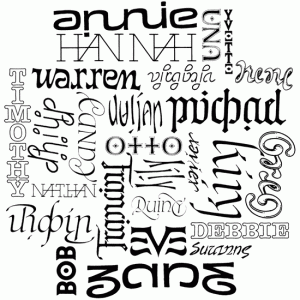
So begins my guest post on Nameberry, a very cool baby name site that’s the brainchild (so to speak — yes, I did) of bestselling writers Pamela Redmond Satran and Linda Rosenkrantz.

Even someone who names fictional people for a living can make mistakes when naming real live babies.  Like when I named my three sons: Eli, his brother William, and his other brother William.

Read more here.

Filed Under: Quick Links Tagged With: best-laid plans, Nameberry, naming characters, Pamela Redmond Satran, Real Life

July 2, 2009 By bakerkline

Guest Blog: Pamela Redmond Satran on Naming Characters

Novelist and naming expert Pam Satran writes:

There’s a character named Billie in the novel I’ve been working on since the invasion of Iraq.  But Billie wasn’t always in the book: Until this spring, she was Lily.

Well, she wasn’t really Lily, but the character who played her role in the plot was named Lily until the most recent draft.  Lily was older – 23 to Billie’s 19 – a college graduate already living on her own in New York.  Billie rides cross country with a stranger, her backpack full of her father’s ashes and a handgun.26names

I changed my character’s name (and persona) after reading Kate Atkinson’s When Will There Be Good News? Sixteen-year-old Reggie is alone in the world, yet winning and resourceful.  I admired the way Atkinson wrote from Reggie’s point of view – third person, but intimate – and decided I wanted my character, Lily, to be more like Reggie.

To be, in other words, Billie.

I’m still not certain Billie is the right name for her.  It feels a little obviously like the name of a scrappy tomboy, which is exactly what Billie is.  Maybe it would be more interesting if her name were something ultra-feminine, like Seraphina?  Plus one of my other main characters, whom Billie spends a lot of time with, also has a name that starts with a B, Bridget, and that name is carved in stone.  As a reader, I hate it when character’s names or physical descriptions, even their hair colors, are too similar.

As the author of ten name books, I should have an easier time of naming my characters. But it’s just like naming children: No matter how much expertise you have, no matter how much thought you’ve put into it, it can still be difficult to settle on the perfect name for someone you love and cherish.

It’s easy for me to give certain kinds of name advice to fellow novelists.  A girl born in the 1950s with sisters named Joanne and Debbie would more likely be Carolyn than Caroline, I recently told one friend, pointing to the popularity charts on my site Nameberry.  Caroline was rarely used outside of the upper classes before the Kennedys popularized it in the early 1960s.  Another character, born in the 1930s, might have been Lillian or Louise, but certainly not LeeAnn.

Yet I feel less certain about my own poor Billie. I’m going to take one more swing through the book, looking closely at that character, still wobbly.  I hope that once Billie’s inner workings and story feel more solid to me, so will my decision about her name.

Pamela Redmond Satran is the author of five novels and ten bestselling baby name books, including Beyond Ava & Aiden.  Her blog How Not to Act Old is becoming a book in August.

Filed Under: Guest Blogs, Inspiration Tagged With: character, creative process, fiction writing, How Not to Act Old, Inspiration, Kate Atkinson, Nameberry, naming characters, Pamela Redmond Satran, Thoughts, writing a novel

COMING MAY 2026: THE FOURSOME

A literary historical novel set in Civil War-era North Carolina, based on a true family story and told from the perspective of Sarah Bunker, one of two sisters who married Chang and Eng, the famous conjoined twins…learn more

Follow on Substack

Subscribe

Connect with Christina

Contact
  • Facebook
  • Instagram
  • Twitter

Copyright © 2026 Christina Baker Kline · Site design: Ilsa Brink