Sign up for Christina’s Newsletter

Christina Baker Kline

Author Website

  • Books
    • The Foursome
    • Please Don’t Lie
    • The Exiles
    • A Piece of the World
    • Orphan Train
      • Orphan Train Girl: The Young Readers’ Edition of Orphan Train
    • Other Novels
      • Bird in Hand
      • The Way Life Should Be
      • Desire Lines
      • Sweet Water
    • Nonfiction
      • Always Too Soon
      • About Face
      • Child of Mine
      • Room to Grow
      • The Conversation Begins
  • Events
  • NEWS
  • Other Writing
  • About
    • Bio
    • FAQs
    • Contact
    • Photos
  • Newsletter

March 1, 2010 By bakerkline

Why Do I Even Want to Write a Novel?

With a challenging, fulfilling job and a satisfying personal life, Anne Burt questions her desire to write a novel – and finds the answer in an unexpected place:

Thomas Roma, Untitled, 1984

Motivation has always been as cruel to me as it has been – well – motivating. I’ve been motivated to write because: I imagine glory when the world reads my masterpiece; I need to act out some childhood revenge fantasy about surpassing my father; I have a contorted sense that immortality is achievable through words on a page.  Any analysis of my past motivations leaves me thinking I’m either a narcissist or an idiot or both.

I’ve won enough self-awareness through experience and therapy over the years to dispel the notion that any of my three aforementioned motivations for writing are a) possible, or b) matter.  I’m over it, and I sleep better at night and enjoy my life far more as a result.

The truth is, I have a creative, absorbing job I love that uses my skills and education, puts me in the company of artists each day and takes care of my family of four.  I have a meaningful career as a writer and editor as well; while I haven’t published a novel, I’ve published books and essays on subjects that move me and have given me great pride and sense of accomplishment.

My old demons don’t scare me into action anymore – for better (who needs the agitation?) or for worse (the agitation drove me to my writing desk, after all).

But a nagging question remains: do I need to recapture the negativity of these old motivations in order to see the writing of a novel all the way through from beginning to end, or has general life happiness turned my old desire to write a novel into phantom-limb syndrome?

Last week I attended an artist talk, one in a series I oversee as part of my job, by photographer and Columbia University School of the Arts professor Tom Roma. I know Tom, so I was prepared to be entertained by his banter, and I know his photographs, so I was prepared to hear about the extreme care with which he approaches every level of the process.  I was unprepared, however, to find the answer to my question.

Discussing his teaching philosophy, Tom described an assignment he gives his undergraduate and grad students in which he sends them to the library or a bookstore.  “I tell them to scan the shelves, feel the spines, look at the size and shape and heft of the books,” he said. “Then I tell them to pull out the one that speaks to them as an object.  Subject doesn’t matter; what matters is how it feels in their hands, how satisfied they are by holding this thing, whether they feel they need this object in their lives.  When they find the book, they must check it out of the library, or buy it from the store, and that will be the inspiration for the size and feel of their book of photographs.  Whenever they get lost in the middle of the work, or feel directionless or confused, I send them back to hold and feel the book because that book is their goal and will motivate them to create.”

And that was it.  I realized that I was missing something so obvious, so straightforward that it was not only staring me in the face but spilling out over every surface in my home, weighing down my shoulder bag week after week, keeping me up late at night reading, making me miss subway stops, informing my favorite conversations, and even creating the best moments spent with my children:  novels are the book for me.  Novels are my goal, and motivate me to create.  The the-ness of a novel matters to me; I run my hands over its spine and feel its weight and size and heft. Essay collections, careers, articles – not so much.

I want to create something I am truly passionate about, and until I commit myself to seeing a novel through, beginning to end, I won’t have done it. My true motivation is as simple, and as complicated, as that.

Anne Burt is Director of Communications for Columbia University School of the Arts. She is the editor of My Father Married Your Mother: Dispatches from the Blended Family and co-editor with Christina Baker Kline of About Face: Women Talk About What They See When They Look in the Mirror.  Anne received Meridian Literary Magazine’s Editors’ Prize in Fiction in 2002.

Add to FacebookAdd to DiggAdd to Del.icio.usAdd to StumbleuponAdd to RedditAdd to BlinklistAdd to TwitterAdd to TechnoratiAdd to Yahoo BuzzAdd to Newsvine

Filed Under: Guest Blogs, Real Life Tagged With: Anne Burt, beginning, Columbia University School of the Arts, creative process, fiction writing, Inspiration, Thomas Roma, Thoughts, writing a novel

February 21, 2010 By bakerkline

Roxana Robinson on Writing About Place

Reading Roxana Robinson’s latest novel, Cost, I was struck by how beautifully and naturally she writes about place, from the coast of Maine to the streets of New York.  Consider this, for example – a coastal view from the perspective of a painter: “Julia’s studio was in the barn overlooking the meadow. Through the big picture window she had painted this many times, the rich rippling grass, the moving water beyond it, the glittering sea-bright light…. For the meadow, for that smoky pink grass, first an undercoat of dead green, for depth.  Or maybe yellow, deep yellow, for vitality.”  Or, later on, this visit to a drug dealer’s Brooklyn apartment:  “The foyer was tiny, with scarred gray walls and a floor littered with Chinese restaurant flyers. The lock on the front door was heavily reinforced with metal plates, but the door itself stood slightly ajar.  They went inside.  There was no light, and they started gingerly upstairs in the dark.”

I wanted to know how Roxana approaches writing about place, and what she may have learned about her process over the years that could be helpful to others.  So I wrote her and asked.  Below is her thoughtful response:

When I teach, I tell my students that, first of all, you must write the scene so that  your reader can see it. Sight is the sense we depend upon most, so, show us the room, or describe the forest path, or create the supermarket aisle, so that we feel as though we’re in it ourselves.

Place, the location, the setting, is integral to fiction. We’ll never forget the sense of openness and possibility, of well-groomed, natural loveliness, of the combination of freshness and candor with deep subtlety and venerability, that underlies the scene in “Portrait of a Lady,” when Isabel Archer has afternoon tea outside, on the lawn of an English country house. The velvet grass, the Persian rug, the tinkling cups. The glorious young woman, and the world before her.

But creating place isn’t simply a question of seeing, it’s a question of feeling as well. The way you feel about a place is the way your reader will come to feel about it – which is as it should be. So you must write from your heart about the place – about every place, a gas station on the New Jersey turnpike or your old kindergarten classroom. The way it makes you feel should be included in the description. Maybe you (or your character) are in a state of exaltation when you stop there for gas, and the way the sun gleams on the gas nozzles makes you giddy with joy. Maybe you hated your kindergarten teacher, the way her dress wrinkled across the hips, and her bad breath. Your feelings should go into the way you describe the wooden tables, the big windows, the boxes of blocks.

I often write about a place that I love. In my story collection A Perfect Stranger, the story “Assez” is, on one level, a love-letter to a part of France that I know very well. I wanted to write about that part of Provence, the way the wind sounds, the way the dark cypresses look, the way it feels to walk through a silent village late at night. So that part of the process of writing that story was really my own pleasure in remembering and revisiting a place I love so much.

In Cost, I did something similar. Much of the book is set on the coast of Maine, in an unnamed place. The book is centered on a shabby old clapboard farmhouse near the water, as the old saltwater farms often were. I have spend many summers on the coast of Maine, and it’s another region I know well and love, with its deep blue skies, bracing waters, staggering tides. But the house I describe is actually based on a particular saltbox cottage in Cape Cod, a place where I went as a child. So the book is, in a way, saying goodbye to a place that I felt very strongly about. It was a way of paying tribute to it, describing the place as I had known it. It was an opportunity for me to reveal, to the reader, the great delights of a place like that, for all its shabbiness and quirks. The house I knew was a place of great solace, solid and silent, peaceful, sheltering and beautiful in its deep connection to its surroundings: the lilacs outside the windows, the apple orchard gone wild in the meadow, the water in the cove, murmuring at the bottom of the hillside.

Because the house was so beloved, it became an integral part in the narrative. That wasn’t something I planned beforehand, but it somehow wrote itself into the story, because the house, and the landscape around it, were such a powerful presence.

Place should always be a part of the narrative – and it always is, really. What two people say to each other in a small stuffy bedroom will be very different from what they say to each other in a noisy train station.

And it’s also just as important for me to visualize the scene before I write it. I’m describing it for myself as much as for the reader, allowing myself to enter into that space, and those emotions. Here we are, I’m saying, this is how it looks. This is how it feels to be here. Now we’ll begin.

*****

Roxana Robinson is a critically acclaimed fiction writer, author of four novels (including her latest, Cost) and three collections of short stories. Her work has appeared in The New Yorker, Harper’s, and The Atlantic; it has appeared often in Best American Short Stories, and has been widely anthologized and broadcast on National Public Radio. Four of her works have been chosen Notable Books of the Year by The New York Times, and she was named a Literary Lion by The New York Public Library.  She has received Fellowships from the Guggenheim Foundation, the National Endowment for the Arts, and the MacDowell Colony.  Her website is www.roxanarobinson.com.

Add to FacebookAdd to DiggAdd to Del.icio.usAdd to StumbleuponAdd to RedditAdd to BlinklistAdd to TwitterAdd to TechnoratiAdd to Yahoo BuzzAdd to Newsvine

Filed Under: Guest Blogs, The Creative Process Tagged With: Cost, creative process, fiction writing, Inspiration, Maine, New York, Roxana Robinson, Thoughts, writing about place

February 15, 2010 By bakerkline

Writing Past the Blind Spot

Last week Bonnie Friedman found out something big …

As soon as I finished writing my guest post for this blog last week about how “people don’t do such things,” I put the computer in “sleep” mode, stood up, and the answer to the question I was secretly asking washed through me.

Why couldn’t I really believe that people in the world do mean and otherwise outrageous things (things that, if I could believe in them, I could let my characters do, as well)?  Because my sister was mean and I couldn’t let myself know it. Voila! Also: not so earthshaking, since she’s my sister, not yours.  But here’s the part that likely does apply to you.  We all have blind spots — things that we can’t let ourselves know and yet which we write in order to find out.  And if we don’t believe what our pens reveal, we have to keep writing the same thing time and again until we do.

What does the blind spot feel like?  What does denial feel like?  It feels like a numbness.  It feels like the bloated anesthetized lip at the dentist’s.  It’s large, it’s tingly, there’s a temptation to bite it and bite it again until one’s mouth drips.  It feels like something is there, but you can’t say what.  It feels like being stupid — others can see what you can’t.  They even laugh at how obvious it is!  And as you become more acutely aware that you are in denial, it feels like needing others for a verdict on your own experience, as if you have to steer your car by looking in a series of tilted mirrors rather than by looking straight ahead at the truth.  There’s something there, you need to know it, but when you look it’s subsumed in fog.

Which is why many of us write.  We want to get at that thing suffused in fog.

Why couldn’t I know that my sister was mean?

Because I loved her, and she was suffering.  She was a bossy, dear, acne-stricken, wounded girl who shared my bedroom and who frightened me.  I thought she was right that my existence was an imposition on her.  She’d been alive six years before I was born, and that proved in both our minds that I was an inconvenience she should not have to put up with.  I cringed, I obliged, I believed I was a doltish, messy thing — as if I lived inside a gooey, disgusting jellyfish or as if the jellyfish was all over me. I was forever pressing my eyeglasses against my face, trying to see better through that jelly haze.  I believed what my sister said. She was a clever, shrewd, unobliging sort, quick to point out others flaws.  I’d gawp, astonished at what she’d illuminated.  And I felt sorry for her, because her suffering was obvious.  And if she were alive today I certainly wouldn’t be writing this.  She passed away four years ago, freeing me to articulate and understand what before I’d had to keep concealed in the slam book of my heart, where I inscribed, under my observations about her, my own verdict on myself: wrong, impulsive, prone to distortion.

Even now it seems unkind and exaggerated to call her mean.  Surely she was merely outspoken. Surely she’d only spoken rashly from time to time.  The old denial wants to subsume me.

I could not see mean people in the world because I could not see a mean person in my bedroom.  And so my writing was hampered by a certain obligingness, a certain vacillating wateriness, a certain wishy-washy tepidity.  And it was only when I started admitting that certain people are bold and spiky and mean, or at least do mean things, and that I can trust my own perceptions, that my own world and writing acquired a greater clarity.

What would you see if you trusted your own vision? I ask myself.  What preposterous things would you know are true?   You are the person riding alongside the blind-spot girl.   You are the tilted mirror she needs.   Oh, believe the truth, believe it, I urge her.  Because in her other ear is the old whispering voice, still suggesting: You’re wrong.  You’re bad.  You don’t know what reality is.  Surely the truth isn’t as stark as all that.

This is the third in a series of three essays – including “The Novel Terminable and Interminable” and the above-linked “People Don’t Do Such Things” – that Bonnie Friedman has written for this blog this month.  Her book Writing Past Dark: Envy, Fear, Distraction, and Other Dilemmas in the Writer’s Life, is a modern-day classic, and has been in print since it was first published in 1993.

Add to FacebookAdd to DiggAdd to Del.icio.usAdd to StumbleuponAdd to RedditAdd to BlinklistAdd to TwitterAdd to TechnoratiAdd to Yahoo BuzzAdd to Newsvine

Filed Under: Guest Blogs, The Creative Process Tagged With: Bonnie Friedman, character, creative process, fiction writing, jellyfish, Real Life, Thoughts, writing a novel

January 29, 2010 By bakerkline

Three Ways to Push Through When You’re Stuck

Writer Julie Metz offers some hard-won advice:

Like many of you, I am working on a new writing project, a novel. What made me think I could do this, anyway? But here I am, too far in to let go, committed to my characters. Some days are thrilling, but lately I often find myself stuck, wondering how I will push out the next sentence.

My first book, published last year, was a memoir titled Perfection. The great thing about writing a memoir is that you know the story; the art is in the writing. With fiction one has that same challenge but in addition the pesky problem of not really knowing where it’s all going to end, or, for that matter, what’s happening in the beginning or middle either.

So here’s what keeps me going on the dark writing days:

1.  Reading a very good novel. At first, as I am reading the very good novel, I’m filled with self-loathing and fear of failure. Wow, this book is so effing amazing, I’ll never be able to write anything like this! But then I relax and begin to enjoy and finally adore the world the author has created, and to see that we all can create our own worlds. I won’t be writing a novel about the day a tightrope walker crossed the space between the World Trade Towers, but I might be able to write a good book about something else. Like a demanding but inspiring teacher, a good book elevates my day-to-day language and my life.

2.  Exercise. While I might tell myself that I don’t have time to take care of my body, because I should be busy writing, taking time to keep fit helps my mind work so much better.  I have begun the year with frequent trips to the gym, which I hope will help me through the winter doldrums. It’s a cliché that our body is our home.  Right now I feel like my body is my home office. If I can keep it clean and tidy, there is room for clearer thinking and perhaps some inspiration.

3. Accidental moments of insight. Just when I think it can’t get worse, that I’ll never write a decent sentence again, that my first book was a weird fluke and now I am doomed, doomed, doomed to utter failure, I’ll have some odd revelatory moment about my story and characters. Often it’s feedback from one of my readers that I have been resisting (grumpily), but suddenly realize is fantastically clear and true. Other times there’ll be some small moment out in the world, a scene at the grocery store or an encounter with a friend in my neighborhood, that allows me to understand a character or scene. These moments help me clarify a point, and then I can move on. Not at the pace I wish, but I move on nonetheless.

Julie Metz, a memoirist, book designer, and soon-to-be novelist, is a frequent contributor to this blog.

Add to FacebookAdd to DiggAdd to Del.icio.usAdd to StumbleuponAdd to RedditAdd to BlinklistAdd to TwitterAdd to TechnoratiAdd to Yahoo BuzzAdd to Newsvine

Filed Under: Uncategorized Tagged With: creative process, fiction writing, Inspiration, Julie Metz, literary, reading a great book, Thoughts, writing a novel

January 18, 2010 By bakerkline

What’s the Big Idea?

How do you come up with an idea that’s big enough to sustain a novel or memoir?  And how do you know when you’ve got it?

As a teacher of creative writing, I get asked this question a lot – and as a novelist, I can tell you that it torments every one of my beginnings.  A few days ago I put this question to the writer Katharine Weber, whose new novel, True Confections, was hailed by the Times Book Review this weekend as “a great American tale.”  (“It’s got everything,” Jincy Willett raved: “Humor, treachery, class struggle, racism, murder, capitalism and mass quantities of candy.”)

And here’s what Katharine Weber said:

I have been thinking about this for a few days since you asked me to consider this intriguing question, Christina. I am grateful to you for forcing me to think directly about something which is present in me as a writer but is intuitive and a bit organic, so I have to rummage a bit to explain it (which is always helpful to me as a writer, explaining what I do habitually without necessarily having full awareness).

I always have too many ideas. The question for me really isn’t ever Where do you get your ideas so much as How do you identify your best idea?

E.M. Forster wrote: “The king died and then the queen died is a story. The king died and the queen died of grief is a plot. The queen died and no one knew why until they discovered it was of grief is a mystery, a form capable of high development.”

So how do we know when we have moved from story to plot to something we can develop? This is the critical and significant kind of self-editing and revision and expansion necessary if one is going to write and publish novels in which the world is going to take an interest.

I think about the number one problem I encounter in writing I see in workshops: Often, a story or a novel manuscript will have sentences that are good, page to page, and the writing is “good enough” too, overall, yet there is something wrong, something not working. And that flaw can usually be characterized in this way: there is something about this writing, even if I am not sure what it is — plot, character, sensibility, key details, events — something, that means a great deal more to the writer than it can ever possibly mean to any reader. The specific details of what that is, only the writer may ever fully understand, but it signifies a serious discrepancy between the writer’s overly personal relationship to the material and any reader’s possible way of finding enough meaning in the material to want to keep turning the pages. So that’s crucial. You cannot fill your novel with personal elements that signify enormously to you and expect those things to glow with meaning for anyone else unless you have made them glow.

But I suppose the only real test for me of whether or not an idea for a novel is enough in every sense of the word — big enough, interesting enough to me first and foremost, nuanced enough, original enough, rich enough for me to write interestingly — is that usually I have dwelled with it for quite a while before I start to write. It has sustained me imaginatively as I dwell in the world of the novel that lies ahead. And that original idea may have in that time shifted and mutated into something different or tangential as I worked it imaginatively and strategically. It would be unlikely, in fact, if the original kernel of a really good idea did not expand in some direction, perhaps a surprising direction, befoe the actual writing began.

And you just have to learn for yourself what works for you, and be willing to trust your instinct even as you develop your instinct, so that over time, experience will tell you when your ideas are enough to sustain a novel, more than enough to sustain a novel, or on the verge of way too much — too much going on, too many disconnected ideas — which can be the mark of insecurity. You have to be able to make decisive choices. Everything in the novel should be necessary to the novel. So for me it is sometimes as much about throwing elements and ideas overboard as it is about finding ideas.

Katharine Weber is the author of five novels: Objects in Mirror Are Closer Than They Appear, The Music Lesson, The Little Women, Triangle, which takes up the notorious Triangle Waist company factory fire of 1911, and the brand-new True Confections, the story of a chocolate candy factory in crisis. She is working a memoir about family stories and the narrative impulse, Symptoms of Fiction. You can learn more at www.katharineweber.com.  Also, follow her brilliant blog: http://staircasewriting.blogspot.com.

Add to FacebookAdd to DiggAdd to Del.icio.usAdd to StumbleuponAdd to RedditAdd to BlinklistAdd to TwitterAdd to TechnoratiAdd to Yahoo BuzzAdd to Newsvine

Filed Under: Guest Blogs, The Creative Process Tagged With: beginning, best-laid plans, creative process, fiction writing, Inspiration, Katharine Weber, The Big Idea, Thoughts, True Confections, writing a novel

  • « Previous Page
  • 1
  • 2
  • 3
  • 4
  • 5
  • …
  • 12
  • Next Page »

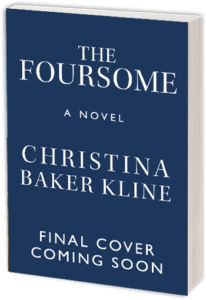
COMING MAY 2026: THE FOURSOME

A literary historical novel set in Civil War-era North Carolina, based on a true family story and told from the perspective of Sarah Bunker, one of two sisters who married Chang and Eng, the famous conjoined twins…learn more

Follow on Substack

Subscribe

Connect with Christina

Contact
  • Facebook
  • Instagram
  • Twitter

Copyright © 2025 Christina Baker Kline · Site design: Ilsa Brink