Sign up for Christina’s Newsletter

Christina Baker Kline

Author Website

  • Books
    • The Foursome
    • Please Don’t Lie
    • The Exiles
    • A Piece of the World
    • Orphan Train
      • Orphan Train Girl: The Young Readers’ Edition of Orphan Train
    • Other Novels
      • Bird in Hand
      • The Way Life Should Be
      • Desire Lines
      • Sweet Water
    • Nonfiction
      • Always Too Soon
      • About Face
      • Child of Mine
      • Room to Grow
      • The Conversation Begins
  • Events
  • NEWS
  • Other Writing
  • About
    • Bio
    • FAQs
    • Contact
    • Photos
  • Newsletter

July 10, 2009 By bakerkline

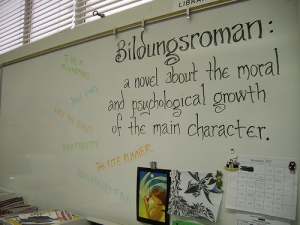
Language Geek, #2: Bildungsroman

“No road offers more mystery than that first one you mount from the town you were born to, the first time you mount it of your own volition, on a trip funded by your own coffee tin of wrinkled up dollars – bills you’ve scrounged and saved for … ” begins Mary Karr’s memoir Cherry.

It’s been said that there are only two stories in the world: a stranger comes to town and a man sets off on a journey.  The German word bildungsroman, or “novel of formation,” is a version of the latter:  a young person (traditionally a boy) undertakes an epic journey, during which he confronts inner and outer demons, and in the process becomes an adult.  (When I think of this word I am reminded of the German poet Holderlin’s line in “The Journey”: “Reluctantly that which dwells near its origin departs.”)  Think Tristram Shandy, The Adventures of Huckleberry Finn, Portrait of the Artist as a Young Man, The Catcher in the Rye.bildungsroman
In some ways, it seems to me, every story contains elements of the bildungsroman.  A story must contain a moment of change, internal or external or both, often experienced as part of a (literal or metaphorical) journey.  This change usually involves a ‘coming of age’: the central character is enlightened or disillusioned; if he doesn’t yet understand the enormity of his experience, the reader knows that soon enough he will.
Filed Under: Language Geek Tagged With: A Catcher in the Rye, bildungsroman, character, creative process, Inspiration, Mary Karr, Portrait of the Artist as a Young Man, The Adventures of Huckleberry Finn, Tristram Shandy, writing a novel

July 9, 2009 By bakerkline

Writing Tip # 6: Mine Your Own Material

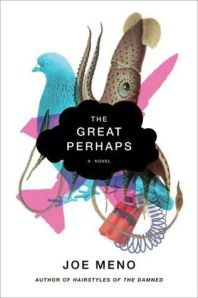
Joe Meno's latest novel“For me, almost everything starts off as a short story,” the novelist and short story writer Joe Meno says in the June 30th issue of One Story magazine.  “All of my novels have been built around material that’s been explored or published as short stories, because it forces me to get to the character and action quickly, and helps me figure out what the story is actually about. I usually write a few short stories and realize that they feature similar questions or characters and decide that there’s a novel there somewhere.”

Meno adds, “To write one good short story, you’re probably going to write about nine bad ones. You have to enjoy the mistakes and failures and misfires and realize writing is all about one thing: trial and error.”

Filed Under: Writing Tips Tagged With: creative process, fiction writing, Inspiration, Joe Meno, One Story, short stories, The Great Perhaps, writing a novel

July 8, 2009 By bakerkline

Breath on the Glass

When I’m working on a novel, ideas rise up at random times from the murk of my subconscious like pronouncements in a Magic 8 ball.  If I don’t write them down right away, these ephemeral thoughts can fade and disappear. FoggyMirror

Driving my 14-year-old son, Hayden, to summer camp in Maine on Sunday, I put him to work as both a DJ and a scribe. (After all, I was the chauffeur.)  He selected a Green Day song from his new i-Pod touch (an 8th-grade graduation present from an indulgent grandmother), then I was allowed a song by The Fray; he picked Ben Folds, I chose Dar Williams.  Every now and then I asked him to open my writing journal – a wire-bound, college-ruled notebook with a green plastic cover – and scribble a line:

Sea air in Galway

Fiction chooses the writer

Breath on the glass

Sea air in Galway. The Maine coastline in similar, in many ways, to the west coast of Ireland, 2500 miles to the east. With this note I was reminding myself to pay particular attention to the sensory details; I thought I might be able to use these impressions in a scene in my novel.

Fiction chooses the writer. This idea for a blog post sprung from an ongoing conversation with several novelists about how and why people start writing fiction.

Breath on the glass. As we drove in the rain, I saw Hayden turn his head to look out the passenger window at two guys on a motorcycle, both without helmets, grimacing into the downpour. Hayden’s breath fogged the glass. When he turned back to me, saying, “Wow, Mom, what were they thinking?” – I glanced over again, and saw that his breath had already evaporated.  And the guys on the bike were gone.

That’s how it is with these fleeting observations, and why I asked Hayden to keep a pen handy and the notebook on his lap. And he was happy to do it – as long as he could listen to Metallica and I promised to get him to Bar Harbor on time.

Filed Under: Inspiration, Real Life Tagged With: creative process, fiction writing, five senses, Inspiration, Ireland, Magic 8 ball, Maine, Thoughts, Writing, writing a novel

July 7, 2009 By bakerkline

Guest Blog: Julie Metz – Some Thoughts on Memoir and Fiction

Metz, PERFECTIONThe memoirist Julie Metz, who is now working on a novel, writes:

When I wrote my memoir, Perfection, the story of my discovery of my husband’s secret life only after his sudden death, my focus was on careful recall aided by journals and letters.  And yet, since I love reading fiction, I wanted my memoir to “read” like a novel.  After many failed attempts, I found a structure for the factual narrative that allowed me to recapture my own state of mind at the moment of my husband’s death and the early months of widowhood.  The primary inspiration for my book was the fictional memoir Jane Eyre, in which an innocent narrator’s life is changed by a devastating revelation.

During this last year, while Perfection was in the final stages of publication, I began working on a new project, a novel.  I am finding it to be a very different process.  I began with a snippet of a story I’d been kicking around in my head for years, but as I got into the project in a deep way, the original story fell away as the characters became more vivid. Very little remains of the original idea except for locations and some back story.  The day I realized I had to quit forcing my original idea into the book was both sad and liberating. My attempts to direct the plot were those of a classroom bully who tries to force other kids to play by his or her rules. No one wants to play with a bully.

Now that I spend my days conjuring rather than exclusively researching my past, I frequently think of Anne Lamott’s advice in Bird by Bird: to focus not on plot but on character. I try to sit with my (mostly) made up characters and hope that if I am quiet and patient I will get to know them as well as the real people in my life, and that they will tell me what they need to do and say.

Julie Metz is a graphic designer (she co-designed the cover of her memoir), artist, and freelance writer whose work has appeared in publications including The New York Times, Glamour, and Publisher’s Weekly. Perfection: A Memoir of Betrayal and Renewal, is her first book.

Filed Under: Guest Blogs, The Creative Process Tagged With: Anne Lamott, beginning, Bird by Bird, creative process, fiction writing, Inspiration, Jane Eyre, Julie Metz, memoir, Perfection, plot, Thoughts, writing a novel

July 6, 2009 By bakerkline

Making Conversation

Dialogue is hard to get right.  It has to sound like natural speech, when in fact it’s nothing like it.

I like to send my creative-writing students out to cafes and parks with notebooks to transcribe bits of overheard conversations.  Then I ask them to type up these transcripts and turn them into dialogue between characters.hopper 1

Inevitably their written dialogue little resembles the overheard conversations.  When you write dialogue, you have to eliminate niceties and unnecessary patter and cut to the core of the exchange — unless the patter is crucial to the story, conveying a dissembling, depressed, incoherent, or boring personality.  (The writer George Garrett called this “dovetailing.”)  At the same time, it has to sound natural, like something someone would really say.

Richard Price, in his recent novel Lush Life, allows his characters to talk and talk and talk. Price maintains a delicate balancing act; his characters’ words matter.  What they say changes the direction of the story.  But he never burdens his dialogue with exposition or forces it to convey plot points that don’t come up naturally.  In Writing Fiction, Janet Burroway says, “In order to engage us emotionally in a disagreement, the characters must have an emotional stake in the outcome.”  Price’s characters are nothing if not emotionally invested.

Price’s dialogue is vital to the story because it moves the action forward.  He constantly puts his characters in conflict with each other.  Their conversations are full of surprises – self-revelation, inadvertent admissions, hearsay, evidence.  But it sounds real: his characters’ speech has kinetic energy; it crackles with life. Real life.

Filed Under: Inspiration Tagged With: "Lush Life", creative process, dialogue, fiction writing, George Garrett, Inspiration, Janet Burroway, Richard Price, writing a novel

  • « Previous Page
  • 1
  • …
  • 27
  • 28
  • 29
  • 30
  • 31
  • …
  • 34
  • Next Page »

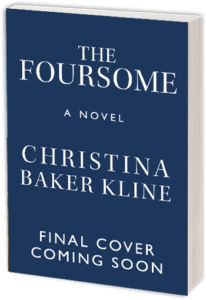
COMING MAY 2026: THE FOURSOME

A literary historical novel set in Civil War-era North Carolina, based on a true family story and told from the perspective of Sarah Bunker, one of two sisters who married Chang and Eng, the famous conjoined twins…learn more

Follow on Substack

Subscribe

Connect with Christina

Contact
  • Facebook
  • Instagram
  • Twitter

Copyright © 2026 Christina Baker Kline · Site design: Ilsa Brink