 Mondays are hard. All weekend you’ve been doing laundry, taking family bike rides, reading the Times in bits and pieces, going to your kids’ soccer games, and then it’s Monday morning and they’re all out the door (except the dog, who is lying on your feet), and it’s hard to know where to begin, how to pick up where you left off.
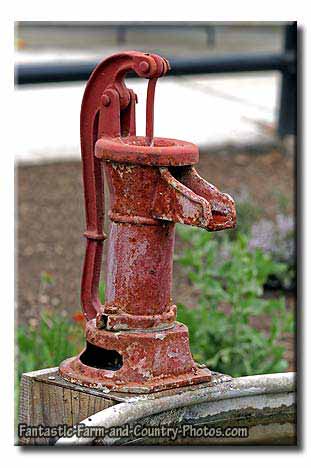
When I was growing up in Maine, my professor parents bought an A-frame on a tiny island on a lake. The house had no electricity or heat, and a red-handled pump was our only source of drinking water. When we arrived on the island (having paddled over from the mainland in our evergreen Old Town canoe), we had to prime the pump with lake water to get it started. One of my sisters poured the water into the top while another pumped. The well water took a while to emerge, and then it was cloudy, rust-colored, for at least a minute or two before running clear.
This reminds me of my own writing on Monday mornings – or anytime I’ve taken a substantial break from it. As with the pump, I’ve learned to prime my writing. I might read a chapter or two of a book on my nightstand, or perhaps turn to one of my ‘touchstones’ – those dog-eared, broken-spined, oft-read volumes I’ve defaced with marginalia and underlinings, and which I know I can count on for inspiration. (I’ve talked about some of those books here and here.)
Then I start to write, knowing that it may take some time to reach the deep, cold source of inspiration, but trusting that sooner or later my words will run clear.
 To get a book underway, you have to fully commit to it.
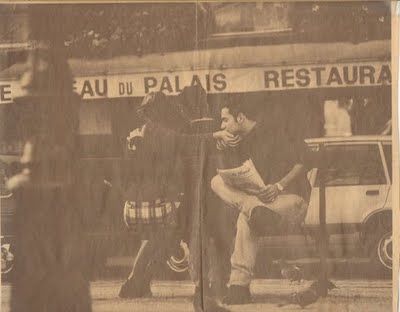 “The newspaper clipping is in tatters. Folded, yellowed, curling at the edges and mended in places with clear tape, it was tacked to the bulletin board in my office for eight years….” So begins a guest post I wrote this week for
  “The blankness of a new page never fails to intrigue and terrify me. Sometimes, in fact, I think my habit of writing on long yellow sheets comes from an atavistic fear of the writer’s stereotypic “blank white page.” At least when I begin writing, my page isn’t utterly blank; at least it has a wash of color on it, even if the absence of words must finally be faced on a yellow sheet as truly as on a blank white one. Well, we all have our own ways of whistling in the dark.”
 A long time ago, before I wrote my first novel, I despaired of ever having the time to undertake such a large and arduous project. I had two small children and my days (nights too, come to think of it) seemed hopelessly fractured; my time, or what there was of it, felt like it had been broken into the small, useless increments: fifteen minutes here, twenty there. An hour that was all my own was a rare and prized occurrence. How I was to cobble together a writing life from all these pieces was inconceivable to me. I could not work in shards, I thought. I needed some great and unbroken expanse of time, time like a freshly opened bar of chocolate: smooth, rich, and mine, mine, mine. But it was not to be, not then, and maybe not ever. If I wanted to write, I was going to have to readjust my thinking and my expectations. Instead of that glorious, unblemished chocolate bar, I had a bag of M & Ms: discrete nuggets of time that I would have to learn to use.