Sign up for Christina’s Newsletter

Christina Baker Kline

Author Website

  • Books
    • The Foursome
    • Please Don’t Lie
    • The Exiles
    • A Piece of the World
    • Orphan Train
      • Orphan Train Girl: The Young Readers’ Edition of Orphan Train
    • Other Novels
      • Bird in Hand
      • The Way Life Should Be
      • Desire Lines
      • Sweet Water
    • Nonfiction
      • Always Too Soon
      • About Face
      • Child of Mine
      • Room to Grow
      • The Conversation Begins
  • Events
  • NEWS
  • Other Writing
  • About
    • Bio
    • FAQs
    • Contact
    • Photos
  • Newsletter

March 8, 2010 By bakerkline

Letting Go

Katharine Davis just finished writing a novel.  Now comes the hard part:

Writing a novel is a long journey.  From the simple physical endurance of turning out all those pages to the emotional ups and downs of the creative act—it’s an enormous endeavor, consuming one’s life for years at a time.

Writers often talk about the difficulty of getting started.  How do you find the voice, where to begin, which point of view, the time frame, the setting?  There are thousands of questions to consider, big and small. Then there is the problem of sticking to it, finding the time to write, getting blocked.  Oh, the agony of finally understanding a character in the thirteenth chapter and having to re-write the previous 200 pages.  How painful it is to discover you’ve gone off on a tangent, another 60 pages.  You love every word, but you have to take them all out.

Eventually, you do the tedious revisions.  Sentence by sentence, word by word, the work of getting the prose just right.  Some days it’s nothing but a pleasure to revise, working on the rhythm, having the perfect metaphor seem to land in your lap.  You might experience the thrill of coming up with that one word that changes everything.  But, the countless hours spent on dialogue that clunks along like the rattle in your car that the mechanic can’t fix, or the flashback that’s brought your narrative drive to a halt – these trials are part of the process too.

Yet, to me, one of the hardest parts of writing a novel is letting it go. You type ‘the end’ in all caps.  You send it out.  You want to celebrate, drink champagne, eat an enormous chocolate cupcake and tell all your friends, “I did it.  I’m done. It’s the best book ever!”  And then, wham.  What have I written?  I didn’t get deeply enough into that character’s head.  Did I tell enough about the mother?  Oh God.  That part’s too sappy.  I should have made it better. These thoughts come at 3 AM, thanks to the champagne, the cupcake, or both.  At that moment, the initial thrill of finding the story, and the enthusiasm of bringing it to the page is like some prehistoric event.

The next day, I feel somewhat better.  There’s that scene where . . . and, remember when . . . , and the ending that can still make me cry.  I find a paragraph I truly love.  When did I write that?  The next few weeks bring a combination of highs and lows.

Letting go of a novel is like sending children off to college.  They’ve spent the last few years of high school driving you crazy, but also bringing you joy and delight. You experience the relief of getting them out from under your roof, to deep sadness.  You miss them.  You want your child to have his own life, to succeed.  But it’s no longer up to you.  Your baby is gone.  Still, you’ve created something with love and hard work.

Months later, when your carefully worked-on manuscript pages have become an actual book, you have the satisfaction of knowing that your story, like your grown child, is out in the world at last.  The joy of connecting with readers and contributing one more piece to the human experience lifts your spirits and brings you the courage to reach for your pen to start writing again.

Katharine Davis’s novels include East Hope and Capturing Paris. Recommended in Real Simple Spring Travel 2007, Capturing Paris was also included in the New York Times suggestions for fiction set in Paris. Davis’s new novel, A Slender Thread, is coming out later this year. She is an Associate Editor at The Potomac Review.  She can be reached at www.katharinedavis.com.

Add to FacebookAdd to DiggAdd to Del.icio.usAdd to StumbleuponAdd to RedditAdd to BlinklistAdd to TwitterAdd to TechnoratiAdd to Yahoo BuzzAdd to Newsvine

Filed Under: Guest Blogs, Real Life Tagged With: A Slender Thread, best-laid plans, Capturing Paris, creative process, East Hope, fiction writing, Inspiration, Katharine Davis, letting go, Thoughts, writing a novel

March 4, 2010 By bakerkline

The Curse of Multitasking

Waiting to pick up my son after his play rehearsal, I sit in the car and grade student essays. I listen to podcasts as I drive over the George Washington Bridge to work. When the phone rings at home and it’s my sister, I get up from my desk to make beds, put in a load of laundry, start the dishwasher.  I make sandwiches for school lunches while fixing dinner.

I have come to realize that I rarely do one thing at a time.  And that’s the problem.

When you write, you can only write.  You can’t do laundry or wash dishes.  You can’t make sandwiches or talk on the phone.  You can’t even listen to music (or I can’t – unless I’m in a coffee shop, where for some reason ambient noise doesn’t usually bother me).  It’s just you and the lined paper – or blank screen – in front of you, and any distraction will not only affect your writing that day, it may change the course or the tenor of the work you’re trying to do.

But multitasking is a hard habit to break, even temporarily.  I sit down to write and items for a “to do” list march through my head.  I suddenly remember that I never called the dentist; I forgot to pick up a package at the post office; we’re out of milk.

In almost every other aspect of my life, my ability to multitask is a good thing.  Doing several things at once is how I’ve learned to juggle my various responsibilities:  mother, wife, editor, teacher, volunteer.  It’s the only way to keep all the balls in the air.

But writing is not about keeping the balls in the air.  It’s about letting them drop.  To unspool a story is to inhabit a different space altogether. You have to let the world in your head grow until it becomes more important than the world you inhabit.  You have to calm your heartbeat, slow your skipping brain, become comfortable with silence.  You have to accept that you will get nothing done except this one thing – this one paragraph or page or, perhaps, on a good day, a chapter – and possibly not even that.

You have to stop worrying about the fact that you’re wasting time.  Of course you are.  That’s what writers do.

And when you emerge from your writing fog you will have accomplished nothing tangible.  You will have checked nothing off your list.  Your teeth still need cleaning.  The package awaits at the post office.  There’s no milk in the fridge.  And your book isn’t finished – far from it.

But perhaps you had a moment of clarity, of insight, about your story.  Maybe you understand it a little better.  And if you really want to be a writer, these moments are more than enough to keep you going, to give you strength to push back against the many-headed hydra of tasks and responsibilities that threatens to devour the precious time you have to create something. Something light-years removed from your ordinary life.

Add to FacebookAdd to DiggAdd to Del.icio.usAdd to StumbleuponAdd to RedditAdd to BlinklistAdd to TwitterAdd to TechnoratiAdd to Yahoo BuzzAdd to Newsvine

Filed Under: Real Life Tagged With: best-laid plans, creative process, Discipline, Inspiration, multitasking, Real Life

January 18, 2010 By bakerkline

What’s the Big Idea?

How do you come up with an idea that’s big enough to sustain a novel or memoir?  And how do you know when you’ve got it?

As a teacher of creative writing, I get asked this question a lot – and as a novelist, I can tell you that it torments every one of my beginnings.  A few days ago I put this question to the writer Katharine Weber, whose new novel, True Confections, was hailed by the Times Book Review this weekend as “a great American tale.”  (“It’s got everything,” Jincy Willett raved: “Humor, treachery, class struggle, racism, murder, capitalism and mass quantities of candy.”)

And here’s what Katharine Weber said:

I have been thinking about this for a few days since you asked me to consider this intriguing question, Christina. I am grateful to you for forcing me to think directly about something which is present in me as a writer but is intuitive and a bit organic, so I have to rummage a bit to explain it (which is always helpful to me as a writer, explaining what I do habitually without necessarily having full awareness).

I always have too many ideas. The question for me really isn’t ever Where do you get your ideas so much as How do you identify your best idea?

E.M. Forster wrote: “The king died and then the queen died is a story. The king died and the queen died of grief is a plot. The queen died and no one knew why until they discovered it was of grief is a mystery, a form capable of high development.”

So how do we know when we have moved from story to plot to something we can develop? This is the critical and significant kind of self-editing and revision and expansion necessary if one is going to write and publish novels in which the world is going to take an interest.

I think about the number one problem I encounter in writing I see in workshops: Often, a story or a novel manuscript will have sentences that are good, page to page, and the writing is “good enough” too, overall, yet there is something wrong, something not working. And that flaw can usually be characterized in this way: there is something about this writing, even if I am not sure what it is — plot, character, sensibility, key details, events — something, that means a great deal more to the writer than it can ever possibly mean to any reader. The specific details of what that is, only the writer may ever fully understand, but it signifies a serious discrepancy between the writer’s overly personal relationship to the material and any reader’s possible way of finding enough meaning in the material to want to keep turning the pages. So that’s crucial. You cannot fill your novel with personal elements that signify enormously to you and expect those things to glow with meaning for anyone else unless you have made them glow.

But I suppose the only real test for me of whether or not an idea for a novel is enough in every sense of the word — big enough, interesting enough to me first and foremost, nuanced enough, original enough, rich enough for me to write interestingly — is that usually I have dwelled with it for quite a while before I start to write. It has sustained me imaginatively as I dwell in the world of the novel that lies ahead. And that original idea may have in that time shifted and mutated into something different or tangential as I worked it imaginatively and strategically. It would be unlikely, in fact, if the original kernel of a really good idea did not expand in some direction, perhaps a surprising direction, befoe the actual writing began.

And you just have to learn for yourself what works for you, and be willing to trust your instinct even as you develop your instinct, so that over time, experience will tell you when your ideas are enough to sustain a novel, more than enough to sustain a novel, or on the verge of way too much — too much going on, too many disconnected ideas — which can be the mark of insecurity. You have to be able to make decisive choices. Everything in the novel should be necessary to the novel. So for me it is sometimes as much about throwing elements and ideas overboard as it is about finding ideas.

Katharine Weber is the author of five novels: Objects in Mirror Are Closer Than They Appear, The Music Lesson, The Little Women, Triangle, which takes up the notorious Triangle Waist company factory fire of 1911, and the brand-new True Confections, the story of a chocolate candy factory in crisis. She is working a memoir about family stories and the narrative impulse, Symptoms of Fiction. You can learn more at www.katharineweber.com.  Also, follow her brilliant blog: http://staircasewriting.blogspot.com.

Add to FacebookAdd to DiggAdd to Del.icio.usAdd to StumbleuponAdd to RedditAdd to BlinklistAdd to TwitterAdd to TechnoratiAdd to Yahoo BuzzAdd to Newsvine

Filed Under: Guest Blogs, The Creative Process Tagged With: beginning, best-laid plans, creative process, fiction writing, Inspiration, Katharine Weber, The Big Idea, Thoughts, True Confections, writing a novel

January 15, 2010 By bakerkline

The Novel Terminable and Interminable

Bonnie Friedman writes about the lure of (and cure for) the endless novel:

I just finished my first novel.  This isn’t the first novel I tried to write.  Before publishing a book of essays and then a memoir, I’d been a devoted fiction writer.  I’d written hundreds of pages of two vast novels, one when I was in my twenties and one in my thirties.  But this last one is the first novel I’ve finished.  Those other novels were a great pleasure and torment to work on — I got to explore internal states that haunted me, and I got to wander amongst skeins of gossamer prose sticky as butterfly wings, and I got to understand (among other things) aspects of my childhood with my sister, who had been a grand volcanic, wounded girl.  But I didn’t know how to finish either of the books I started.

They were all middle and no end.  They were all sprawling, surging second act.

I didn’t know that I was allowed to figure out where my characters ought to end up, and then explore how they might get there. I didn’t know how conscious I was allowed to be during the writing process.  I didn’t know that if I focused on one particular problem that a character was trying to solve, myriad others would snap into clarity.

I’d grown up reading experimental writers — Woolf, Stein, Barnes, Joyce — and really didn’t understand the least thing about novel structure. For me, reading a novel was a state of immersion.  I read slowly, savoring the serif type and the glow of the linen page (I’m thinking of a certain paperback of Mrs. Dalloway that I was given for my 21st birthday, and which I read munching Mint Milanos and sipping sweet instant coffee from a tin).  “How true!” I’d write in the margins with a coal-soft pencil.  I’d assumed that to write a book one must simply get immersed.  And I liked immersion.  It was less scary than decision.  “Discover, discover!” I told myself — the mantra of writing schools in those days.

I wrote in order to set on the page certain internal states.  I wanted to see what they meant.  I didn’t yet know how useful it is to give one’s traits to a character who is a bolder version of oneself.  I didn’t yet know that a novel must involve a character who changes by the end. At a certain point I recognized with this last novel that it too might go on forever accumulating pages and becoming less and less publishable if I didn’t impose a bit of discipline on myself.

I bought screenplay writing books, playwriting books, and even a novel-writing book or two — those dreaded texts I was convinced would flatten all my originality, what there was of it, to mere formula.  And all proved useful.  I hadn’t understood that the effect that a novel creates isn’t the same as the technique used to create that book.  Nor had I understood how entirely I merely loved the dream-state of adding to my novel.

Now what’s thrilling is pacing through other people’s novels and seeing how they’re hinged and braced.  Noticing the decision points.  And allowing my own characters to make decisions.

Gone — I hope — is some of that sticky enthrallment that kept me caged in mammoth manuscripts for so long.  Each writing temperament, I’m convinced, has its own perils.  The peril of mine was to remain for epochs in a prolonged inchoate state of mazy inconclusiveness.  The heroine of my novel altered, as did I by writing her.  Now I see a book as a device to discover more than one could have known beforehand.  And that acquiring technique is essential.  It is the artifice that, like eyeglasses, lets the world become clearer.  I’m all for it now, when once upon a time it was anathema to me.

Bonnie Friedman is the author of the Village Voice bestseller Writing Past Dark, Envy, Fear, Distraction, and Other Dilemmas in the Writer’s Life, a widely anthologized book of essays.  She is also the author of the memoir The Thief of Happiness: The Story of an Extraordinary Psychotherapy.  Her essays have been included in The Best American Movie Writing, The Best Writing on Writing, The Best Spiritual Writing, and the Best of O., the Oprah Magazine.

Add to FacebookAdd to DiggAdd to Del.icio.usAdd to StumbleuponAdd to RedditAdd to BlinklistAdd to TwitterAdd to TechnoratiAdd to Yahoo BuzzAdd to Newsvine

Filed Under: Guest Blogs, The Creative Process Tagged With: best-laid plans, Bonnie Friedman, creative process, Discipline, fiction writing, Inspiration, The Thief of Happiness, writing a novel, Writing Past Dark

January 13, 2010 By bakerkline

What a Story Intends for Itself

Lorrie Moore is one of my favorite authors (Like Life and Birds of America, her story collections, are on my shelf of prized books), but I did not love her new novel, The Gate at the Stairs.  I found it emotionally arid, the dialogue too clever by half, the twists, when they come, both unsurprising and unearned.  I think it was a mistake for Moore to graft her own distinctive, sardonic voice onto the college-aged farm girl who narrates the story.

And yet.  Moore is undeniably a good writer, a real writer.  I marveled at her language, from the sound and simile of “In the sky the returning geese were winging over, their honking alto bark like the complaining squawk of a cart” to a starkly vivid “hot lemony sun.”  The novel contains observations so acute and thoughtful that I had to restrain myself from underlining them in my borrowed book.  (I used Post-Its instead.)  Moore captures small moments in all their fibrous complication, as when the narrator catches a little girl before she tumbles to the ground:  “Her face seemed to smile and sob at the same time, a look that said That may be fun for some people but not for me, and I placed her securely on my hip, feeling the biceps in my arm already beginning to strengthen and my jutted hip on its way to socket stress and limpage.”

Toward the end of the book, Moore makes a quiet, incisive comment about authorial intent that resonated with me, one that I think many writers can relate to.  The narrator muses that “in literature — perhaps as in life — one had to speak not of what the author intended but of what a story intended for itself.  The creator was inconvenient — God was dead.  But the creation itself had a personality and hopes and its own desires and plans and little winks and dance steps and collaged intent.  In this way Jacques Derrida overlapped with Walt Disney.  The story itself had feet and a mouth, could walk and talk and speak of its own yearnings!”

As a writer, I find it freeing to remember that my conscious intentions for my work are only one part of it, that a fully realized story takes on a life of its own beyond the will and intent of the creator.  This moment of insight – one of many such illuminations – redeemed the book for me.

Add to FacebookAdd to DiggAdd to Del.icio.usAdd to StumbleuponAdd to RedditAdd to BlinklistAdd to TwitterAdd to TechnoratiAdd to Yahoo BuzzAdd to Newsvine

Filed Under: The Creative Process Tagged With: best-laid plans, creative process, fiction writing, Lorrie Moore, The Gate at the Stairs, writing a novel

  • « Previous Page
  • 1
  • 2
  • 3
  • 4
  • Next Page »

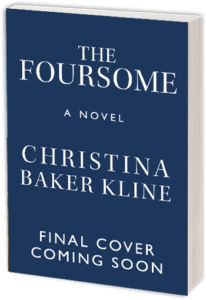
COMING MAY 2026: THE FOURSOME

A literary historical novel set in Civil War-era North Carolina, based on a true family story and told from the perspective of Sarah Bunker, one of two sisters who married Chang and Eng, the famous conjoined twins…learn more

Follow on Substack

Subscribe

Connect with Christina

Contact
  • Facebook
  • Instagram
  • Twitter

Copyright © 2026 Christina Baker Kline · Site design: Ilsa Brink