Sign up for Christina’s Newsletter

Christina Baker Kline

Author Website

  • Books
    • The Foursome
    • Please Don’t Lie
    • The Exiles
    • A Piece of the World
    • Orphan Train
      • Orphan Train Girl: The Young Readers’ Edition of Orphan Train
    • Other Novels
      • Bird in Hand
      • The Way Life Should Be
      • Desire Lines
      • Sweet Water
    • Nonfiction
      • Always Too Soon
      • About Face
      • Child of Mine
      • Room to Grow
      • The Conversation Begins
  • Events
  • NEWS
  • Other Writing
  • About
    • Bio
    • FAQs
    • Contact
    • Photos
  • Newsletter

November 1, 2009 By bakerkline

Quick Link: The Picture that Inspired 80,000 Words

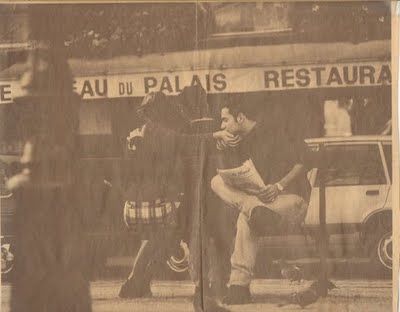
BIH inspiration“The newspaper clipping is in tatters.  Folded, yellowed, curling at the edges and mended in places with clear tape, it was tacked to the bulletin board in my office for eight years….”  So begins a guest post I wrote this week for In This Light, a blog about the influence of images on writers and writing.   Instinctively I knew that this image would help me access the core motivations of my characters in Bird in Hand, who act in comparably indiscreet and scandalous ways …

You can read the rest here.
Filed Under: Bird in Hand, Quick Links Tagged With: beginning, Bird in Hand, character, Christina Baker Kline, creative process, Dory Adams, fiction writing, In This Light, Inspiration, Paris, writing a novel

July 31, 2009 By bakerkline

Language Geek, #3: Semiotics

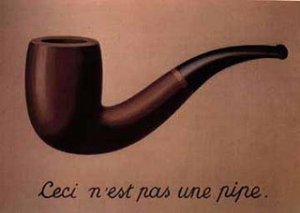
Magritte's pipe - semioticsSemiotics is the study of signs, and a sign is anything that stands for something else. It took me a long time to understand this seemingly simple idea.

The argument goes like this: it is a myth to believe there is any such thing as an objective reality; ‘reality,’ in fact, is a system of signs. As Proust has said, “Everything can be several things at the same time.” Or, to put a finer point on it: the art historian Ernst Gombrich says, “There is no reality without interpretation.”

The British semiotician Daniel Chandler suggests that studying semiotics can make us “more aware of reality as a construction and of the roles played by ourselves and others in constructing it. Meaning is not ‘transmitted’ to us – we actively create it according to a complex interplay of codes or conventions of which we are normally unaware. Becoming aware of such codes is both inherently fascinating and intellectually empowering.”

The process of creating literary fiction, I would argue, is the practice of semiotics. It’s all about signs. Our characters’ reality – an artificial construct to begin with – is freighted with meaning, conscious and unconscious, for the writer, the characters themselves, and ultimately for the reader.

In his preface to The Picture of Dorian Gray, Oscar Wilde wrote, “All art is at once surface and symbol. Those who go beneath the surface do so at their peril.”  But these signs and symbols, the dual or multiple meanings, must be subservient to the story, and not the other way around.  Otherwise the fictional trance will be broken; the characters will be types and not individuals. The novel will become a treatise.

Filed Under: Language Geek Tagged With: character, creative process, Daniel Chandler, Ernst Gombrich, fiction writing, literary fiction, Proust, semiotics, signs

July 10, 2009 By bakerkline

Language Geek, #2: Bildungsroman

“No road offers more mystery than that first one you mount from the town you were born to, the first time you mount it of your own volition, on a trip funded by your own coffee tin of wrinkled up dollars – bills you’ve scrounged and saved for … ” begins Mary Karr’s memoir Cherry.

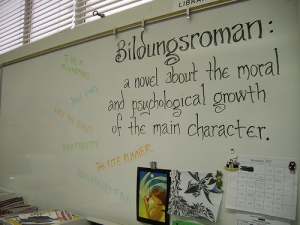
It’s been said that there are only two stories in the world: a stranger comes to town and a man sets off on a journey.  The German word bildungsroman, or “novel of formation,” is a version of the latter:  a young person (traditionally a boy) undertakes an epic journey, during which he confronts inner and outer demons, and in the process becomes an adult.  (When I think of this word I am reminded of the German poet Holderlin’s line in “The Journey”: “Reluctantly that which dwells near its origin departs.”)  Think Tristram Shandy, The Adventures of Huckleberry Finn, Portrait of the Artist as a Young Man, The Catcher in the Rye.bildungsroman

In some ways, it seems to me, every story contains elements of the bildungsroman.  A story must contain a moment of change, internal or external or both, often experienced as part of a (literal or metaphorical) journey.  This change usually involves a ‘coming of age’: the central character is enlightened or disillusioned; if he doesn’t yet understand the enormity of his experience, the reader knows that soon enough he will.

Filed Under: Language Geek Tagged With: A Catcher in the Rye, bildungsroman, character, creative process, Inspiration, Mary Karr, Portrait of the Artist as a Young Man, The Adventures of Huckleberry Finn, Tristram Shandy, writing a novel

July 2, 2009 By bakerkline

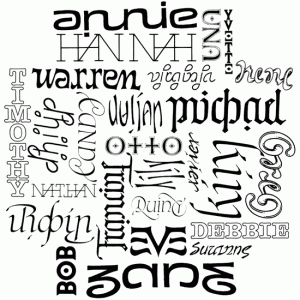
Guest Blog: Pamela Redmond Satran on Naming Characters

Novelist and naming expert Pam Satran writes:

There’s a character named Billie in the novel I’ve been working on since the invasion of Iraq.  But Billie wasn’t always in the book: Until this spring, she was Lily.

Well, she wasn’t really Lily, but the character who played her role in the plot was named Lily until the most recent draft.  Lily was older – 23 to Billie’s 19 – a college graduate already living on her own in New York.  Billie rides cross country with a stranger, her backpack full of her father’s ashes and a handgun.26names

I changed my character’s name (and persona) after reading Kate Atkinson’s When Will There Be Good News? Sixteen-year-old Reggie is alone in the world, yet winning and resourceful.  I admired the way Atkinson wrote from Reggie’s point of view – third person, but intimate – and decided I wanted my character, Lily, to be more like Reggie.

To be, in other words, Billie.

I’m still not certain Billie is the right name for her.  It feels a little obviously like the name of a scrappy tomboy, which is exactly what Billie is.  Maybe it would be more interesting if her name were something ultra-feminine, like Seraphina?  Plus one of my other main characters, whom Billie spends a lot of time with, also has a name that starts with a B, Bridget, and that name is carved in stone.  As a reader, I hate it when character’s names or physical descriptions, even their hair colors, are too similar.

As the author of ten name books, I should have an easier time of naming my characters. But it’s just like naming children: No matter how much expertise you have, no matter how much thought you’ve put into it, it can still be difficult to settle on the perfect name for someone you love and cherish.

It’s easy for me to give certain kinds of name advice to fellow novelists.  A girl born in the 1950s with sisters named Joanne and Debbie would more likely be Carolyn than Caroline, I recently told one friend, pointing to the popularity charts on my site Nameberry.  Caroline was rarely used outside of the upper classes before the Kennedys popularized it in the early 1960s.  Another character, born in the 1930s, might have been Lillian or Louise, but certainly not LeeAnn.

Yet I feel less certain about my own poor Billie. I’m going to take one more swing through the book, looking closely at that character, still wobbly.  I hope that once Billie’s inner workings and story feel more solid to me, so will my decision about her name.

Pamela Redmond Satran is the author of five novels and ten bestselling baby name books, including Beyond Ava & Aiden.  Her blog How Not to Act Old is becoming a book in August.

Filed Under: Guest Blogs, Inspiration Tagged With: character, creative process, fiction writing, How Not to Act Old, Inspiration, Kate Atkinson, Nameberry, naming characters, Pamela Redmond Satran, Thoughts, writing a novel

July 1, 2009 By bakerkline

More Monkey Business

A writer friend, Cindy Handler, asks: “A few posts back [Writing Tip #3: Use a Monkeywrench] you mentioned that you like to give your characters a trait that goes counter to their basic nature and makes it harder for them to get what they want (if I understand correctly).  Could you give an example?  The main character in my novel is so controlling that it works both for and against her, but I don’t think that’s the same thing.”monkey-reading book

So here’s an example.  In my novel-in-progress there’s a 17-year-old tattooed, pierced, tough kid named Michelle who’s in trouble for stealing.  But she steals books.  She loves to read; libraries became a refuge when her home life was in chaos. And her love of reading gives me access to a more interesting inner life for her.

I don’t mean, necessarily, that this kind of contradiction makes it harder for characters to get what they want, only that by working against type I can deepen and expand who they are.  I find, especially at the beginning, that the more complexity I add, the more my characters surprise and intrigue me and the more I have to say about them.

Cindy adds, “And the more real it makes them seem, because real people are full of contradictions.”

Filed Under: Writing Tips Tagged With: beginning, Books, character, characterization, Cindy Handler, creative process, fiction writing, writing a novel

  • « Previous Page
  • 1
  • 2
  • 3
  • Next Page »

COMING MAY 2026: THE FOURSOME

A literary historical novel set in Civil War-era North Carolina, based on a true family story and told from the perspective of Sarah Bunker, one of two sisters who married Chang and Eng, the famous conjoined twins…learn more

Follow on Substack

Subscribe

Connect with Christina

Contact
  • Facebook
  • Instagram
  • Twitter

Copyright © 2026 Christina Baker Kline · Site design: Ilsa Brink